


























Views
Downloads
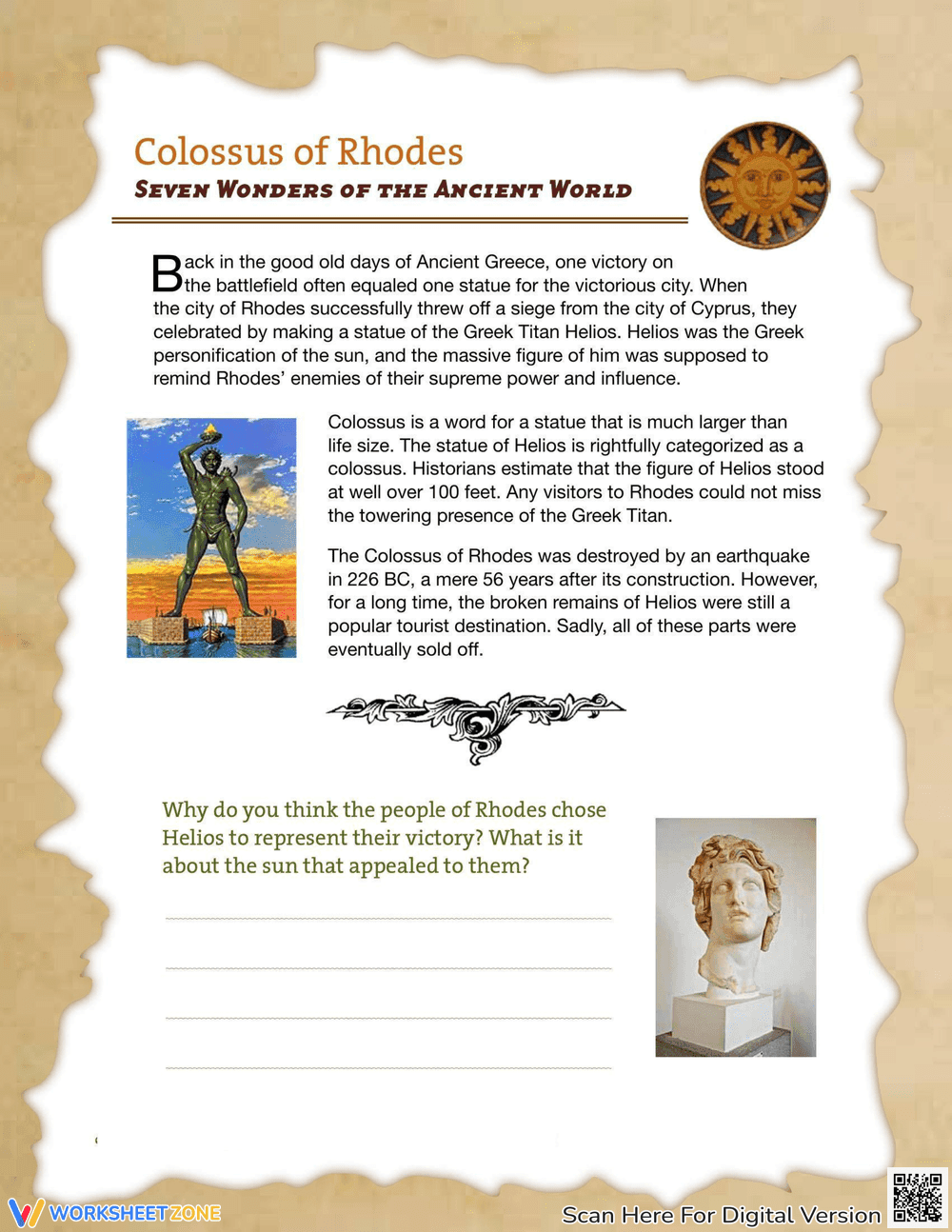


Grade 4 Colossus of Rhodes — Printable No-Prep Worksheet
Paste this activity's link or code into your existing LMS (Google Classroom, Canvas, Teams, Schoology, Moodle, etc.).
Students can open and work on the activity right away, with no student login required.
You'll still be able to track student progress and results from your teacher account.
This Grade 4 reading comprehension worksheet builds critical inference and text analysis skills through an engaging historical passage. Students read about the Colossus of Rhodes, answer open-ended questions connecting the ancient world to modern concepts, and complete a vocabulary word scramble to reinforce key terms.
At a Glance
- Grade: 4 · Subject: ELA
- Standard:
CCSS.ELA-LITERACY.RI.4.1— Refer to details and examples to draw inferences- Skill Focus: Reading Comprehension
- Format: 2 pages · 5 problems · Answer key included · PDF
- Best For: Independent practice
- Time: 15–20 minutes
This resource features a concise informational text about the Colossus of Rhodes. Following the passage, students tackle two short-answer questions requiring them to draw inferences and make real-world connections. The second page includes a three-question word scramble with context clues and a "Did you know?" trivia section. An upside-down answer key is printed directly on the page.
This worksheet is designed for immediate classroom implementation with zero teacher preparation required.
- Print (1 minute): The two-page layout prints cleanly.
- Distribute (1 minute): Hand out copies for immediate engagement.
- Review (3 minutes): Students self-correct using the inverted answer key.
Total teacher prep time is under two minutes, making this an excellent option for emergency sub plans or quick reading centers.
This activity aligns directly with CCSS.ELA-LITERACY.RI.4.1: "Refer to details and examples in a text when explaining what the text says explicitly and when drawing inferences from the text." Students use historical context to infer why Rhodes chose Helios. Both standard codes can be copied directly into lesson plans, IEP goals, or district curriculum mapping tools.
Teachers can deploy this resource during independent reading blocks to assess comprehension without direct instruction. It serves perfectly as a focused activity after a history lesson. For formative assessment, observe if students pull specific details from the text to support their reasoning. Expected completion time ranges from 15 to 20 minutes.
This worksheet is ideal for fourth-grade general education students, though it accommodates fifth graders needing foundational review. The short passage length makes it accessible for students building reading stamina. Pair this resource with a broader unit on ancient Greece or a lesson on identifying main ideas.
Developing strong inference skills requires consistent practice with accessible, high-interest informational texts. According to a recent RAND AIRS 2024 report, students who regularly engage with cross-curricular reading materials demonstrate significantly higher retention of both core literacy skills and historical content knowledge. This resource directly targets CCSS.ELA-LITERACY.RI.4.1, asking students to refer to details and examples to draw inferences. By combining historical facts about the Colossus of Rhodes with relatable prompts about modern sports mascots, the worksheet bridges the gap between abstract ancient history and concrete, everyday understanding. The inclusion of a context-based word scramble further reinforces domain-specific vocabulary in a low-stakes, engaging format. Providing structured, independent opportunities to practice these specific comprehension strategies ensures students build the analytical habits necessary for advanced reading tasks across all academic subject areas.


