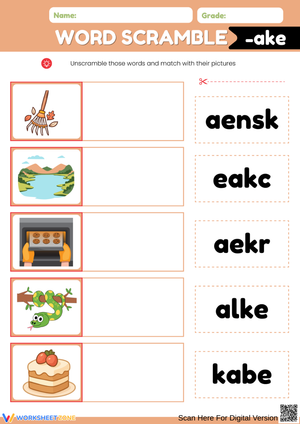
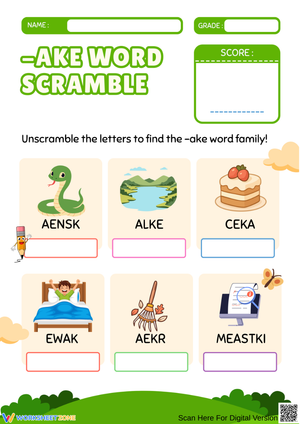
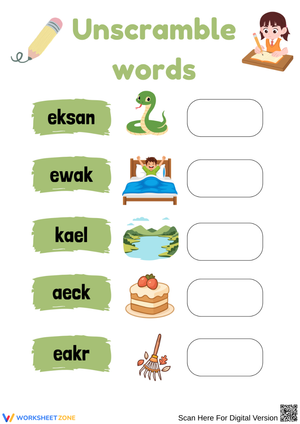
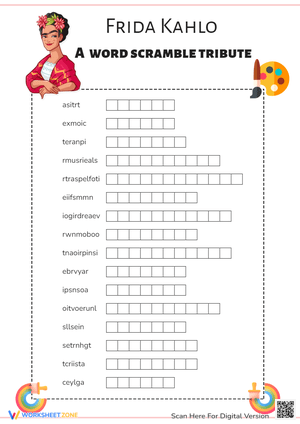
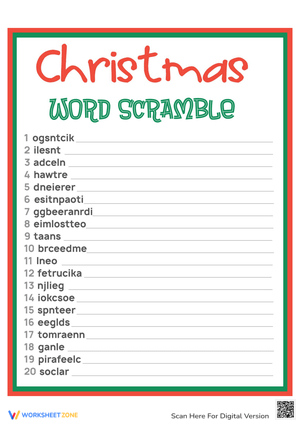
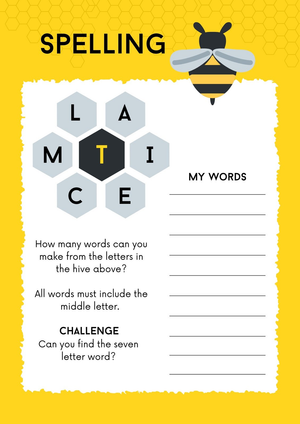
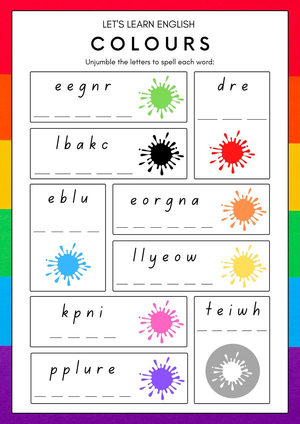
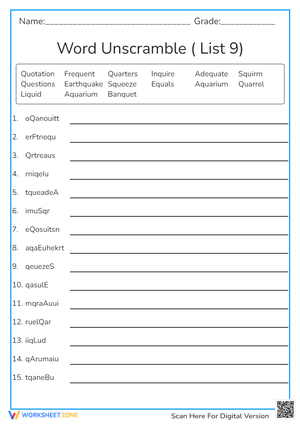
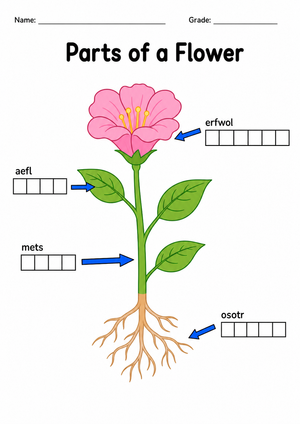
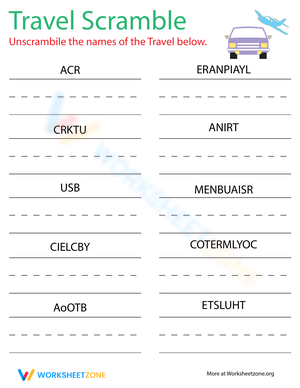
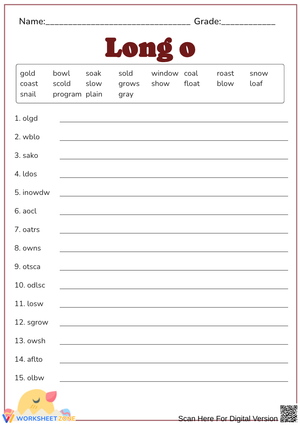
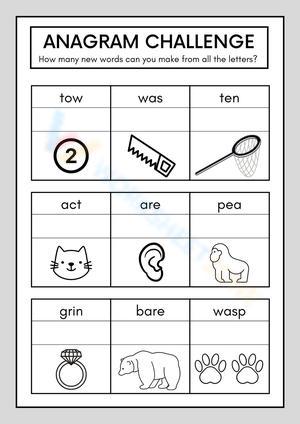
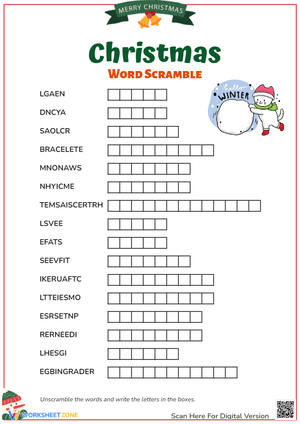
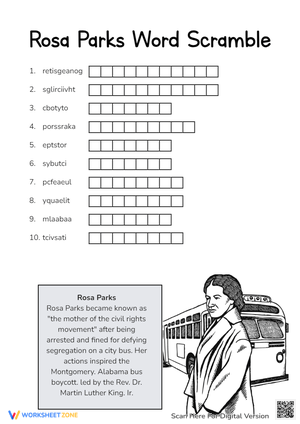
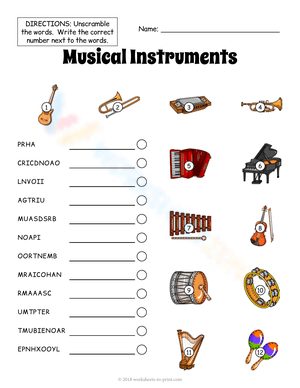
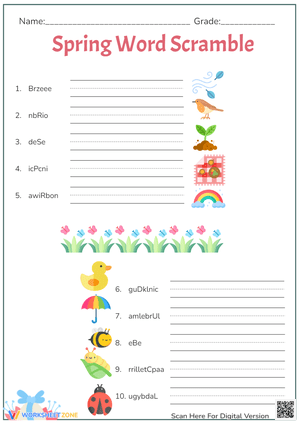
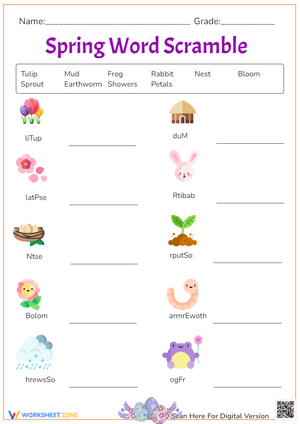
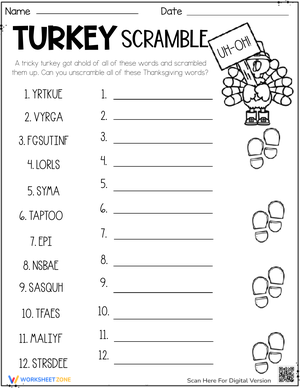
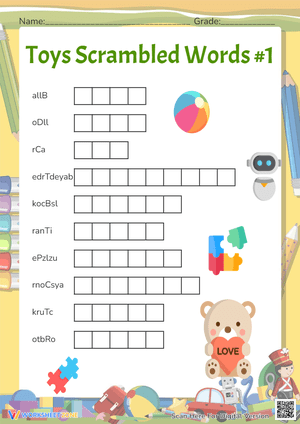
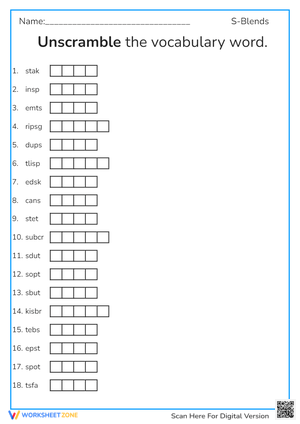
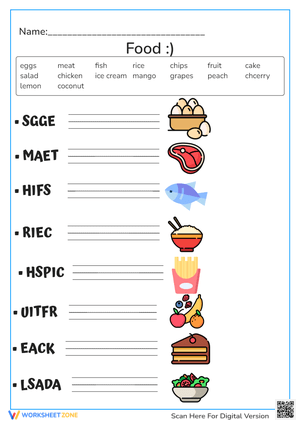
These word scramble worksheets give teachers a low-prep, high-return tool for spelling reinforcement that works across grade levels and content areas. Each worksheet is a standalone printable — drop it into morning work, a transition slot, or an early-finisher folder without modification. Because the files hold their layout regardless of which printer or device you use, word banks, spacing, and any thematic graphics arrive on students' desks exactly as designed.
What Each Worksheet Targets
The core demand of every unscrambling task is orthographic mapping under working memory pressure: students must hold a jumbled letter string in mind while simultaneously searching their mental lexicon for a match. That process builds a different kind of spelling knowledge than copying from a board or filling a blank. Students who can pronounce a word fluently may still need multiple attempts to reassemble its written form — that gap is diagnostic, and these worksheets surface it quickly.
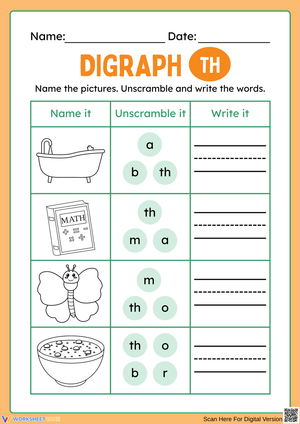
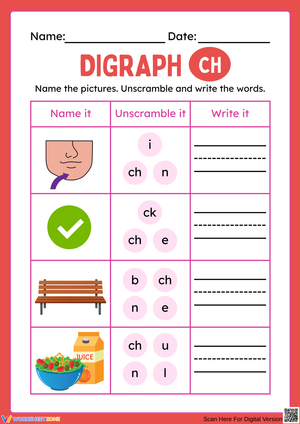
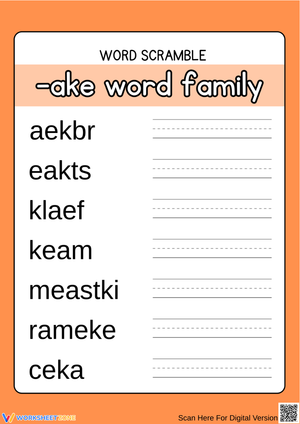
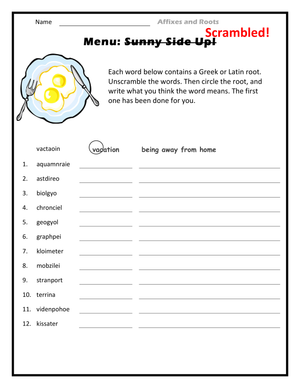
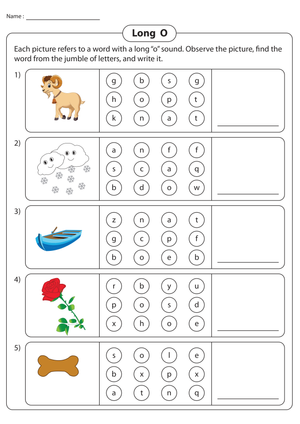
Across the set, students practice recognizing consonant digraphs (th, sh, ch, wh), common vowel teams (ea, oa, ou, ai), silent-letter patterns, and positional rules like the final-e convention. At higher grade levels, the focus shifts toward prefixes, suffixes, and Latin or Greek roots — reinforcing the morphological awareness that supports both spelling accuracy and vocabulary depth. These word scramble worksheets cover a deliberate range of difficulty levels so teachers can match each task to the spelling pattern students are currently working on, rather than defaulting to a random word list.
Student Mistake Patterns Worth Knowing Before You Print
The most consistent error isn't random guessing — it's over-reliance on the first plausible vowel placement. A student given the letter string ECEIV will frequently write "ECIVE" or "EVICE" before landing on "CEIVE," even though they know the word receive perfectly well when they hear it. That pattern tells you the student recognizes the word aurally but hasn't yet locked in its visual form. It points directly toward explicit instruction on vowel exceptions — particularly words where the familiar "i before e" rule breaks down.
A second pattern appears in students who rely heavily on sounding out: they produce phonetically plausible but incorrect spellings. Given the scramble TGHNI, a student might produce "thign" before self-correcting to "night," because the gh cluster doesn't behave like any letter-sound rule they've been formally taught. These students benefit from seeing the correctly spelled word immediately after completing the task — not at the end of a week's unit — so the correct visual form gets reinforced while the attempt is still fresh.
Watch also for students who skip unfamiliar words and return to them at the end. What looks like avoidance is often a vocabulary gap: the student can't unscramble PCCONET into "concept" because they've never encountered the word, not because they lack phonics knowledge. A word bank included at the bottom of the worksheet handles this cleanly — the student still matches letter sequences to the target word, reinforcing the orthographic pattern, but the recognition task replaces the recall demand for that subset of words.
Building These Worksheets Into Your Instructional Week
The most productive use is as a pre-unit diagnostic. Before introducing a new spelling pattern — say, words with silent consonants — distribute a scramble of the upcoming vocabulary and watch how students approach it. Students who solve it quickly have already internalized the pattern; students who produce plausible-but-wrong forms show you exactly where direct instruction needs to start. That five-minute task generates more usable planning information than a written pre-test that students often rush through without genuine effort.
Morning work is the other reliable slot. Placing a worksheet face-down on each desk before students arrive means the room settles quickly: students turn it over, read the direction line, and begin working without waiting for the teacher to give instructions. That quiet window — roughly the first eight minutes after students enter, while the teacher handles attendance and morning logistics — is often lost to social chatter when no clear task is waiting. A word scramble fills it without requiring teacher availability.
For the final ten minutes of a Friday lesson block — the window where a grammar lesson or writing activity would lose students entirely — a set of word scramble worksheets organized around the week's content vocabulary serves as an unobtrusive retrieval check. Students are practicing words they've already encountered in context, and the puzzle format sustains engagement where a traditional list review would not.
Standard Alignment
These worksheets align with CCSS ELA standards L.K.2, L.1.2, L.2.2, and L.3.2, which address conventions of standard English spelling at the primary grades, and extend through L.4.2 and L.5.2 for grade-appropriate patterns including multisyllabic words and irregular forms. The letter-pattern work in these tasks also supports RF.3.3 and RF.4.3, the phonics and word recognition standards, because the same orthographic knowledge that helps students unscramble a word accelerates their decoding of unfamiliar text during reading. At middle school, the tasks connect to L.6–8.2 when teachers pull worksheets organized around science or social studies terminology rather than a generic word list.
Adjusting Each Worksheet for the Range of Learners in Your Room
The most direct adjustment is the word bank. For students who are still building phonological awareness — whether early readers, English language learners, or students who receive reading support — including a word bank at the bottom shifts the cognitive demand from pure recall to recognition-and-confirmation. That's still meaningful spelling work: the student must still match letter sequences to the target word, which reinforces orthographic patterns without overwhelming working memory. For students who need a greater challenge, remove the word bank, increase word length, or substitute grade-level content vocabulary from an ongoing science or social studies unit.
These word scramble worksheets also lend themselves to differentiation by grouping. Distribute the word-bank version to one table and the open version to another — the format looks identical from across the room, so neither group feels marked as receiving a different task. Pairing a stronger speller with a developing speller during the most difficult items adds a peer-explanation layer: when the stronger speller has to articulate why receive places the e before the i, that verbalization consolidates their own understanding as much as it supports their partner's.
Frequently Asked Questions
Can these worksheets support content-area vocabulary, or are they limited to ELA spelling lists?
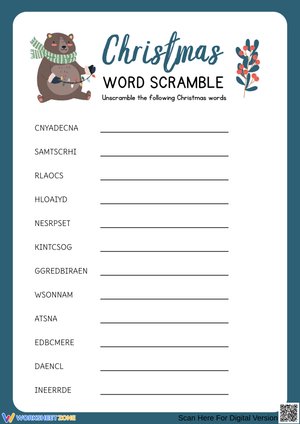
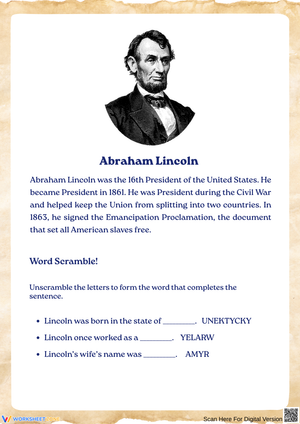
Both applications work. Because each worksheet is a standalone file, teachers pull the one that matches their current unit — a scramble built around ecosystem vocabulary for a life science class, or one organized around the causes of World War I for a history course. When students encounter scrambled versions of terms they've already seen in context, the unscrambling process reinforces both the spelling and the word's phonological form, which strengthens recall during content assessments.
How do I manage pacing when some students finish quickly and others need more time?
Early finishers can write a sentence using each word they've unscrambled, which extends the task without requiring an additional worksheet. For students who haven't finished when the class needs to move on, asking them to complete only the first column or the shorter words keeps the task achievable within the available time. The item-by-item structure of these puzzles makes partial completion natural — there's no narrative thread that breaks if a student stops partway through.
How reliable are word scrambles as a formative assessment tool?
More reliable than they look. When you collect completed worksheets and scan for systematic errors — every student confusing the ou/ow distinction, or no one correctly solving the words with silent consonants — you have a clear signal for the next day's mini-lesson. The pre-unit use is especially useful: a scramble of next week's words given cold on Monday tells you precisely which patterns students have already internalized and which require explicit teaching before the words go home on a list.












 Interactive Worksheet Maker
 Quiz Maker
 Word Search Maker
 Crossword Puzzle Maker
 Word Scramble Generator
 Sentence Scramble Generator
 Handwriting Worksheet Generator
 Name Tracing Generator
 Fill In The Blank Generator