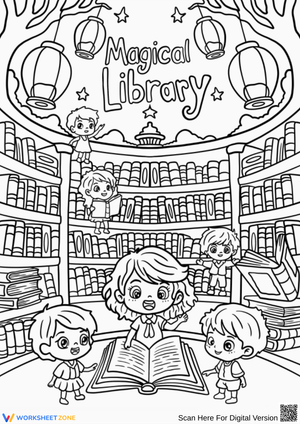
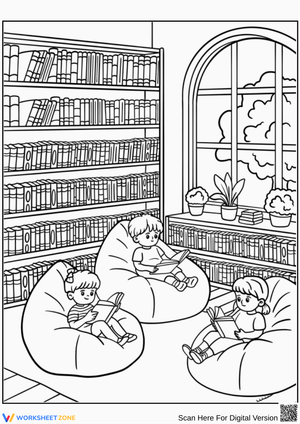
Most library coloring pages center on tall bookshelves lined with stacked spines, a rolling ladder, and a checkout desk with a librarian stamping cards. Many designs add a reading lamp, a globe, or a library cart loaded with returns. Kids often appear curled up in a reading nook with a pillow, a cat, or a stack of picture books nearby. These recurring details give each sheet plenty to color without feeling cluttered or overly busy.
Variety Inside the Collection
A full set of library coloring sheets usually ranges from about 20 to nearly 80 designs, so there is more than one mood to pick from. Some pages show a full building exterior with stone steps and arched windows, while others zoom into a cozy corner with beanbags and fairy lights. A few sheets swap the big building for a Little Free Library, the small neighborhood book-box that neighbors fill and trade from year-round.
Matching the Page to a Skill Level
Younger kids do best with bold-outline pages that keep book spines simple and leave large open shelf sections to fill in. Teens and adults tend to enjoy denser scenes with dozens of tiny titled spines, patterned rugs, and shaded lamp light, which take longer to complete and reward careful blending. Picking the right complexity keeps the activity relaxing instead of frustrating, whether it is a quick after-school sheet or a slower weekend project.
Frequently Asked Questions
1. What supplies work best for detailed bookshelf scenes?
Fine-tip markers or colored pencils give the cleanest results on narrow book spines and small shelf lines, since broad markers can bleed past the edges. Warm browns and tans work well for wooden shelving, while a mix of bright hues along the spines makes the shelf look full. A light gray or yellow wash on lamps and windows adds a cozy, lived-in reading feel.
2. Can these sheets encourage reading habits at home?
Pairing a library coloring page with a real trip to the library or a short reading challenge gives kids a visual reward tied to books. Some families color a page after finishing a chapter or before a weekend library visit, turning it into a small ritual. Because the scenes show librarians, storytime circles, and checkout desks, they also help younger kids understand what a library visit involves.
3. What hidden detail often shows up in these designs?
Look closely and many sheets hide a small library cat napping on a shelf, a tiny mouse peeking from behind a book stack, or a Little Free Library tucked into a yard scene. Some artists also sneak in miniature, unreadable book titles along the spines as a playful extra detail. Spotting these small touches adds a bit of discovery to an otherwise quiet coloring session.












 Interactive Worksheet Maker
 Quiz Maker
 Word Search Maker
 Crossword Puzzle Maker
 Word Scramble Generator
 Sentence Scramble Generator
 Handwriting Worksheet Generator
 Name Tracing Generator
 Fill In The Blank Generator