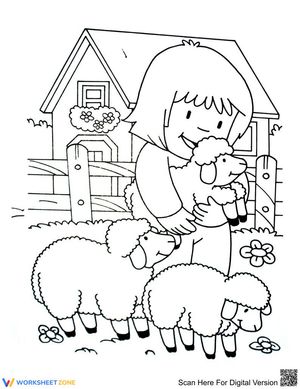
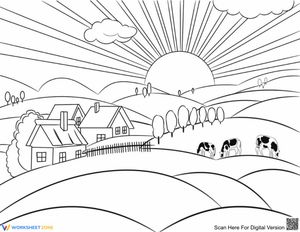
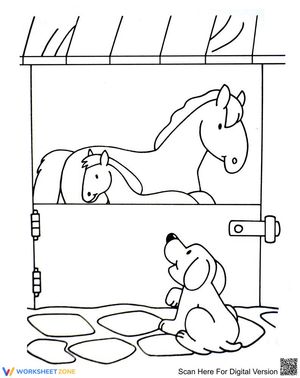
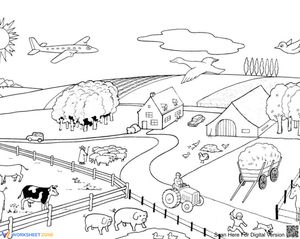
Farm coloring pages give teachers and parents a no-prep tool for building early science and social studies vocabulary with young learners. Each sheet places a familiar barnyard subject in front of students, creating an immediate visual anchor for concepts like animal habitats, food origins, and rural landscapes. Worksheetzone designs these printables with clean black-and-white outlines so they work on any classroom printer without wasting ink or preparation time.
The most effective way to use these sheets is to pair each image with a single focused question. Ask students where the animal sleeps, what it eats, or what product it provides before they pick up a crayon. That brief exchange transforms a quiet coloring activity into a structured vocabulary moment that reinforces the lesson without requiring extra materials or setup from the teacher.
Parents working at home can take a similar approach. Sitting beside a child while they color a tractor or a barn is a natural opening for conversation about where food comes from and how farms operate. For families looking to extend the activity further, the guide on art therapy activities for kids offers practical ideas for turning creative work into meaningful learning time at home or in a tutoring session.
For classrooms studying specific barnyard animals in greater depth, chicken coloring pages provide a focused look at poultry characteristics including feathers, beaks, and body structure. Combining targeted animal sheets with broader farm scenes gives students both the detail and the context they need to build a complete picture of agricultural life. Worksheetzone farm coloring pages are designed to support exactly that kind of layered, efficient instruction.
Frequently Asked Questions
Question 1: What age group benefits most from farm coloring pages?
Farm coloring pages work best for children between the ages of three and eight. At this stage, students are building vocabulary and fine motor skills simultaneously, making a structured coloring activity an efficient way to introduce barnyard animals, farm tools, and agricultural concepts without overwhelming young learners with text-heavy materials.
Question 2: How can teachers use farm coloring pages in a lesson plan?
Teachers can use farm coloring pages as a warm-up activity, a quiet center task, or a take-home worksheet. Pairing each sheet with a short discussion question about the animal or object pictured turns the activity into a vocabulary-building exercise that fits naturally into science, social studies, or language arts lessons.
Question 3: Are farm coloring pages suitable for students with different learning styles?
Yes. Visual learners benefit from the detailed illustrations, while kinesthetic learners engage through the hands-on coloring process. Teachers can extend the activity for auditory learners by reading aloud facts about each animal as students work, making the same printable worksheet accessible and productive across a range of learning preferences in one classroom session.
Question 4: How do farm coloring pages support early science education?
Farm coloring pages introduce foundational science concepts such as animal classification, habitats, and the origins of common food products. When a child colors a cow or a chicken, a teacher or parent can connect the image to real-world knowledge about dairy and poultry farming, giving early science lessons a concrete visual reference that supports long-term retention.












 Interactive Worksheet Maker
 Quiz Maker
 Word Search Maker
 Crossword Puzzle Maker
 Word Scramble Generator
 Sentence Scramble Generator
 Handwriting Worksheet Generator
 Name Tracing Generator
 Fill In The Blank Generator