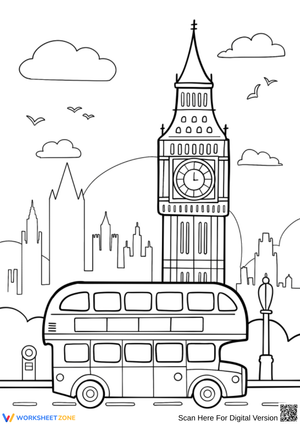
Most designs in this set lean on strong black outlines set against open white space, so colors stay easy to control. Expect skyline silhouettes packed with skyscrapers, a few arched bridges, yellow taxis rolling down avenues, and busy crosswalks dotted with tiny figures. Some sheets zoom into a single building facade with rows of windows, while others pull back for a full downtown panorama at sunset. Night scenes swap in star-dotted skies and lit windows for extra contrast once colored.
What's Inside the Printable Collection
The set mixes bustling downtown scenes with quieter corners of a city, so there's more than one mood to pick from. You'll find busy avenues lined with shops, a subway entrance, rooftop gardens, and a park bench tucked between apartment buildings. A few sheets focus on city vehicles like buses, delivery trucks, and bikes, while others show a quiet neighborhood street with parked cars and porch lights. Day and night versions of the same skyline let colorers try two different palettes on one layout.
Picking the Right Sheet by Age and Skill
Younger kids do best with bold, simple shapes: a single row of buildings, thick outlines, and few small details to stay inside. Teens and adults tend to reach for the architectural skyline pages, where individual bricks, window grids, and shadow lines reward slower, careful coloring. Print on plain 8.5x11 inch paper for crayons or thicker cardstock if using markers, since ink can bleed through thinner sheets. A home printer set to standard quality reproduces the fine skyline lines cleanly without fading.
Frequently Asked Questions
1. What supplies work best for detailed skyline designs?
Fine-tip markers or colored pencils give the cleanest results on detailed skyline pages, since they let you shade individual windows and building edges without smudging. Blending pencils work well for gradient sunset or night skies behind the buildings. Thicker crayons suit the bolder, simpler outlines instead, since fine architectural lines can get lost under a wide crayon tip.
2. Can these be printed for group or classroom use?
Yes, the sheets print cleanly on standard letter paper, making them easy to hand out for a group activity, a geography-themed lesson, or a quiet desk task. Printing several designs at once lets a group compare skylines, streets, and city vehicles side by side, which works well for table groups or a shared coloring station during downtime.
3. Is there a fun fact behind famous city skyline art?
Skyline illustrations often exaggerate building height and spacing to make a city instantly recognizable from just a few landmark shapes. Artists frequently place a bridge, a tower, or a river in the foreground as a visual anchor, a trick borrowed from postcard art decades ago. That's why even a simplified skyline sheet can still feel tied to a specific, familiar city.












 Interactive Worksheet Maker
 Quiz Maker
 Word Search Maker
 Crossword Puzzle Maker
 Word Scramble Generator
 Sentence Scramble Generator
 Handwriting Worksheet Generator
 Name Tracing Generator
 Fill In The Blank Generator