


























Views
Downloads
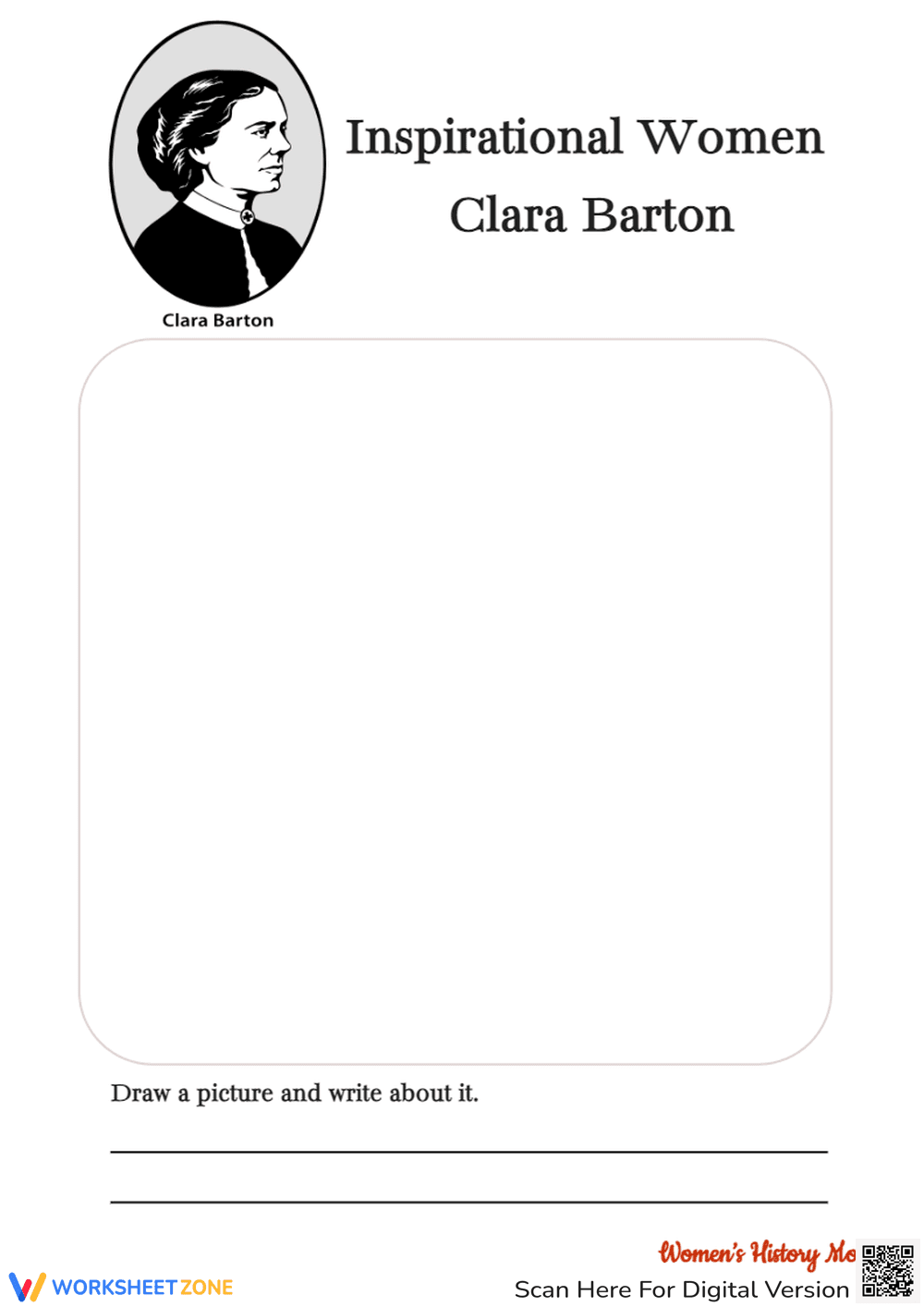

Clara Barton Worksheet: Printable Grade 1-3 Activity
Paste this activity's link or code into your existing LMS (Google Classroom, Canvas, Teams, Schoology, Moodle, etc.).
Students can open and work on the activity right away, with no student login required.
You'll still be able to track student progress and results from your teacher account.
This Clara Barton worksheet provides a creative outlet for elementary students to engage with Women's History Month. By combining visual art with descriptive writing, students synthesize their knowledge of the Red Cross founder. This activity encourages historical empathy and reinforces informational writing skills through a structured, open-ended format that supports diverse learning styles.
At a Glance
- Grade: 2 · Subject: ELA & Social Studies
- Standard:
CCSS.ELA-LITERACY.W.2.2— Write informative texts to name a topic and provide facts- Skill Focus: Historical Biography & Writing
- Format: 1 page · 2 tasks · No answer key · PDF
- Best For: Women's History Month bell-ringers
- Time: 15–20 minutes
The worksheet features a high-quality portrait of Clara Barton to serve as a visual reference. Below the header, a large, rounded rectangular frame provides ample space for student illustrations. The bottom of the page includes two primary-ruled lines for students to compose a brief summary or fact about Barton's life and contributions to nursing and humanitarian aid.
The zero-prep workflow is designed for maximum efficiency. First, print the single-page PDF (30 seconds). Second, distribute the sheets to students along with drawing materials (1 minute). Third, review student work by having them share one fact they wrote about Clara Barton (5 minutes). This makes it an ideal emergency sub plan or transition activity for busy classrooms.
This resource aligns with `CCSS.ELA-LITERACY.W.2.2`, focusing on writing informative/explanatory texts in which students name a topic, use facts and definitions to develop points, and provide a concluding statement. It also supports historical literacy by connecting individuals to their impact. Both standard codes can be copied directly into lesson plans, IEP goals, or district curriculum mapping tools.
Use this worksheet as a formative assessment after a read-aloud about Clara Barton. Observe if students can translate verbal information into a representative drawing and a coherent sentence. It also works well as a center activity during a Women's History Month rotation. Expect students to complete the drawing and writing within 15 to 20 minutes depending on their grade level.
This activity is designed for Grade 1, 2, and 3 students. It is particularly effective for English Language Learners (ELLs) who benefit from the visual-to-text connection. Pair this worksheet with a picture book biography of Clara Barton or a classroom anchor chart detailing her role in the American Red Cross to provide necessary scaffolding.
Research from Fisher & Frey (2014) emphasizes the importance of "writing to learn," where students use brief writing tasks to solidify their understanding of new content. This Clara Barton worksheet applies this principle by requiring students to synthesize historical facts into a single sentence and a supporting illustration. By engaging both the linguistic and spatial centers of the brain, the activity promotes better retention of historical facts compared to passive reading alone. Aligned with CCSS.ELA-LITERACY.W.2.2, the worksheet provides a low-stakes environment for Grade 2 students to practice naming a topic and providing supporting details. This method of dual coding—using both images and words—is a proven strategy for early elementary learners to build background knowledge in social studies. The 1-page format ensures that the cognitive load remains focused on the historical figure rather than complex formatting, making it a reliable tool for classroom teachers.


