


























Views
Downloads

Printable Would You Rather Worksheet | Grade 2 ELA
Paste this activity's link or code into your existing LMS (Google Classroom, Canvas, Teams, Schoology, Moodle, etc.).
Students can open and work on the activity right away, with no student login required.
You'll still be able to track student progress and results from your teacher account.
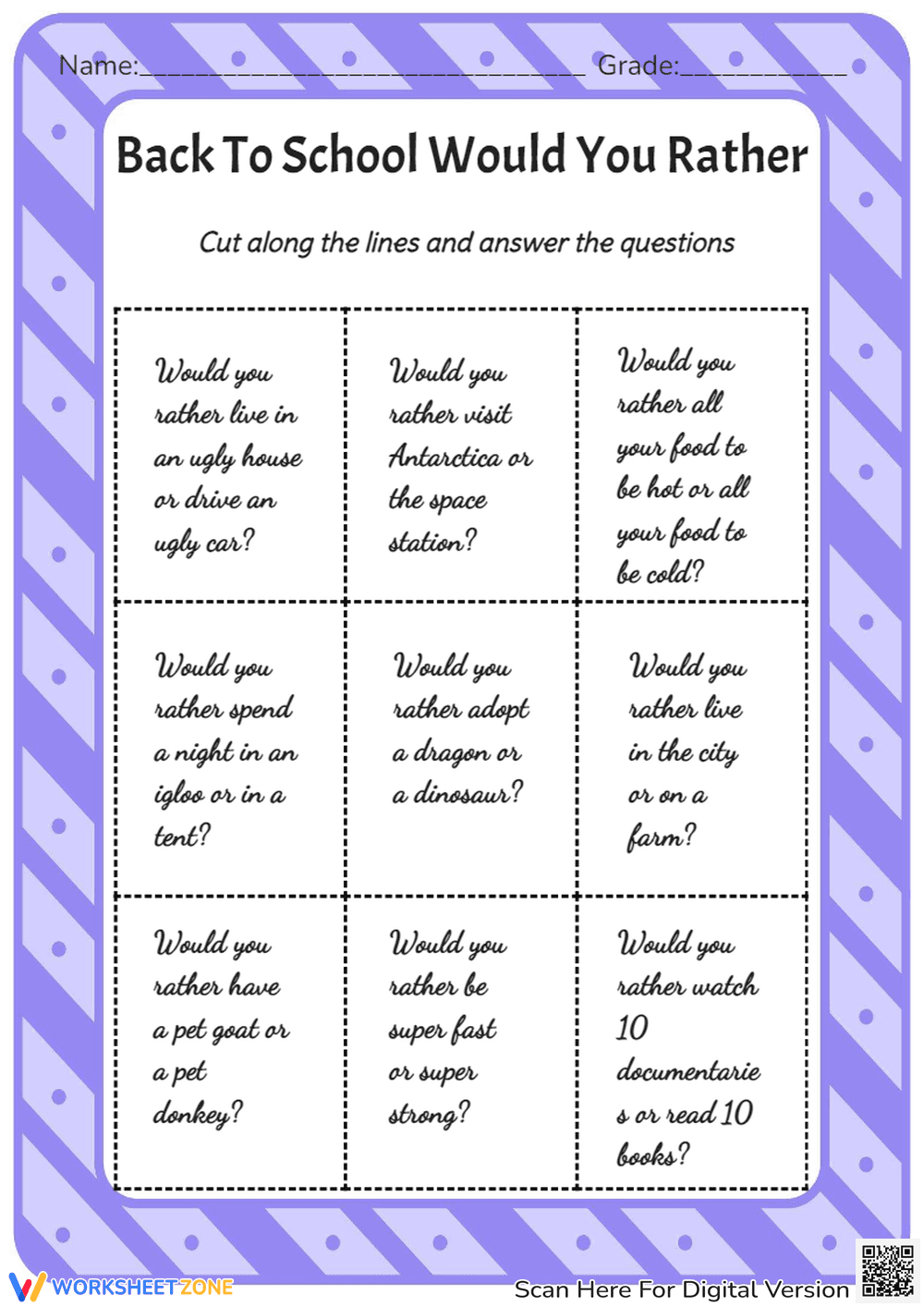
This engaging Back-to-School worksheet provides students with nine fun "Would You Rather" prompts to build communication and decision-making skills. By cutting out and discussing these cards, young learners practice expressing their opinions clearly while interacting with peers in a structured, low-pressure environment.
At a Glance
- Grade: 2 · Subject: ELA
- Standard:
CCSS.ELA-LITERACY.SL.2.1— Participate in collaborative conversations with peers- Skill Focus: Opinion Expression
- Format: 1 page · 9 problems · No answer key · PDF
- Best For: Back-to-school icebreakers
- Time: 15–20 minutes
Inside this single-page resource, educators will find nine distinct dashed-line cards featuring imaginative scenarios. Each card presents a unique choice, such as deciding between visiting Antarctica or a space station. The layout is designed for easy cutting, allowing the prompts to be used as physical task cards or discussion starters. Because the questions are subjective, no answer key is required.
This resource is designed for immediate classroom implementation with minimal teacher setup:
- Print (1 minute): Simply print the single-page PDF for each student or group.
- Distribute (1 minute): Hand out the sheets along with scissors if students are cutting their own cards.
- Review (1 minute): Read one example aloud to model how to state a choice and provide a reason.
Total teacher prep time is under two minutes, making this an excellent option for emergency sub plans or unexpected schedule gaps during the first weeks of school.
This activity aligns with CCSS.ELA-LITERACY.SL.2.1: "Participate in collaborative conversations with diverse partners about grade 2 topics and texts with peers and adults in small and larger groups." It also supports foundational opinion writing skills if used as drafting prompts. Both standard codes can be copied directly into lesson plans, IEP goals, or district curriculum mapping tools.
Teachers can utilize these cards during morning meetings as a daily icebreaker. Draw one card and have students move to opposite sides of the room based on their preference. Alternatively, place the cut-out cards in a literacy center where students write a short paragraph explaining their decision. This activity typically takes 15 to 20 minutes. As a formative assessment tip, listen to student conversations to gauge their ability to take turns speaking.
This worksheet is ideal for first through third-grade students who are developing their speaking, listening, and reasoning abilities. For students needing extra support, provide sentence frames like "I would rather ___ because ___." Advanced learners can be challenged to write a persuasive paragraph convincing a peer to agree with their choice. It pairs perfectly with beginning-of-the-year community-building lessons or read-alouds focused on friendship and making choices.
Integrating structured speaking activities like this one is crucial for early elementary development. Aligned to CCSS.ELA-LITERACY.SL.2.1, this resource helps students participate in collaborative conversations with peers. According to Fisher & Frey (2014), providing students with dedicated instructional time for peer-to-peer dialogue significantly increases their academic vocabulary acquisition and overall oral language proficiency. When children are given low-stakes, highly engaging prompts—such as choosing between adopting a dragon or a dinosaur—they are more likely to take linguistic risks and practice articulating complex reasoning. This foundational practice not only builds classroom community during the critical back-to-school period but also lays the cognitive groundwork for formal opinion writing later in the academic year. Utilizing these targeted conversational routines ensures that all learners have a voice in the classroom.


