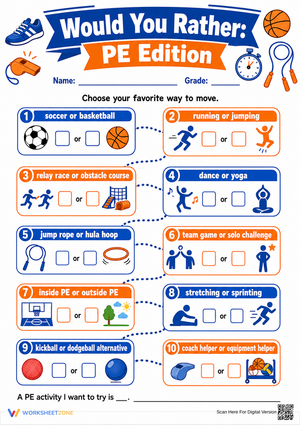
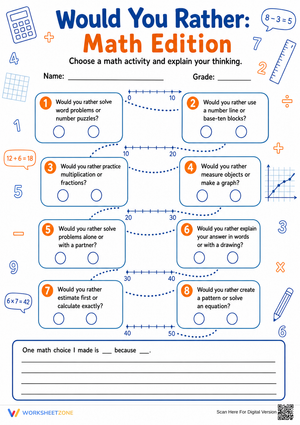
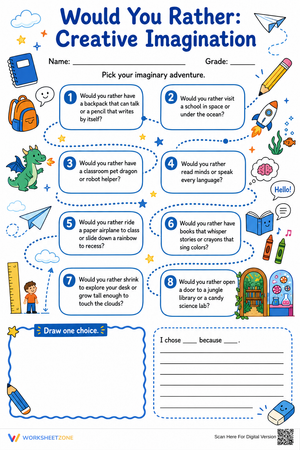
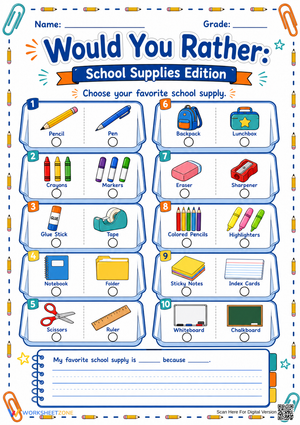
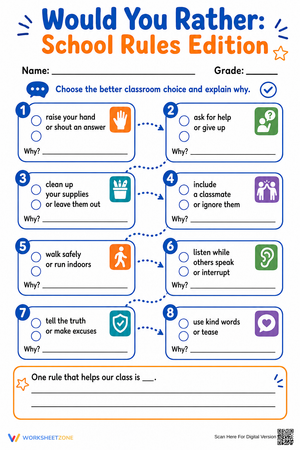
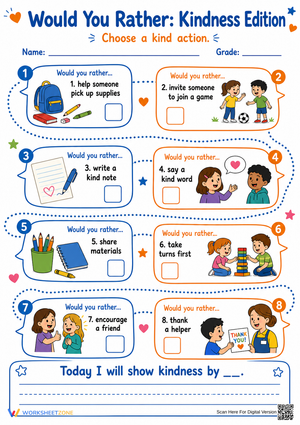
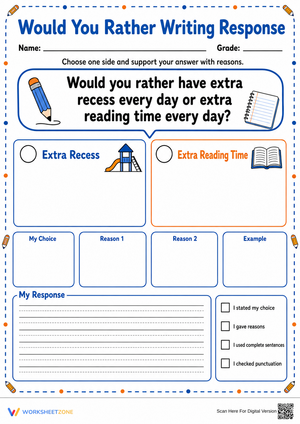
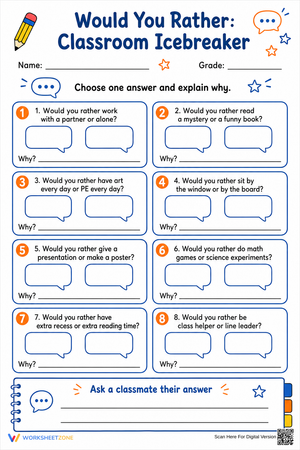
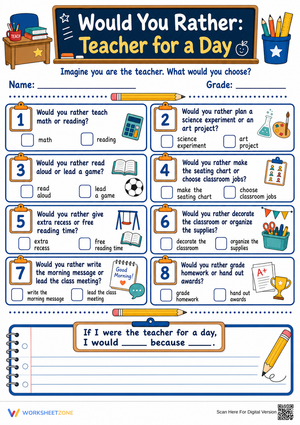
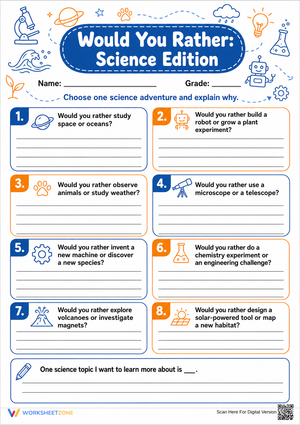
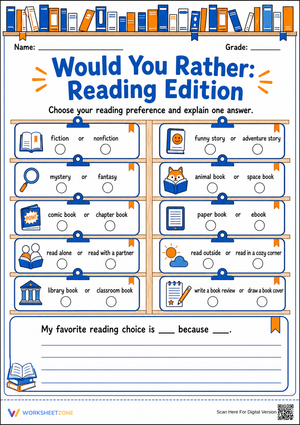
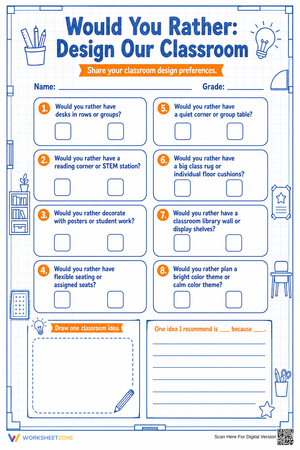
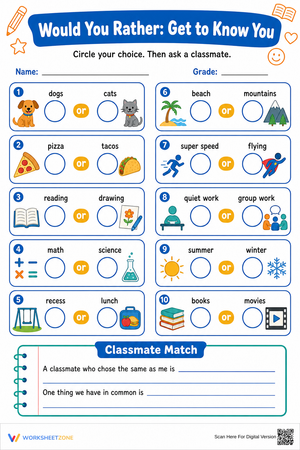
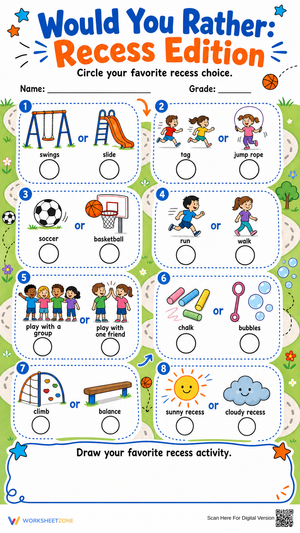
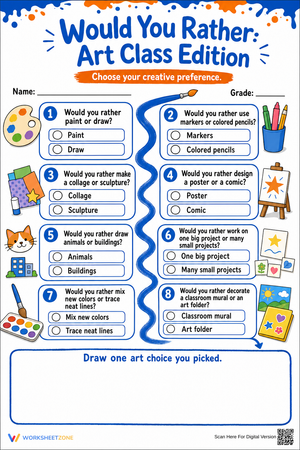
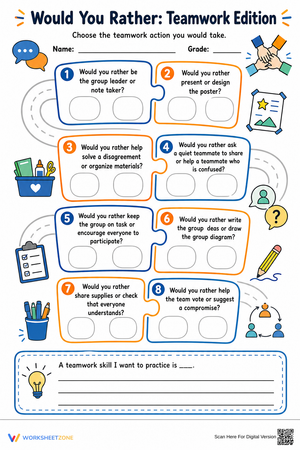
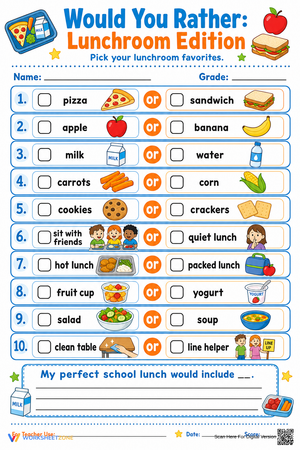
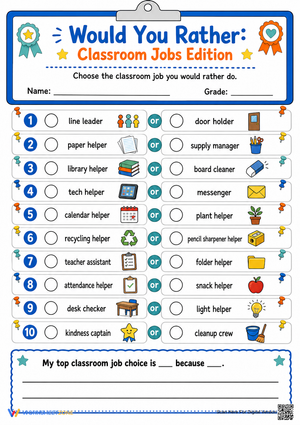
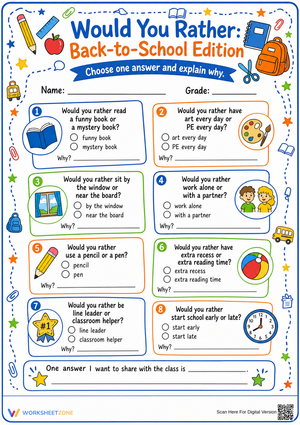
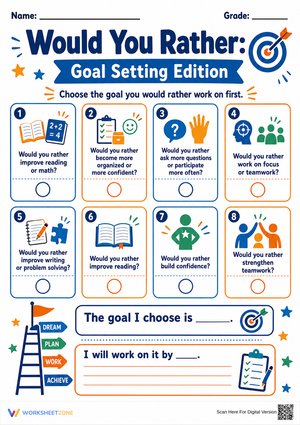
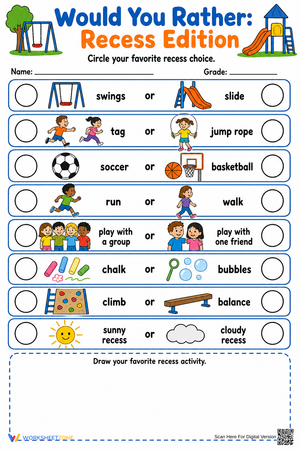
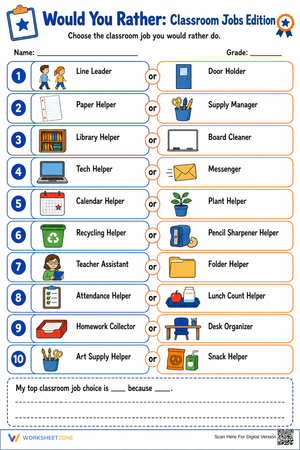
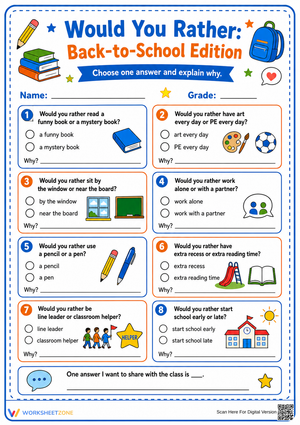
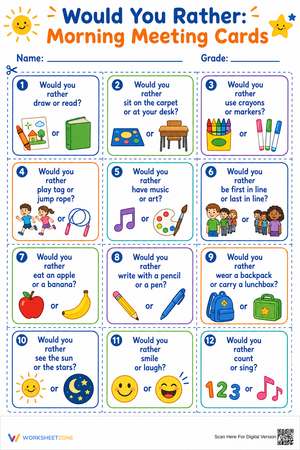
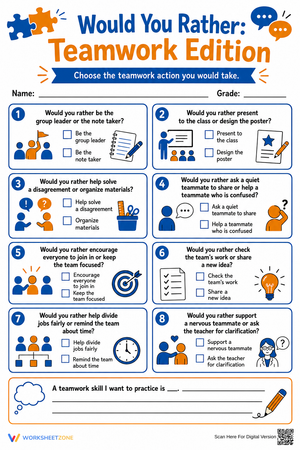
These back to school would you rather printable worksheets give teachers a structured, low-pressure entry point for the first days of class — a way to get every student making a decision and expressing a preference before the room's social dynamics have had time to calcify. The binary-choice format removes the blank-page paralysis that hits students when asked to simply "share something about yourself," which means fewer silences, less visible discomfort, and faster connection across a room full of strangers.
What's Inside the Set
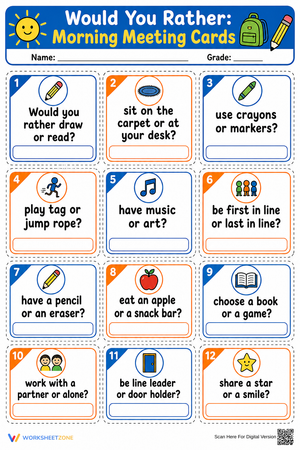
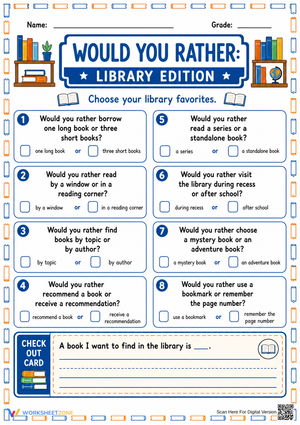
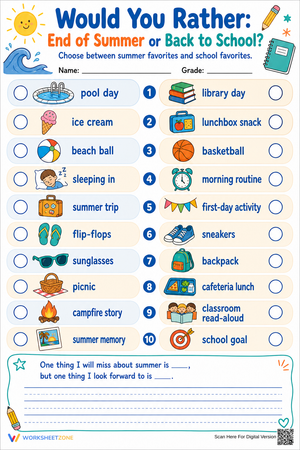
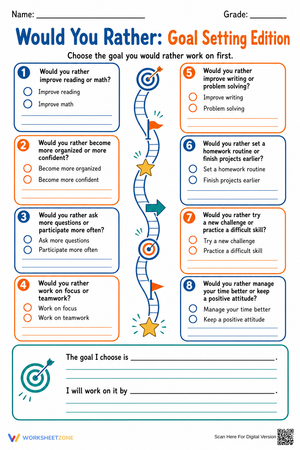
Each worksheet presents a collection of "Would You Rather" prompts paired with space for students to mark their choice, write a brief reason, and — in several worksheets — record a partner's response alongside their own. Prompts range from purely silly ("Would you rather have to hop everywhere or walk backward everywhere?") to school-themed ("Would you rather have no homework for a month or choose your own seat all year?") to mild hypothetical reasoning prompts that require students to think through consequences before choosing. Teachers can sequence the worksheets by complexity or pull specific ones based on what the room needs that day.
Across the set, students practice:
- Committing to a position rather than deflecting with "both" or "it depends"
- Stating at least one reason that supports their choice, in writing or aloud
- Listening to a partner's reasoning and noting a point of agreement or difference
- Reading a peer's written response without immediately dismissing it
Partner interview worksheets include two name lines and two response columns, which builds in a structural reminder that both students have a role — not just the one who tends to dominate the conversation.
The Pedagogical Case for Binary Choice in Week One
Open-ended community-building prompts — "What are three things you want your teacher to know about you?" — place the entire burden of content generation on the student. In the first week of school, when students are actively managing the social stress of being observed and evaluated by unfamiliar peers, that demand draws on executive function that many students simply don't have available. The "Would You Rather" format hands students the content and asks only for a judgment. A student who freezes at "tell us about yourself" can answer "roller coasters or waterslides" without hesitation. The constraint is the point.
This matters most in grades 3 through 6, when peer perception becomes a significant driver of classroom behavior and students grow acutely aware of how their answers will land with classmates. By removing the content-generation demand, the format frees students to focus on what the first week actually requires: observing peers, noticing who they might connect with, and practicing the low-stakes social exchange that community-building depends on. The worksheet is the structure; the conversation is the outcome.
Weaving These Worksheets Into Your Weekly Schedule
The most reliable slot is the first eight to ten minutes before attendance is finalized — before the day's agenda is posted, before the room has settled into a tone. Handing a worksheet to a student walking through the door signals that this is a room where something is expected of them. By the time the bell rings, most students have made a choice and have something they can say.
Back to school would you rather printable worksheets also fit well as morning meeting share segments — one prompt per day, three or four students respond aloud, no pressure to explain at length. They work as partner warm-ups before writing workshop sessions, when students who have just made and defended a low-stakes choice are already in the mode of holding an opinion, which transfers directly into persuasive and personal writing tasks. Friday community circle, the eight minutes before dismissal, sub day structures that run themselves: the format holds across all of it because it requires no prior knowledge of classroom content or routines.
One approach that works consistently in grades 4 through 8: post one prompt on the board each morning during the first two weeks, have students mark their choice on a sticky note, and build a two-column chart on the wall. By mid-week two, the chart becomes a visual data set. Students count tallies, notice patterns, and generate their own follow-up questions without any prompting from the teacher.
Participation Patterns Teachers Should Anticipate
The most predictable behavior in early uses: students who answer "both" or "neither" instead of committing to a choice. This is not indecision — it is social self-protection. The student does not yet know whether their answer will invite ridicule, so they opt out of both options simultaneously. Address it directly before distributing the worksheet. State that "both" and "neither" are not available answers, that every prompt requires a selection, and that no one will be asked to defend their choice publicly unless they volunteer. That one instruction eliminates most of the stalling.
In partner interview formats, a second pattern appears regularly: one student asks all the questions and the other answers, and they never switch roles. The worksheet gets completed, but only one student practiced listening. A mid-activity check from the teacher — "Switch — the person who's been answering now asks the questions" — enforces the reciprocal structure built into the format.
A third pattern surfaces specifically with hypothetical prompts that contain unfamiliar references. "Would you rather visit Machu Picchu or the Great Barrier Reef?" stalls when students don't recognize either location. This is not a reading issue; it is a background knowledge gap. Keep a world map or quick image reference visible during the first several sessions, or preview vocabulary-heavy prompts the afternoon before with students who need additional processing time.
What Differentiation Looks Like With This Set
For students reading below grade level, the prompts work best read aloud before students mark their responses — by the teacher or a partner. The worksheet runs identically; only the delivery changes. Removing the decoding demand lets students focus on the judgment rather than the text.
For students who finish quickly and want more depth, the reasoning line becomes a full-paragraph task: write your choice, explain why, then anticipate why someone might reasonably choose differently. That perspective-taking layer keeps the extension anchored in the same activity rather than branching into something entirely separate, which reduces management overhead during a whole-class session.
Back to school would you rather printable worksheets serve a specific instructional function for students with social communication goals on their IEPs. The structured exchange — ask, listen, respond, switch — gives a clear start, middle, and end to a peer conversation. Students who struggle to initiate or close interactions have a built-in script that mirrors the worksheet format exactly, without requiring a separate social narrative or additional visual aid. The predictability is the support.
Frequently Asked Questions
Do these worksheets work with students who resist sharing activities?
Yes. The binary format gives reluctant students a way to participate without speaking. A student can mark their choice, keep the paper face-down, and still contribute to a class tally through a raised hand or a sticky note. Verbal sharing stays optional until the student is ready, which removes the stakes that cause resistant students to shut down entirely.
How long does each worksheet take to complete?
A full individual-plus-partner cycle runs 10 to 15 minutes. Using only the individual response section drops that to five to seven minutes. Teachers who run the sticky-note wall chart version add about three minutes for posting and counting. Plan for the shorter end if this is a transition activity; the longer end if it anchors a dedicated community-building block.
Can these worksheets be used after the first week of school has passed?
These back to school would you rather printable worksheets are framed around the opening days of the year, but the prompts hold up any time the class needs a community reset — after winter break, following a rough week, or as a backup when a planned lesson falls through. Several teachers keep the set specifically for substitute days, since the format requires no explanation of classroom content or prior instructional context.
What grade levels are these written for?
The set spans kindergarten through grade 8. In kindergarten and first grade, prompts work best read aloud, with the worksheet functioning mainly as a visual anchor for a spoken activity. Upper elementary students can run the partner format independently. By middle school, the written reasoning section carries more weight than the conversation does, and prompts can lean toward mild ethical or hypothetical territory that pushes students to justify a position rather than simply state a preference.












 Interactive Worksheet Maker
 Quiz Maker
 Word Search Maker
 Crossword Puzzle Maker
 Word Scramble Generator
 Sentence Scramble Generator
 Handwriting Worksheet Generator
 Name Tracing Generator
 Fill In The Blank Generator