


























Views
Downloads
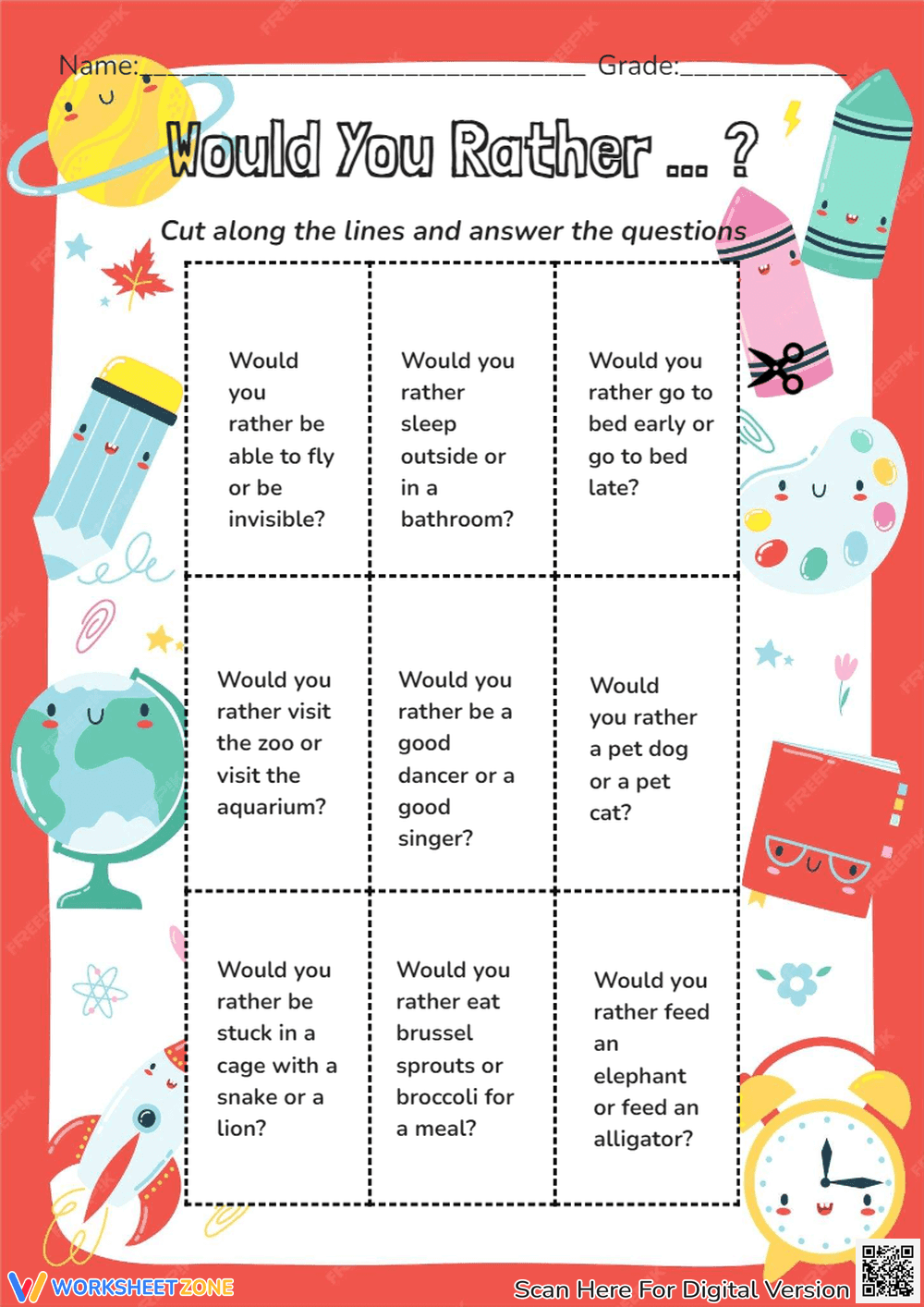

Back to School Would You Rather | Essential Grade 1-3
Paste this activity's link or code into your existing LMS (Google Classroom, Canvas, Teams, Schoology, Moodle, etc.).
Students can open and work on the activity right away, with no student login required.
You'll still be able to track student progress and results from your teacher account.
This Grade 1-3 "Would You Rather" worksheet facilitates immediate student engagement through oral language practice and critical thinking. By choosing between two distinct scenarios, students develop the ability to express preferences and provide reasoning, fostering a positive classroom culture during the back-to-school season.
At a Glance
- Grade: 1-3 · Subject: ELA
- Standard:
CCSS.ELA-LITERACY.SL.2.1— Participate in collaborative conversations with diverse partners about grade-level topics- Skill Focus: Oral Language & Decision Making
- Format: 1 page · 9 problems · Answer key included · PDF
- Best For: Back-to-school icebreakers and morning meetings
- Time: 15–20 minutes
The resource features a clean, 3x3 grid containing 9 unique "Would You Rather" prompts designed for primary learners. Each box is separated by dashed lines, allowing the worksheet to double as a fine-motor cutting activity. The prompts range from imaginative scenarios, like being able to fly, to everyday preferences regarding food and pets. The visual cues and simple text are accessible for early readers.
This resource follows a streamlined zero-prep workflow to maximize instructional time. First, print the single-page PDF for your entire class (approx. 1 minute). Second, distribute the sheets and have students cut out the prompt cards or simply circle their choices (approx. 5 minutes). Third, review the answers in a whole-group circle or "turn and talk" format where students justify their selections (approx. 10 minutes). This structure makes it an ideal icebreaker activity.
This worksheet is aligned with CCSS.ELA-LITERACY.SL.2.1, which focuses on participating in collaborative conversations. By engaging with these prompts, students practice following agreed-upon rules for discussion and building on others' talk. It also supports CCSS.ELA-LITERACY.L.1.1 by encouraging the use of complete sentences during oral responses. Both standard codes can be copied directly into lesson plans, IEP goals, or district curriculum mapping tools.
Use this worksheet as a "Four Corners" activity where different areas of the room represent different choices. This gets students moving while they practice their speaking skills. Alternatively, use it as a formative assessment for oral sentence structure; listen as students explain why they would rather sleep outside than in a bathroom. Expect the full activity to take between 15 and 20 minutes depending on the depth of discussion.
This resource is designed for students in Grades 1, 2, and 3, including English Language Learners who benefit from the binary choice format. It pairs naturally with a "Getting to Know You" anchor chart or a direct instruction lesson on respectful listening. The playful illustrations of planets, crayons, and art supplies make it visually appealing for younger children.
According to the RAND AIRS 2024 report, structured oral language activities in the early grades are foundational for later reading comprehension and social-emotional development. This worksheet addresses the CCSS.ELA-LITERACY.SL.2.1 standard by providing a low-stakes environment for students to practice collaborative conversation and decision-making. Research from Fisher & Frey (2014) emphasizes that "Would You Rather" prompts serve as effective scaffolds for academic talk, allowing students to practice the "language of choice" before moving to complex argumentative writing. By integrating 9 specific prompts with fine-motor cutting tasks, this resource supports a multi-sensory approach to ELA instruction. Educators can utilize these prompts to observe student turn-taking and the ability to stay on topic, which are critical indicators of communicative competence in primary education. This printable tool ensures that every student has a starting point for meaningful classroom interaction.


