


























Views
Plays



Author's Purpose Quizizz | Grade 2-3 Essential
Paste this activity's link or code into your existing LMS (Google Classroom, Canvas, Teams, Schoology, Moodle, etc.).
Students can open and work on the activity right away, with no student login required.
You'll still be able to track student progress and results from your teacher account.
This Grade 2 and 3 reading worksheet helps students master the concept of author's purpose through a comprehensive 25-question assessment. By analyzing various text snippets, students identify whether the writer intends to persuade, inform, or entertain. This resource ensures learners can distinguish between different writing goals across fiction and nonfiction genres effectively.
At a Glance
- Grade: 2-3 · Subject: ELA Reading
- Standard:
CCSS.ELA-LITERACY.RI.2.6— Identify the main purpose of a text and what the author explains- Skill Focus: Author's Purpose (PIE)
- Format: 6 pages · 25 problems · Answer key included · PDF
- Best For: Formative assessment or sub plans
- Time: 30–45 minutes
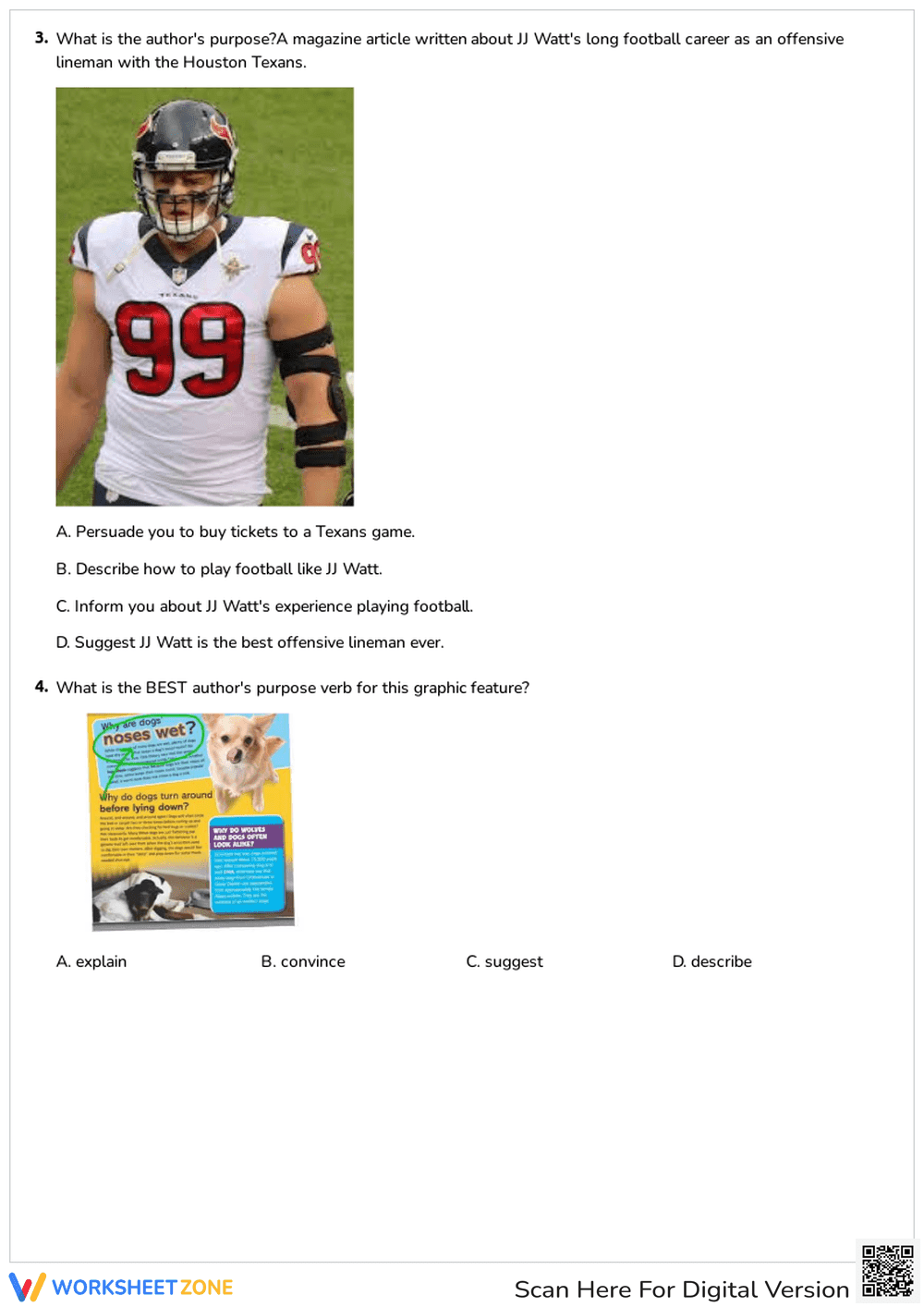
Inside this 6-page PDF, you will find 25 multiple-choice questions that utilize real-world examples, such as biographies of Michael Jordan, fables by Aesop, and even song lyrics. The layout includes visual aids like book covers and diagrams to help students identify how graphic features support the author's intent. A complete answer key is provided for quick grading and immediate student feedback.
The zero-prep workflow for this resource is designed for maximum efficiency. First, print the 6-page document (30 seconds). Second, distribute the packets to your students during your reading block or as a quiet assessment (1 minute). Finally, review the answers using the included key or have students self-correct to reinforce their understanding of text intent (5 minutes). Total teacher prep time is under 2 minutes, making it an ideal sub plan.
Standards Alignment
This resource is aligned with `CCSS.ELA-LITERACY.RI.2.6`, which requires students to identify the main purpose of a text, including what the author wants to answer, explain, or describe. It also supports the Grade 3 requirement to distinguish point of view in informational texts. Both standard codes can be copied directly into lesson plans, IEP goals, or district curriculum mapping tools.
How to Use It
Use this worksheet as a summative assessment at the end of a unit on nonfiction text features. It works well for identifying which students still struggle with the "Persuade" vs. "Inform" distinction. Alternatively, assign it as a high-interest independent practice activity during literacy centers. Observe if students are using the visual cues in the images to justify their answer choices. Expected completion time is 30 to 45 minutes.
Who It's For
This material is ideal for general education students in second and third grade, as well as English Language Learners who benefit from the clear, short text samples and visual supports. It pairs naturally with an anchor chart displaying the "PIE" acronym (Persuade, Inform, Entertain) or a direct instruction lesson on identifying text evidence in short passages.
According to the RAND AIRS 2024 report, explicit instruction in identifying an author's intent significantly improves reading comprehension scores in early elementary learners. This worksheet targets the core requirements of CCSS.ELA-LITERACY.RI.2.6 by requiring students to evaluate 25 distinct text samples. By moving beyond simple definitions to application, students develop the critical thinking skills necessary to interpret complex informational texts. Research from Fisher & Frey (2014) emphasizes that using varied genres—from fables to biographies—helps solidify the concept of authorial purpose across different contexts. This resource provides the structured practice needed to move students toward mastery of identifying whether a text aims to persuade, inform, or entertain. The inclusion of graphic features as evidence further aligns with modern literacy standards that prioritize multi-modal text analysis. Educators can use this data-driven tool to track student progress and inform future small-group instruction.


