


























Views
Downloads

Essential Salmon Life Cycle Worksheet | Grade 3-5 Ready
Paste this activity's link or code into your existing LMS (Google Classroom, Canvas, Teams, Schoology, Moodle, etc.).
Students can open and work on the activity right away, with no student login required.
You'll still be able to track student progress and results from your teacher account.
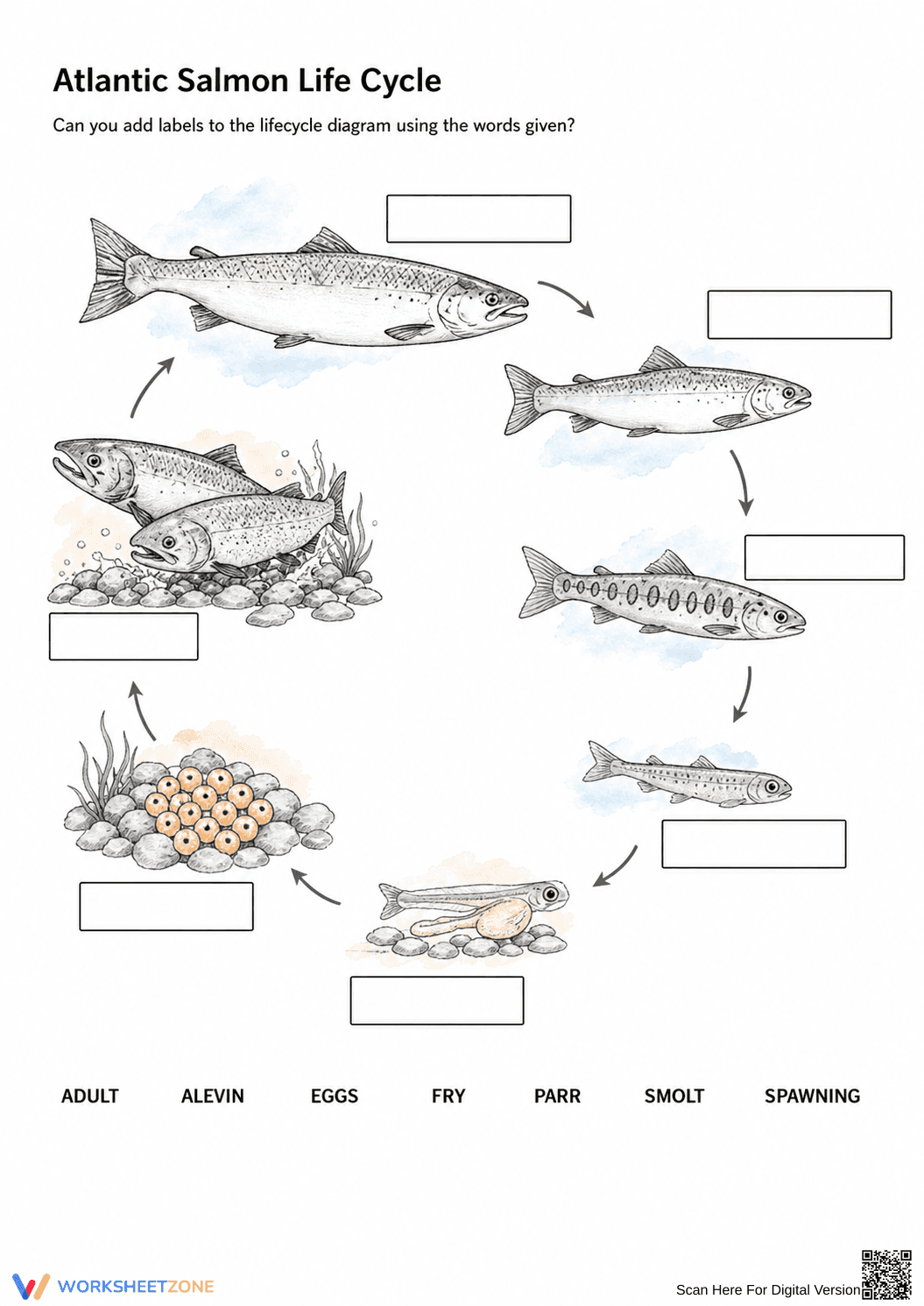
This Atlantic Salmon life cycle worksheet provides a clear, visual framework for students to identify and sequence the biological stages of a migratory fish. By matching specific vocabulary to detailed illustrations, learners develop a concrete understanding of how organisms grow and change over time.
At a Glance
- Grade: 3-5 · Subject: Science
- Standard:
3-LS1-1— Develop models to describe that organisms have unique and diverse life cycles- Skill Focus: Biological sequencing and vocabulary
- Format: 1 page · 7 problems · Answer key included · PDF
- Best For: Independent practice or formative assessment
- Time: 15–20 minutes
The resource features a high-quality circular diagram representing the continuous nature of the salmon's life. It includes seven distinct stages: Eggs, Alevin, Fry, Parr, Smolt, Adult, and Spawning. A word bank at the bottom provides the necessary terminology, while directional arrows guide the student through the chronological progression of the species.
This worksheet is designed for a zero-prep classroom workflow. Teachers can print the single-page PDF in less than 30 seconds. Distribution takes approximately one minute, and because the instructions are self-explanatory, students can begin immediately. Reviewing the seven labels as a whole-class activity takes roughly five minutes, making this an ideal sub plan or warm-up.
Aligned to `3-LS1-1`, this activity requires students to "develop models to describe that organisms have unique and diverse life cycles but all have in common birth, growth, reproduction, and death." It specifically addresses the growth and reproduction phases of the Atlantic Salmon. Both standard codes can be copied directly into lesson plans, IEP goals, or district curriculum mapping tools.
Use this worksheet during the "Explain" or "Evaluate" phase of a 5E science lesson. It serves as an excellent formative assessment tool; teachers should observe if students can distinguish between the 'Parr' and 'Smolt' stages, which often require closer attention to visual detail. Completion typically ranges from 15 to 20 minutes depending on prior knowledge.
This resource is tailored for elementary students in grades 3 through 5. It is particularly effective for English Language Learners (ELLs) due to the heavy visual scaffolding and word bank support. Pair this worksheet with a short video clip of salmon migration or an anchor chart detailing freshwater versus saltwater habitats.
According to the RAND AIRS 2024 report on science literacy, visual modeling of biological processes significantly improves long-term retention of complex vocabulary in elementary learners. This worksheet utilizes a non-linear diagrammatic approach, which research suggests helps students internalize the concept of life cycles as continuous loops rather than finite lines. By requiring students to actively label stages like Alevin and Smolt, the activity moves beyond passive recognition into active cognitive retrieval. The inclusion of the 3-LS1-1 standard ensures that the task remains focused on the core disciplinary ideas of life science. Educators can rely on this structured format to provide evidence of student mastery in identifying life cycle variations. This resource aligns with the Fisher & Frey (2014) gradual release of responsibility model by providing a clear word bank that supports students as they transition from guided instruction to independent application of scientific terminology.


