


























Views
Downloads
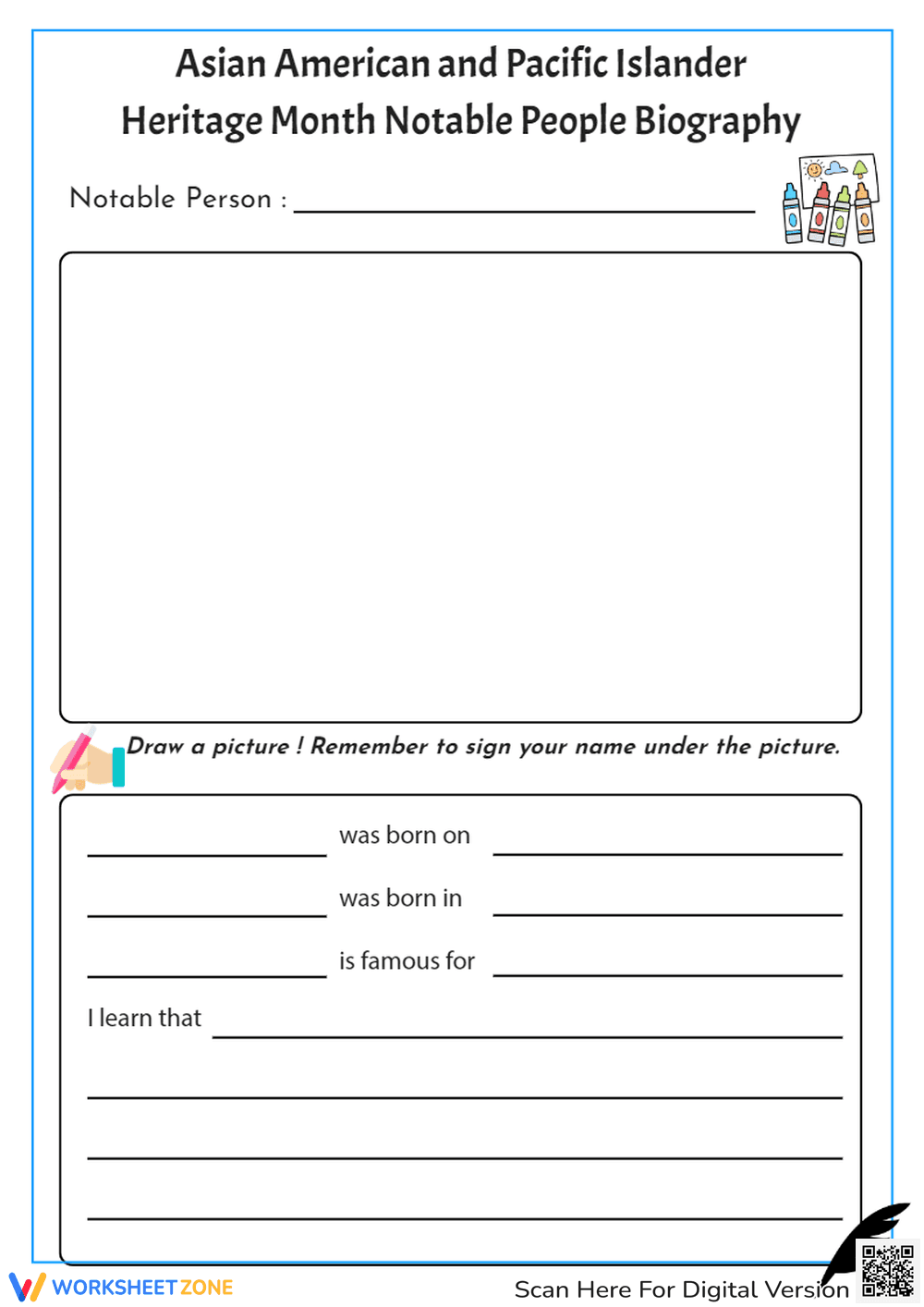

Printable AAPI Biography Graphic Organizer | Grade 2
Paste this activity's link or code into your existing LMS (Google Classroom, Canvas, Teams, Schoology, Moodle, etc.).
Students can open and work on the activity right away, with no student login required.
You'll still be able to track student progress and results from your teacher account.
This printable biography graphic organizer helps early elementary students structure their research on notable Asian American and Pacific Islander figures. By combining illustration with guided writing prompts, the worksheet enables young learners to document key facts and summarize their learning effectively while celebrating AAPI Heritage Month.
At a Glance
- Grade: 2 · Subject: ELA
- Standard:
CCSS.ELA-LITERACY.W.2.2— Write informative texts using facts to develop points- Skill Focus: Informational writing and research
- Format: 1 page · 5 problems · No answer key · PDF
- Best For: Independent research projects
- Time: 20–30 minutes
This single-page resource features a clean layout for young researchers. It includes a large space for students to draw a portrait of their chosen historical figure and sign their artwork. Below the illustration box, four guided fill-in-the-blank sentence frames prompt students to record essential biographical details: birth date, birthplace, major accomplishments, and a personal takeaway. Because this is an open-ended research template, an answer key is not included.
This resource is designed for immediate classroom implementation. Print (1 minute): Generate the PDF and print a class set. Distribute (1 minute): Hand out the organizers alongside classroom library books. Review (3 minutes): Briefly model how to locate facts and transfer them to the sentence frames. Total teacher preparation time is under five minutes, making this an excellent option for emergency sub plans or spontaneous seasonal activities.
This activity is tightly aligned to CCSS.ELA-LITERACY.W.2.2: Write informative/explanatory texts in which they introduce a topic, use facts and definitions to develop points, and provide a concluding statement or section. It also supports shared research objectives by giving students a concrete framework to organize gathered information. Both standard codes can be copied directly into lesson plans, IEP goals, or district curriculum mapping tools.
Teachers can utilize this graphic organizer during independent literacy centers or as a culminating activity after a whole-class read-aloud. It can also serve as a webquest recording sheet where students browse approved digital encyclopedias. As a formative assessment observation tip, educators should monitor whether students accurately transfer specific dates from their source material into the correct frames. Expected completion time ranges from twenty to thirty minutes.
This worksheet is primarily designed for first through third-grade students developing their foundational research and informational writing skills. The built-in sentence frames provide essential differentiation for English Language Learners and students who struggle with blank-page writing anxiety, offering just enough scaffolding to ensure success. It pairs perfectly with a curated basket of picture book biographies or a direct instruction lesson on identifying main ideas and key details in nonfiction texts.
Effectively teaching early elementary students to synthesize information requires structured tools that reduce cognitive load. This resource targets CCSS.ELA-LITERACY.W.2.2, helping students write informative texts using facts to develop points. According to a comprehensive EdReports 2024 analysis on early literacy, providing young learners with integrated drawing and writing tasks significantly improves their ability to retain and articulate newly acquired factual knowledge. By utilizing targeted sentence frames, the graphic organizer bridges the critical gap between reading comprehension and expressive writing. This scaffolded approach ensures that students can focus entirely on extracting meaningful biographical data rather than struggling with basic sentence formation. Consequently, educators can facilitate deeper engagement with historical content while simultaneously reinforcing essential literacy standards. This dual-modality format supports diverse learning profiles and fosters a more inclusive environment for early research initiatives.


