


























Views
Downloads
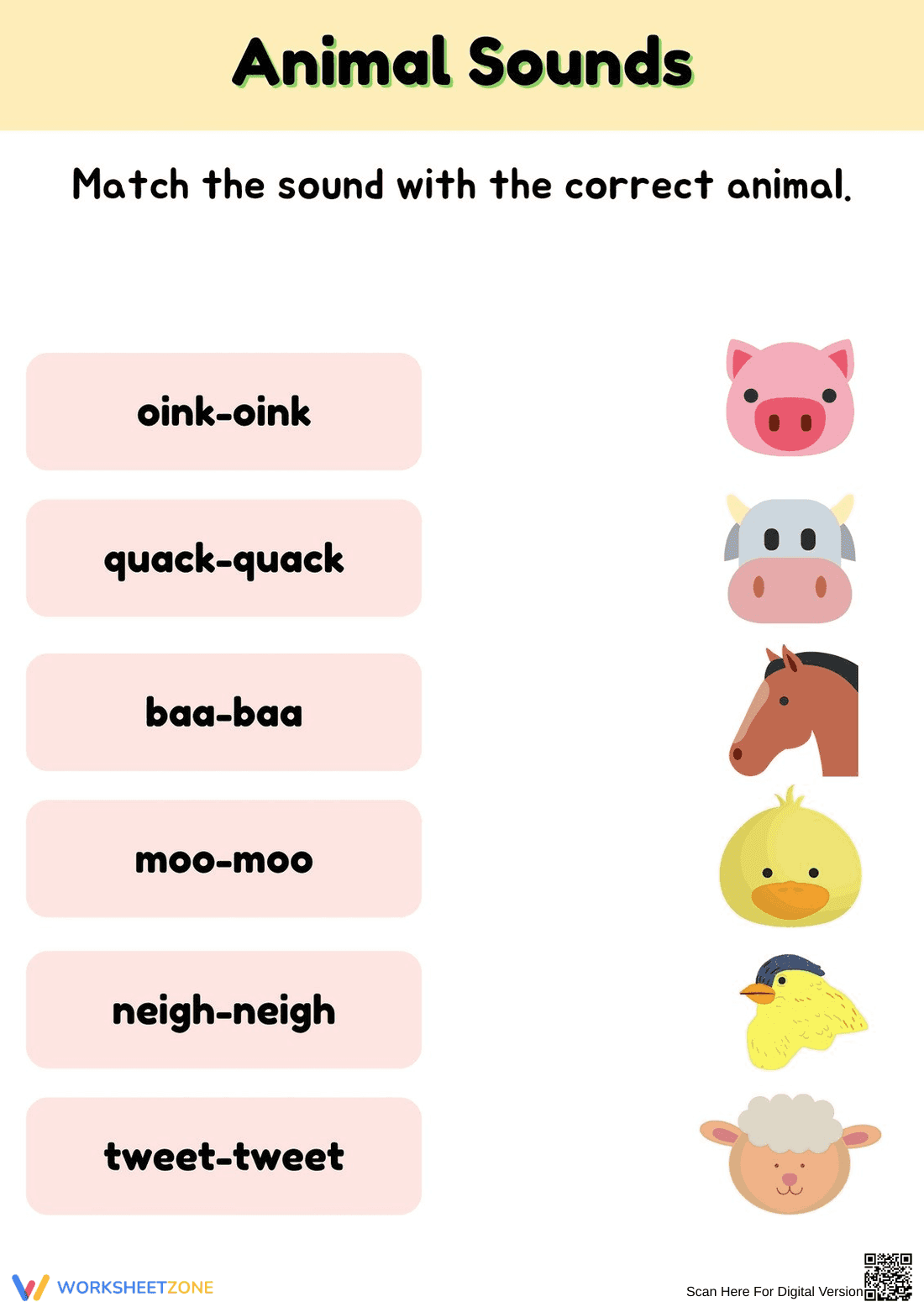

Animal Sounds Matching Worksheet | Essential Grade K Ready
Paste this activity's link or code into your existing LMS (Google Classroom, Canvas, Teams, Schoology, Moodle, etc.).
Students can open and work on the activity right away, with no student login required.
You'll still be able to track student progress and results from your teacher account.
This Grade K animal sounds worksheet helps young learners connect onomatopoeic words with their corresponding animals. By matching sounds like "oink-oink" and "quack-quack" to visual icons, students strengthen their phonological awareness and early literacy skills. It provides a clear, engaging way to master basic vocabulary through direct association and visual cues.
At a Glance
- Grade: K · Subject: ELA
- Standard:
CCSS.ELA-LITERACY.L.K.5.C— Identify real-life connections between words and their use- Skill Focus: Animal sound recognition
- Format: 1 page · 6 problems · Answer key included · PDF
- Best For: Early literacy centers and morning work
- Time: 5–10 minutes
What's Inside: This single-page PDF features six distinct animal icons paired with text boxes containing phonetic animal sounds. The layout is clean and high-contrast, making it accessible for early readers. It includes a full answer key for quick grading and uses recognizable farm and domestic animals to ensure student success during independent practice.
Zero-Prep Workflow:
- Print: Select the single-page PDF and print enough copies for your class (30 seconds).
- Distribute: Hand out the sheets during your morning routine or literacy block (1 minute).
- Review: Use the included answer key to check student work or review as a whole group (1 minute).
Total teacher prep time is under 2 minutes, making this an ideal sub plan or filler activity.
Standards Alignment: The primary standard is CCSS.ELA-LITERACY.L.K.5.C, which requires students to identify real-life connections between words and their use. This worksheet applies that logic to the natural world by connecting auditory descriptions to visual subjects. Both standard codes can be copied directly into lesson plans, IEP goals, or district curriculum mapping tools.
How to Use It: Use this as a formative assessment after a read-aloud about farm animals to gauge vocabulary retention. During the activity, observe if students are sounding out the words or relying solely on the first letter. It typically takes 5 to 10 minutes to complete, making it perfect for transition periods or as a quiet-time activity.
Who It's For: This resource is designed for Kindergarten students, English Language Learners (ELLs), and students with speech-language IEP goals. It pairs naturally with an anchor chart of animal names or a classroom listening center featuring nature recordings to provide a multi-sensory learning experience.
According to the Fisher & Frey (2014) framework for gradual release of responsibility, visual-to-text matching activities serve as a critical bridge for early learners transitioning from oral language to print literacy. This worksheet aligns with CCSS.ELA-LITERACY.L.K.5.C by requiring students to synthesize their real-world knowledge of animal sounds with written onomatopoeia. Research from the NAEP indicates that early exposure to phonological patterns and word-object association significantly predicts later reading fluency and comprehension. By engaging with 6 specific animal-sound pairs, students practice the decoding skills necessary for identifying non-standard word forms. This resource provides a structured environment for this cognitive development, ensuring that students can independently demonstrate mastery of basic environmental vocabulary. The inclusion of an answer key allows for immediate feedback, a practice shown by EdReports 2024 to be essential for reinforcing correct associations in the early childhood classroom.


