


























Views
Plays


Alliteration Practice Worksheet | Grade 2 Essential
Paste this activity's link or code into your existing LMS (Google Classroom, Canvas, Teams, Schoology, Moodle, etc.).
Students can open and work on the activity right away, with no student login required.
You'll still be able to track student progress and results from your teacher account.
This Grade 2 alliteration worksheet provides targeted practice for students learning to identify and apply figurative language. By focusing on repeating initial consonant sounds, students develop a deeper understanding of word choice and phonetic patterns. This resource ensures learners can distinguish between alliterative sentences and other literary devices through structured multiple-choice exercises.
At a Glance
- Grade: 2 · Subject: ELA
- Standard:
CCSS.ELA-LITERACY.RL.2.4— Describe how words and phrases supply rhythm and meaning in a text- Skill Focus: Alliteration identification and completion
- Format: 2 pages · 12 problems · Answer key included · PDF
- Best For: Independent practice and formative assessment
- Time: 15–20 minutes
What's Inside
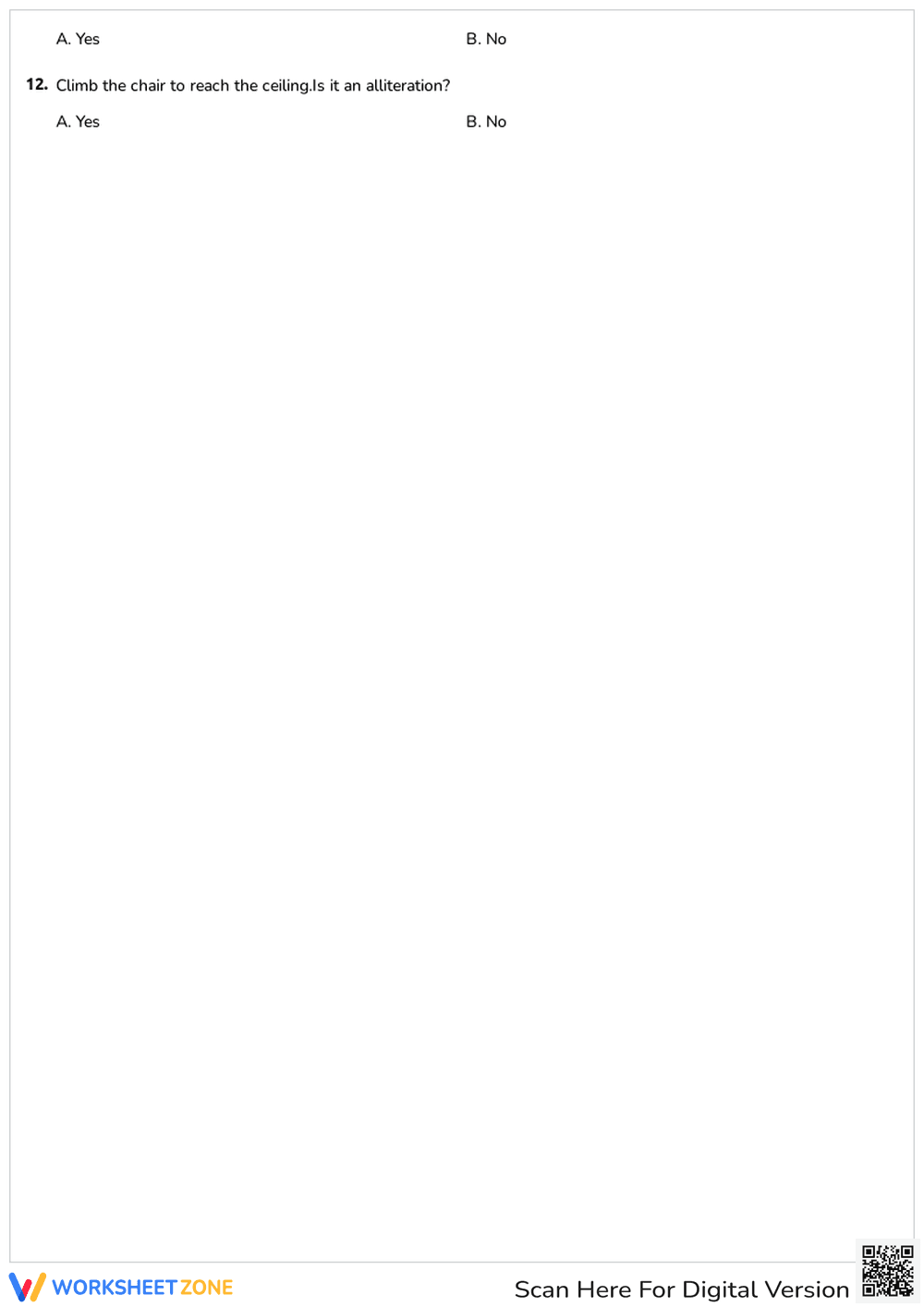
This two-page PDF features 12 carefully crafted multiple-choice questions. The first five questions require students to identify which sentence among four options demonstrates alliteration. The subsequent questions challenge students to complete famous phrases or sentences using the correct alliterative word bank. The clear layout and large font make it accessible for primary learners.
Zero-Prep Workflow
This resource is designed for immediate classroom implementation with a total teacher prep time of under 2 minutes. Simply print the required number of copies and distribute them to students. The worksheet functions perfectly as a last-minute substitute plan or a transition activity between ELA blocks. Reviewing the 12 answers as a whole group takes less than five minutes, providing immediate feedback.
Standards Alignment
The primary focus is `CCSS.ELA-LITERACY.RL.2.4`, which requires students to describe how words and phrases supply rhythm and meaning in a story, poem, or song. It also supports L.2.3 by helping students use knowledge of language and its conventions when reading or listening. These standard codes can be copied directly into lesson plans, IEP goals, or district curriculum mapping tools.
How to Use It
Assign this worksheet during the "You Do" phase of a gradual release lesson on figurative language. It serves as an excellent formative assessment to check if students can distinguish alliteration from rhyming or simple descriptive sentences. For a quick check, have students circle the repeating letters in the correct answers to visualize the phonetic pattern.
Who It's For
This practice set is ideal for general education students in grades 1 through 3, as well as English Language Learners (ELLs) who benefit from seeing phonetic patterns in context. It pairs naturally with an anchor chart on figurative language or a read-aloud of "She Sells Seashells" to reinforce the auditory nature of the skill.
According to Fisher & Frey (2014), the gradual release of responsibility model is most effective when students are provided with clear, scaffolded opportunities to practice specific linguistic skills like alliteration. This worksheet aligns with that research by offering 12 structured tasks that move from simple identification to contextual completion. By focusing on CCSS.ELA-LITERACY.RL.2.4, the resource helps students recognize how repeating initial consonant sounds creates rhythm and emphasizes meaning within a text. This phonetic awareness is a critical precursor to more complex literary analysis in upper elementary grades. Research from the NAEP suggests that early exposure to figurative language devices improves overall reading comprehension and vocabulary acquisition. This worksheet provides the necessary repetition to move these concepts from short-term memory to long-term mastery, ensuring students can confidently identify alliterative patterns in diverse reading materials and their own creative writing.


