


























Views
Downloads
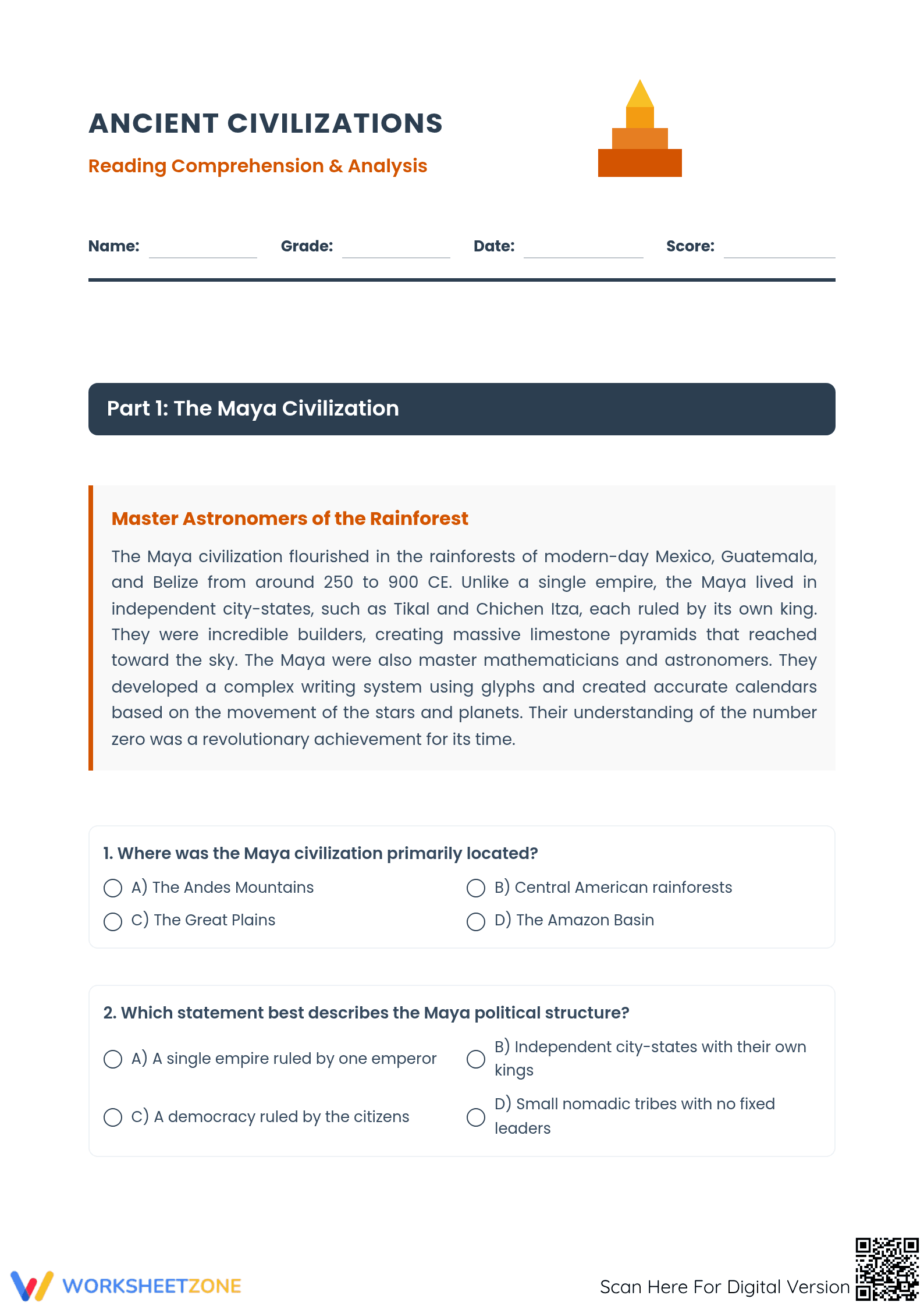
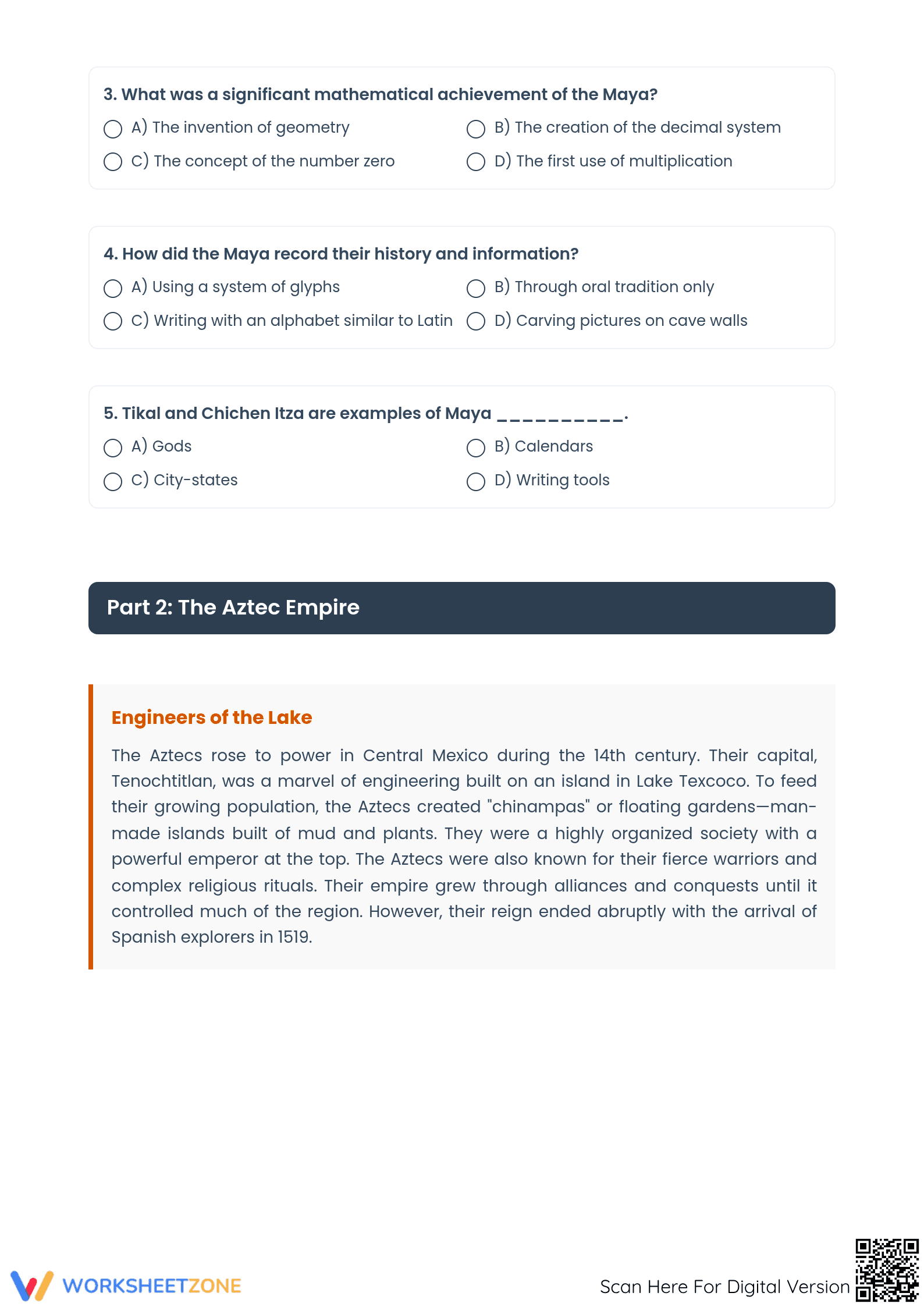
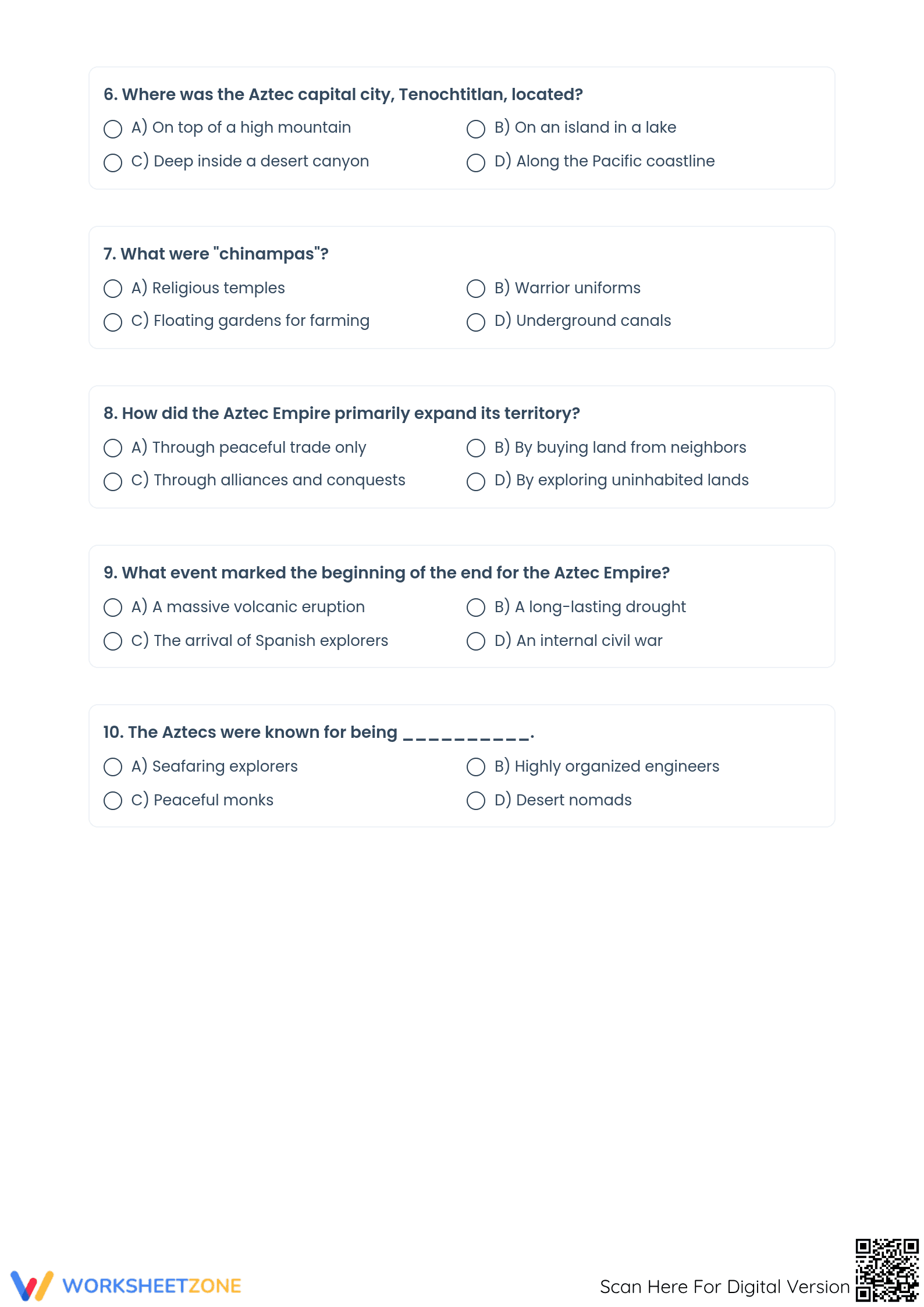
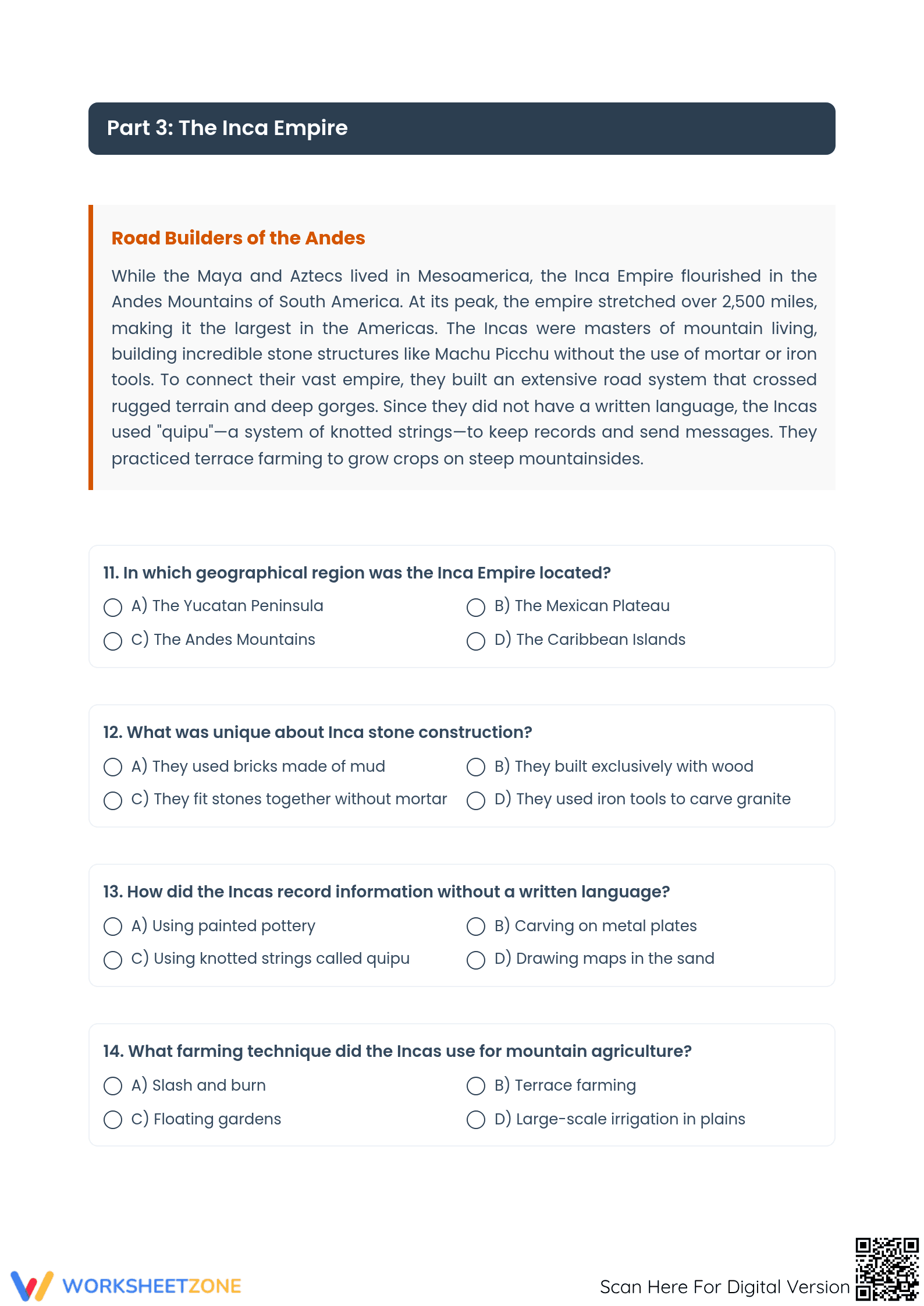

Grade 6 Ancient Civilizations Reading | Essential Worksheet
Paste this activity's link or code into your existing LMS (Google Classroom, Canvas, Teams, Schoology, Moodle, etc.).
Students can open and work on the activity right away, with no student login required.
You'll still be able to track student progress and results from your teacher account.
This Grade 6 reading comprehension worksheet provides a comprehensive analysis of the Maya, Aztec, and Inca civilizations. Students engage with informational texts to identify key historical facts, cultural achievements, and geographical contexts. By completing these 17 structured tasks, learners build the critical analysis skills necessary to synthesize complex historical information from multiple sources.
At a Glance
- Grade: 6 · Subject: ELA
- Standard:
CCSS.ELA-LITERACY.RI.6.1— Cite textual evidence to support analysis of what the text says explicitly.- Skill Focus: Reading Comprehension & Analysis
- Format: 5 pages · 17 problems · Answer key included · PDF
- Best For: Independent practice or social studies integration
- Time: 35–45 minutes
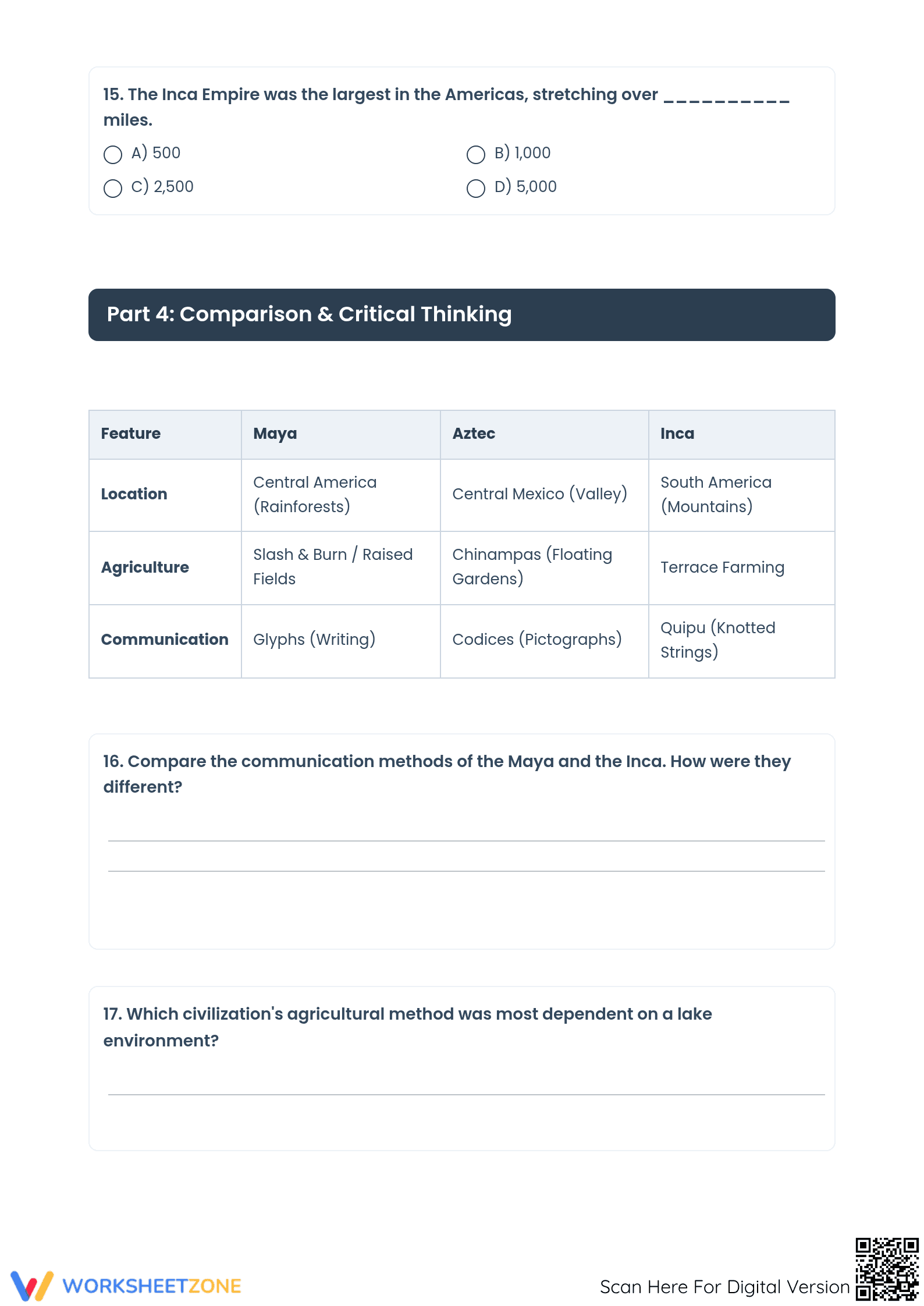
This 5-page packet features three distinct reading passages covering the Maya, Aztec, and Inca empires, followed by a comparison and critical thinking section. It includes 15 multiple-choice questions designed to test factual recall and 2 open-ended comparison tasks. A comparison table is provided to help students organize data before the final analysis. A full answer key is included for rapid grading.
Zero-Prep Workflow
- Print: Select the 5-page PDF and print enough copies for your class (30 seconds).
- Distribute: Hand out the packets as a standalone reading block or a social studies supplement (1 minute).
- Review: Use the included answer key to grade student work or facilitate a whole-class discussion on the comparative table (5 minutes).
Total teacher preparation time is under 2 minutes, making this an ideal sub plan or Friday assessment.
Standards Alignment
The primary focus is `CCSS.ELA-LITERACY.RI.6.1`, which requires students to cite textual evidence to support analysis of what the text says explicitly as well as inferences drawn from the text. The worksheet also supports RI.6.3 by asking students to analyze in detail how a key individual, event, or idea is introduced, illustrated, and elaborated in a text. Both standard codes can be copied directly into lesson plans, IEP goals, or district curriculum mapping tools.
How to Use It
Use this resource during the "Independent Practice" phase of a unit on ancient civilizations or as a summative assessment for informational text standards. For a formative assessment, observe students as they complete the comparison table in Part 4; their ability to correctly categorize features like "Agriculture" and "Communication" indicates mastery of text-based evidence retrieval. Completion typically takes 35 to 45 minutes.
Who It's For
This resource is designed for Grade 6 students but is suitable for Grade 5 enrichment or Grade 7 review. It is particularly effective for students who benefit from structured reading passages with clear headings. Pair this worksheet with a map-labeling activity or an anchor chart on Mesoamerican geography to provide a multi-sensory learning experience.
According to the RAND AIRS 2024 report, high-quality informational text sets that integrate social studies content significantly improve literacy outcomes for middle school students. This worksheet aligns with CCSS.ELA-LITERACY.RI.6.1 by requiring students to extract specific evidence regarding the Maya, Aztec, and Inca empires. By engaging with 17 targeted tasks, students practice the "Cite and Explain" model of reading comprehension, which is a foundational requirement for success in secondary ELA. Research from Fisher & Frey (2014) emphasizes that structured comparison tasks, like the one included in Part 4 of this packet, help students move beyond surface-level reading to deep conceptual understanding. This resource provides the necessary scaffolding to bridge the gap between simple recall and complex historical analysis, ensuring students are prepared for the rigorous demands of state-level assessments and future humanities coursework.


