




























Views
Downloads
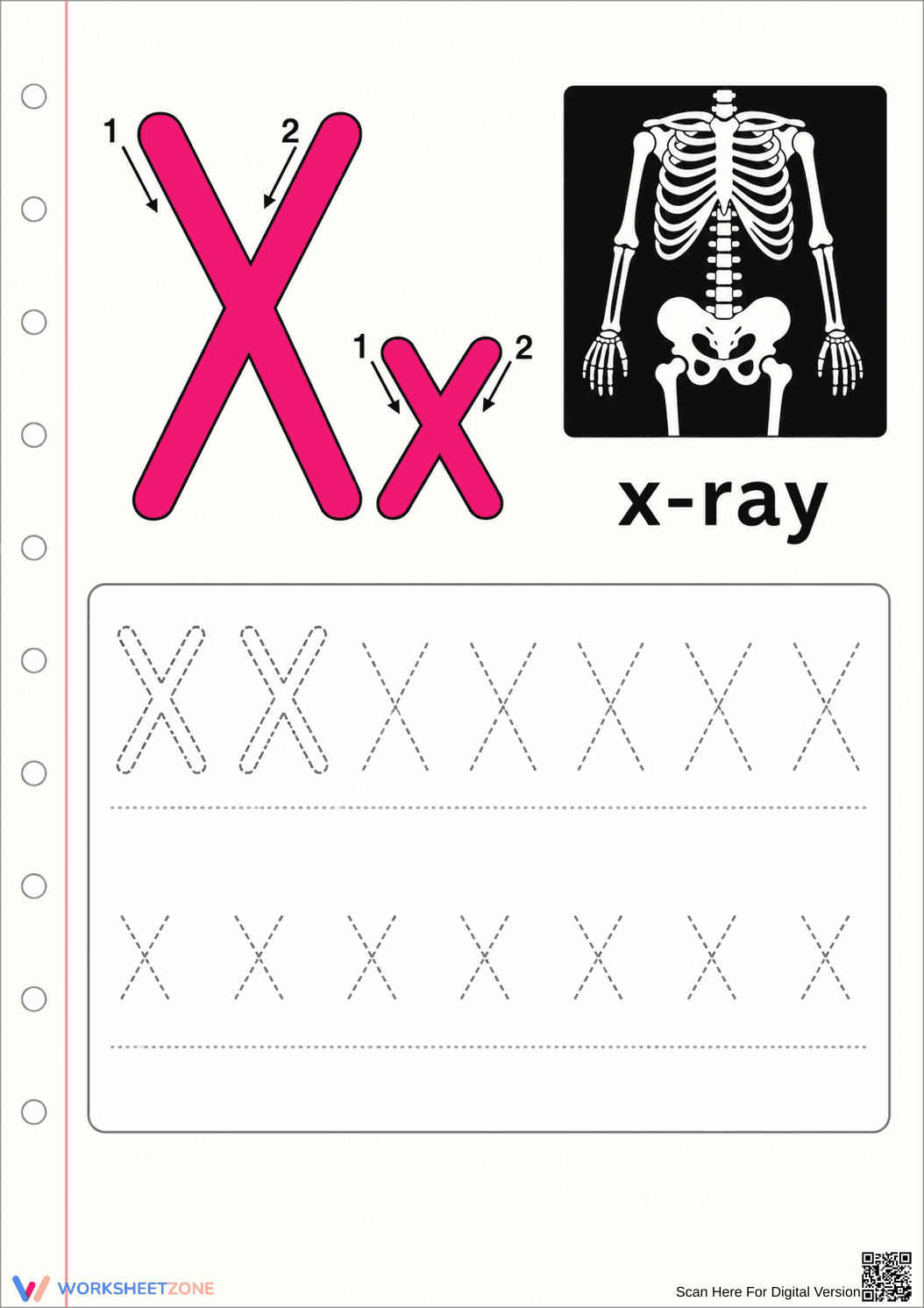

Letter X Tracing Worksheet | Essential Grade K-1 Phonics

Paste this activity's link or code into your existing LMS (Google Classroom, Canvas, Teams, Schoology, Moodle, etc.).
Students can open and work on the activity right away, with no student login required.
You'll still be able to track student progress and results from your teacher account.
This Grade K-1 phonics worksheet provides targeted practice for letter formation and beginning sound recognition. Students engage with the letter X through visual identification and repetitive tracing exercises. By connecting the letter shape to the "x-ray" anchor image, learners build the foundational muscle memory and phonemic awareness necessary for early literacy success.
At a Glance
- Grade: K-1 · Subject: ELA Phonics
- Standard:
CCSS.ELA-LITERACY.L.K.1.A— Print upper- and lowercase letters with proper form and directionality- Skill Focus: Letter X formation and identification
- Format: 1 page · 14 problems · Answer key included · PDF
- Best For: Morning work or initial letter introduction
- Time: 5–10 minutes
This single-page PDF features a large-scale visual guide for both uppercase and lowercase X, complete with numbered directional arrows to ensure correct stroke order. Below the anchor image, students find 14 dashed-line tracing opportunities organized into two rows. The inclusion of the "x-ray" graphic provides a concrete vocabulary link for the beginning sound, aiding in long-term retention.
Skill Progression
- Guided practice: Large-format letters with numbered arrows provide a clear visual roadmap for initial stroke placement and directionality.
- Supported practice: The first row of tracing tasks offers high-density dashed lines to help students maintain consistent letter height and width.
- Independent practice: The second row allows students to refine their fine motor control across seven additional repetitions with minimal visual interference.
This worksheet follows a gradual-release model, moving from heavy visual scaffolding to repetitive independent tracing to ensure mastery.
Standards Alignment
The primary focus is `CCSS.ELA-LITERACY.L.K.1.A`, which requires students to print many upper- and lowercase letters. It also supports `CCSS.ELA-LITERACY.RF.K.1.D` by reinforcing the recognition of specific letter shapes. Both standard codes can be copied directly into lesson plans, IEP goals, or district curriculum mapping tools.
How to Use It
Use this worksheet during the "You Do" phase of a phonics lesson after demonstrating the letter strokes on a whiteboard. It serves as an excellent formative assessment tool; teachers can observe grip and stroke directionality in real-time. Expected completion time ranges from 5 to 10 minutes depending on student fine motor development.
Who It's For
This resource is designed for kindergarteners and first graders beginning their handwriting journey. It is particularly helpful for students requiring fine motor intervention or English Language Learners needing visual vocabulary support. Pair this with a physical alphabet tray or a letter X anchor chart to reinforce the phonics connection.
According to the RAND AIRS 2024 report on early childhood literacy, repetitive tracing exercises are fundamental in developing the graphomotor skills required for fluent writing. This worksheet targets CCSS.ELA-LITERACY.L.K.1.A by providing 14 distinct opportunities for students to practice the specific diagonal strokes of the letter X. By integrating a visual anchor like an x-ray, the resource bridges the gap between abstract letter shapes and concrete phonemic sounds. Research from Fisher & Frey (2014) emphasizes that such guided practice is essential for moving students toward independent mastery of the alphabet. This printable PDF is structured to support the instructional framework, ensuring that young learners receive the necessary scaffolding before being asked to produce letters without guides. It is a reliable tool for early elementary educators seeking to build foundational literacy skills through structured, repeatable practice.


