


























Views
Downloads

Letter P Tracing Worksheet | Essential Grade K Handwriting
Paste this activity's link or code into your existing LMS (Google Classroom, Canvas, Teams, Schoology, Moodle, etc.).
Students can open and work on the activity right away, with no student login required.
You'll still be able to track student progress and results from your teacher account.
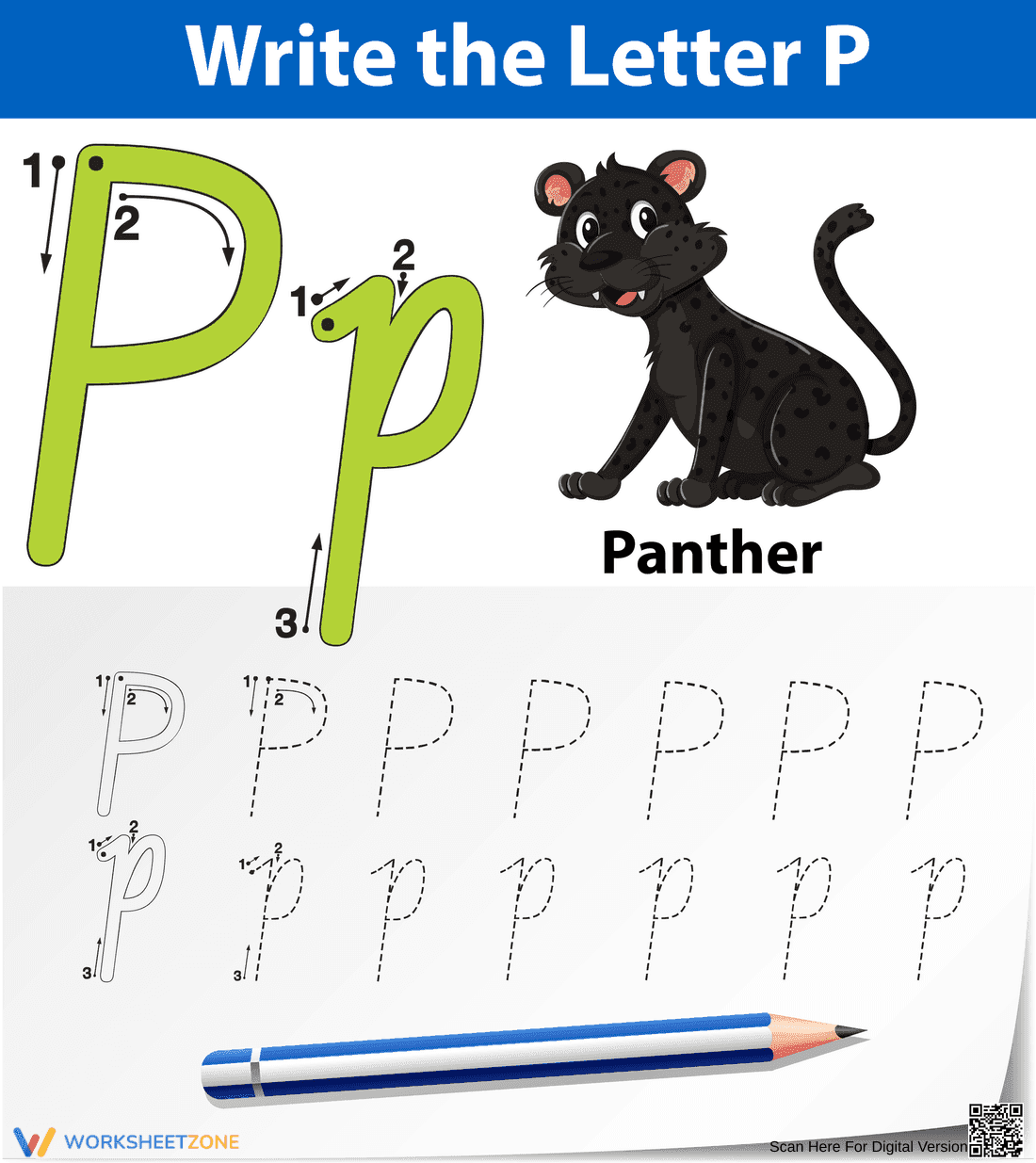
Mastering the letter P is a vital step in early literacy development. This printable worksheet provides students with a structured environment to practice forming both uppercase and lowercase P. By following guided stroke arrows, learners build the muscle memory needed for neat handwriting and letter recognition. This resource ensures students achieve mastery through repetitive, high-quality practice.
At a Glance
- Grade: Kindergarten · Subject: Handwriting
- Standard:
CCSS.ELA-LITERACY.L.K.1.A— Print many upper- and lowercase letters accurately and legibly- Skill Focus: Letter P formation
- Format: 1 page · 14 problems · Answer key included · PDF
- Best For: Independent morning work and literacy centers
- Time: 5–10 minutes
This single-page PDF features a clear, engaging layout designed for young learners. It includes two large guided examples with numbered stroke directions to introduce the letter P. Below, students find 14 tracing tasks—7 for uppercase and 7 for lowercase—using dashed lines to support independent practice. A friendly panther illustration serves as a mnemonic device to reinforce the letter's sound.
The zero-prep design allows teachers to integrate this into their daily routine in under 2 minutes. First, print the required number of copies for your class. Second, distribute the sheets during morning work or as a transition activity; the intuitive layout requires minimal verbal instruction. Finally, review student work by checking for proper stroke order and line alignment to provide immediate formative feedback.
This resource is specifically aligned to CCSS.ELA-LITERACY.L.K.1.A, which requires students to print many upper- and lowercase letters. It also supports fine motor development and phonemic awareness by connecting the letter P to the "Panther" keyword. Both standard codes can be copied directly into lesson plans, IEP goals, or district curriculum mapping tools.
Use this worksheet during the "You Do" phase of a gradual release lesson on the alphabet. It is also an excellent choice for a quiet literacy center or as a quick assessment tool to gauge fine motor readiness. Observe students as they work to ensure they are starting their strokes at the top, as indicated by the numbered guides.
This activity is designed for preschool and kindergarten students who are beginning their handwriting journey. It is also suitable for first-grade students needing remedial support or occupational therapy practice. Pair this worksheet with a letter P anchor chart or a phonics song to create a comprehensive multi-sensory learning experience.
According to the RAND AIRS 2024 report on early literacy, the tactile process of letter formation is a foundational predictor of later reading fluency and orthographic mapping. This worksheet targets CCSS.ELA-LITERACY.L.K.1.A by providing explicit directional cues for the letter P, ensuring students internalize the correct stroke sequence rather than just copying a shape. Research indicates that repetitive tracing with guided arrows reduces cognitive load for novice writers, allowing them to focus on the phoneme-grapheme connection. By integrating a visual anchor like the "Panther," the resource leverages dual-coding theory to strengthen memory retrieval. Consistent practice with both uppercase and lowercase variants helps preschoolers and kindergarteners develop the fine motor control necessary for legible handwriting. This structured approach to alphabet instruction ensures that students meet early language standards while building the physical stamina required for more complex writing tasks in subsequent primary grades.


