


























Views
Plays
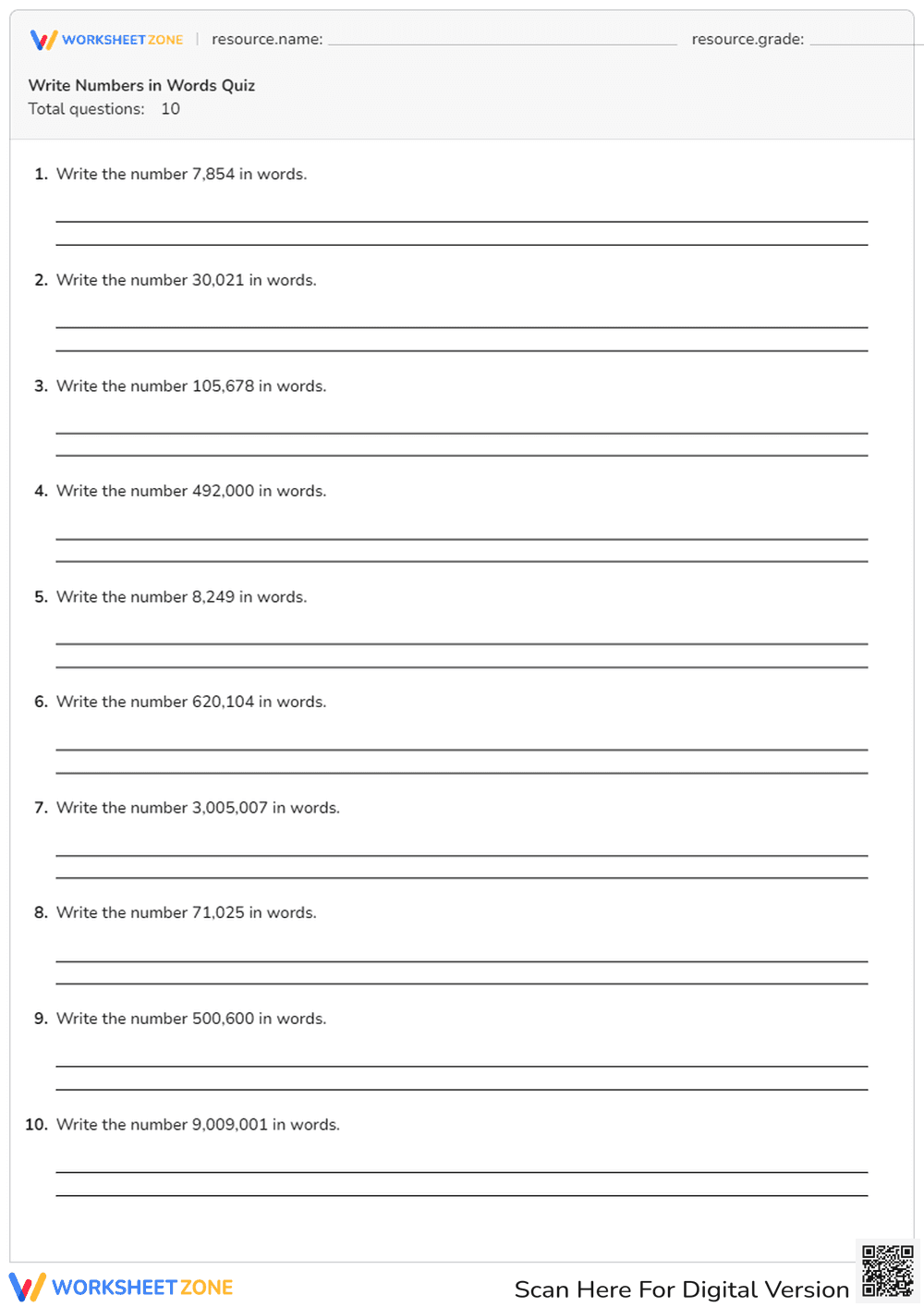

Write Numbers in Words Quiz | Essential Grade 4 Math
Paste this activity's link or code into your existing LMS (Google Classroom, Canvas, Teams, Schoology, Moodle, etc.).
Students can open and work on the activity right away, with no student login required.
You'll still be able to track student progress and results from your teacher account.
This Grade 4 math worksheet provides targeted practice for students learning to translate multi-digit numbers from standard form into written word form. By focusing on the linguistic representation of numerical values, students strengthen their understanding of place value and mathematical literacy. This resource ensures students can accurately communicate large values up to the millions place.
At a Glance
- Grade: 4 · Subject: Math
- Standard:
CCSS.MATH.CONTENT.4.NBT.A.2— Read and write multi-digit whole numbers using number names- Skill Focus: Standard to Word Form Conversion
- Format: 1 page · 10 problems · Answer key included · PDF
- Best For: Formative assessment and quick skills check
- Time: 15–20 minutes
This single-page PDF features 10 distinct multi-digit numbers ranging from four digits to seven digits. Each problem provides a clear prompt and a generous writing line for students to record their written expressions. The layout is clean and distraction-free, making it ideal for students who require clear visual organization. A comprehensive answer key is provided to facilitate rapid grading or student self-correction.
The zero-prep workflow for this resource is designed for maximum efficiency in busy classrooms. First, print the single-page PDF (30 seconds). Next, distribute the worksheet to students as a bell-ringer or exit ticket (1 minute). Finally, review the answers using the included key to identify common spelling or place-value errors (1 minute). Total teacher preparation time is under two minutes, making it an excellent option for substitute folders.
The primary focus is `CCSS.MATH.CONTENT.4.NBT.A.2`: "Read and write multi-digit whole numbers using base-ten numerals, number names, and expanded form." This worksheet specifically targets the number names component of the standard. By requiring students to write out numbers like 9,009,001, it reinforces the role of zero as a placeholder. Both standard codes can be copied directly into lesson plans, IEP goals, or district curriculum mapping tools.
Use this worksheet as a formative assessment after a lesson on place value periods (thousands, millions). Observe students as they work; if a student struggles with the and placement or hyphenation (e.g., seventy-one), provide immediate corrective feedback. It also serves as a quiet independent practice activity during math rotations. Expected completion time is 15 to 20 minutes depending on writing speed.
This resource is primarily designed for 4th-grade students mastering multi-digit numbers, though it is highly effective for 5th-grade review or 3rd-grade enrichment. It is particularly useful for English Language Learners (ELLs) who need to bridge the gap between numerical symbols and English vocabulary. Pair this with a place value anchor chart or a Say It, Write It direct instruction lesson for best results.
According to the RAND AIRS 2024 report on mathematical literacy, the ability to fluently transition between different representations of numbers—such as standard form and number names—is a critical predictor of success in later algebraic thinking. This worksheet directly addresses the linguistic demands of CCSS.MATH.CONTENT.4.NBT.A.2 by requiring students to synthesize their knowledge of place value with formal writing conventions. Research by Fisher & Frey (2014) emphasizes that scaffolded practice in mathematical nomenclature helps students internalize the base-ten system's structure. By engaging with 10 varied problems, students move beyond rote memorization toward a conceptual understanding of how large numbers are constructed and communicated. This resource provides the necessary repetition to ensure that students can accurately name values up to the millions period, a foundational skill identified by NAEP as essential for middle-school readiness.


