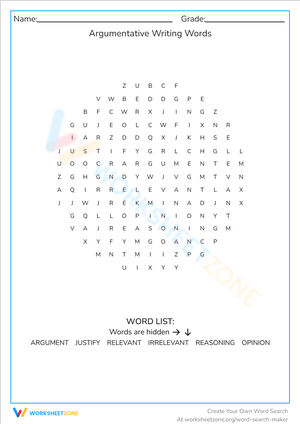
the intended readers of specific types of texts : audience. the reason for writing; what the writer hopes to accomplish: purpose. words or phrases that connect ideas, details, or events in writing: transitions. academic writing that shows care and appropriate language: formal style. closely connected or appropriate to what is being done, said, or considered : relevant. able to be believed : credible. state or assert that something is the case : claim. giving credit to the authors of source information: citation. a sentence, in the introduction of an essay, that states the writer’s position or opinion on the topic of the essay: thesis statement. the opening paragraph of an essay, which must get the reader’s attention and indicate the topic: introduction. occurs at the end of an argumentative text to make clear what the writer or speaker wants the audience to think or do: call to action. a paragraph that contains a topic sentence, supporting details and commentary, and a concluding sentence and that is usually part of a longer text: body paragraph. an important topic or problem for debate or discussion: issue. a sentence that states the main idea of a paragraph; in an essay, it also makes a point that supports the thesis statement: topic sentence. the ending of a paragraph or essay, which brings it to a close and leaves an impression with the reader : conclusion. facts or reasoning offered to support a position as being true : argument












 Interactive Worksheet Maker
 Quiz Maker
 Word Search Maker
 Crossword Puzzle Maker
 Word Scramble Generator
 Sentence Scramble Generator
 Handwriting Worksheet Generator
 Name Tracing Generator
 Fill In The Blank Generator