


























Views
Plays

Argumentative Essay Structure Worksheet | Grade 4 Ready
Paste this activity's link or code into your existing LMS (Google Classroom, Canvas, Teams, Schoology, Moodle, etc.).
Students can open and work on the activity right away, with no student login required.
You'll still be able to track student progress and results from your teacher account.
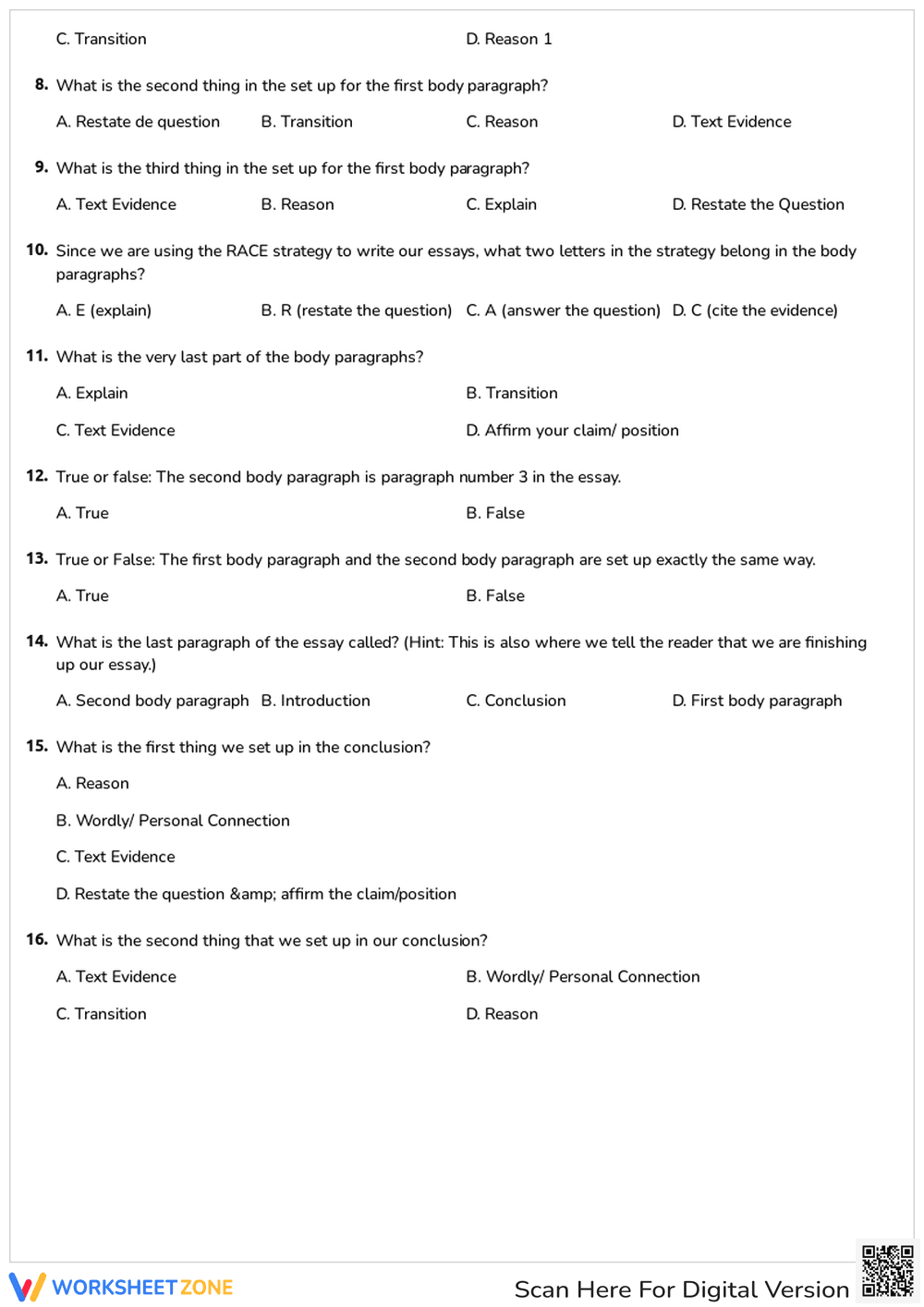
This Grade 4 argumentative essay worksheet helps students master the structural components of persuasive writing. By identifying the specific roles of introductions, body paragraphs, and conclusions, learners build a mental map for successful composition. It provides immediate practice in recognizing the RACE strategy and logical flow required for high-quality academic writing.
At a Glance
- Grade: 4 · Subject: ELA Writing
- Standard:
CCSS.ELA-LITERACY.W.4.1— Write opinion pieces supporting a point of view with reasons and information- Skill Focus: Argumentative Essay Structure
- Format: 2 pages · 16 problems · Answer key included · PDF
- Best For: Writing centers and formative assessment
- Time: 15–20 minutes
What's Inside
This 2-page PDF features 16 multiple-choice questions designed to test a student's knowledge of essay anatomy. The worksheet covers the specific sequence of an introduction (hook, restate, claim), the internal logic of body paragraphs (transitions, reasons, evidence), and the finality of a conclusion. It specifically references the RACE strategy to reinforce classroom writing frameworks and ensure students understand how to cite and explain evidence.
Zero-Prep Workflow
- Print: Generate copies of the 2-page document in less than 1 minute.
- Distribute: Hand out to students during the independent practice phase of your writing block.
- Review: Use the included answer key to grade or conduct a 5-minute whole-class review to clear up misconceptions.
This streamlined process makes the worksheet an ideal choice for emergency sub plans or quick checks for understanding during a busy writing unit.
Standards Alignment
The primary focus is `CCSS.ELA-LITERACY.W.4.1`, which requires students to organize their writing into a clear structure that supports a claim. This worksheet ensures students understand the organizational logic behind paragraph placement before they begin the drafting process. Both standard codes can be copied directly into lesson plans, IEP goals, or district curriculum mapping tools.
How to Use It
Use this worksheet as a pre-assessment before starting a persuasive writing unit to gauge prior knowledge of essay parts. Alternatively, assign it as a formative assessment after teaching the RACE strategy to ensure students can identify where "Cite" and "Explain" belong in a body paragraph. Completion typically takes 15 to 20 minutes depending on student familiarity with the terminology.
Who It's For
This resource is tailored for Grade 4 students but serves as an excellent review for Grade 5 or a challenge for Grade 3. It is particularly helpful for visual learners who benefit from seeing writing broken down into discrete, manageable steps. Pair this with a graphic organizer or an anchor chart for maximum instructional impact during direct instruction.
Understanding the structural requirements of an argumentative essay is a foundational literacy skill that directly impacts a student's ability to communicate complex ideas. According to Fisher & Frey (2014), explicit instruction in text structure and the gradual release of responsibility are critical for developing proficient writers. This worksheet facilitates that process by isolating the organizational components of writing, allowing students to master the "skeleton" of an essay before adding their own unique content. By focusing on the CCSS.ELA-LITERACY.W.4.1 standard, the resource ensures that learners are meeting national benchmarks for opinion writing. Research from the NAEP suggests that students who can identify and apply organizational frameworks like the RACE strategy consistently outperform peers in writing clarity and logical progression. This 16-question assessment provides the necessary repetition to move these structural concepts from short-term memory into long-term mastery, preparing students for more rigorous middle-school writing demands.


