


























Views
Plays

Printable Compare and Contrast Sources Grade 4 Worksheet
Paste this activity's link or code into your existing LMS (Google Classroom, Canvas, Teams, Schoology, Moodle, etc.).
Students can open and work on the activity right away, with no student login required.
You'll still be able to track student progress and results from your teacher account.
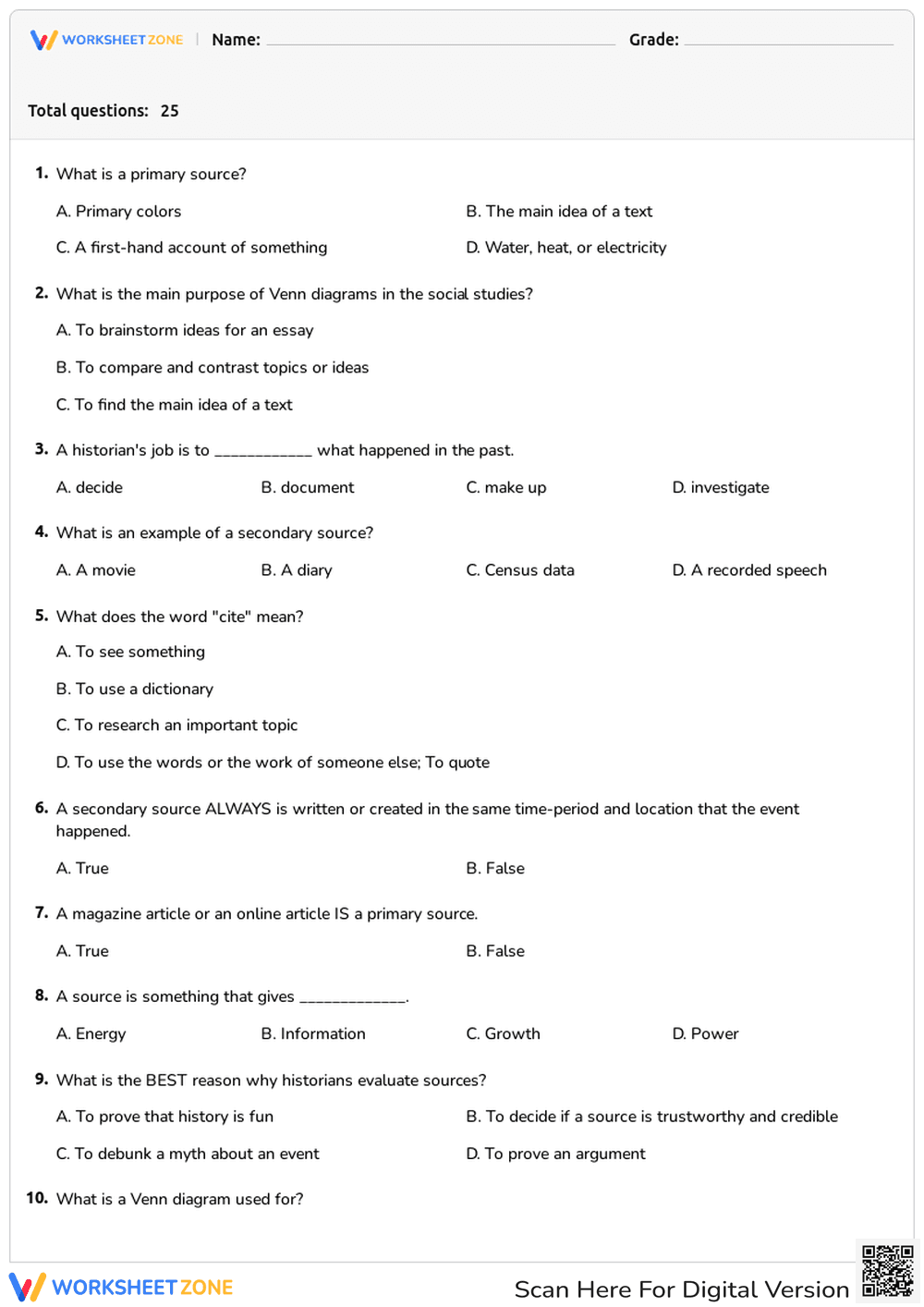
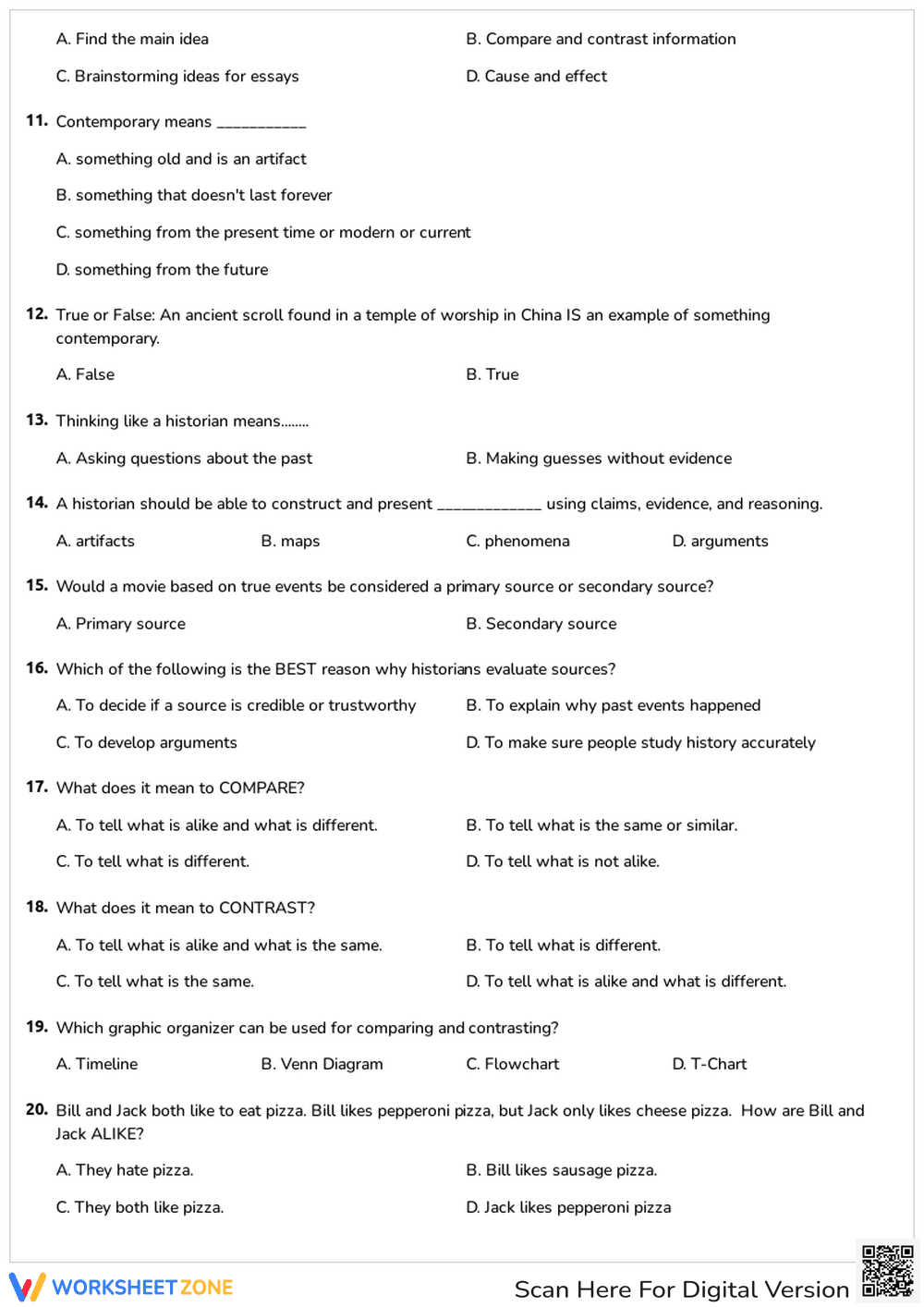
This Grade 4 reading comprehension worksheet helps students master comparing and contrasting firsthand and secondhand accounts. By evaluating primary and secondary sources, learners build critical thinking skills essential for historical analysis. The multiple-choice format provides immediate feedback on their understanding of these key concepts.
At a Glance
- Grade: 4 · Subject: ELA
- Standard:
CCSS.ELA-LITERACY.RI.4.6— Compare firsthand and secondhand accounts of an event- Skill Focus: Comparing and Contrasting Sources
- Format: 3 pages · 25 problems · Answer key included · PDF
- Best For: Formative assessment or sub plans
- Time: 20–30 minutes
What's Inside
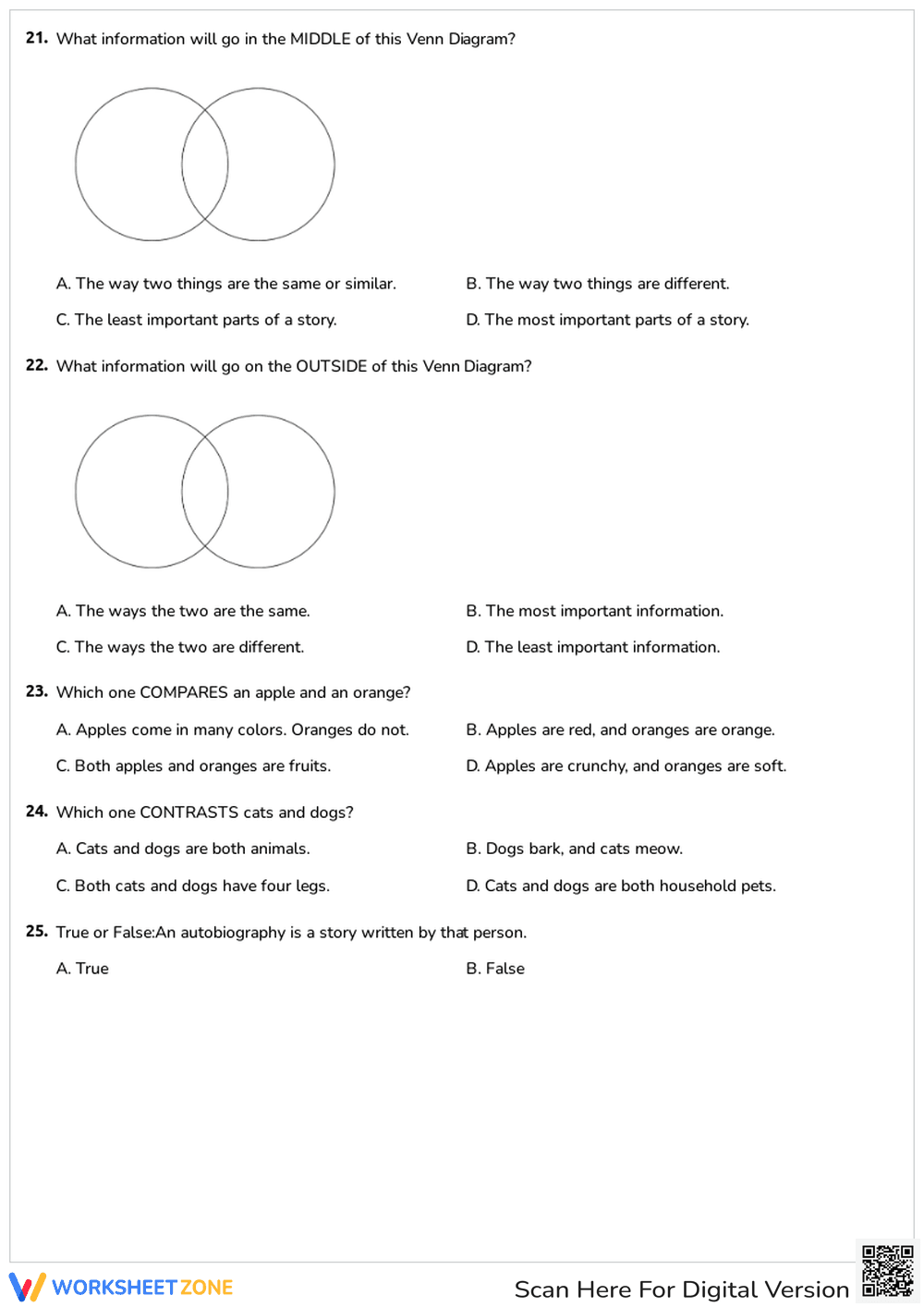
Inside this resource, educators will find a 25-question multiple-choice assessment spanning three pages. Task types range from defining vocabulary like "primary source" to applying knowledge of Venn diagrams for comparing specific scenarios. A complete answer key is included to ensure fast, objective grading for busy teachers.
Zero-Prep Workflow
- Print (1 minute): Simply print the three-page PDF assessment for each student.
- Distribute (1 minute): Hand out the worksheets at the start of your reading or social studies block.
- Review (3 minutes): Use the provided answer key to quickly grade or conduct a whole-class review.
Total teacher prep time is under two minutes. Because the instructions are completely self-explanatory, this worksheet is highly suitable for emergency sub plans or independent practice stations.
Standards Alignment
This resource is strictly aligned to CCSS.ELA-LITERACY.RI.4.6: Compare and contrast a firsthand and secondhand account of the same event or topic; describe the differences in focus and the information provided. It also supports general reading comprehension strategies for informational texts. Both standard codes can be copied directly into lesson plans, IEP goals, or district curriculum mapping tools.
How to Use It
This worksheet is highly versatile for various instructional moments. Use it after direct instruction on primary and secondary sources as a summative quiz to measure retention. Alternatively, assign it during independent work time while you pull small groups. As a formative assessment observation tip, watch how students approach the Venn diagram application questions (numbers 21-24) to see if they truly grasp where similarities and differences are recorded. Expected completion time is 20 to 30 minutes.
Who It's For
This resource is designed for Grade 4 students, though it serves as an excellent review for Grade 5 learners or a challenge for advanced Grade 3 students. For differentiation, teachers can read the questions aloud to students with accommodations or reduce the number of answer choices. It pairs perfectly with an anchor chart on firsthand versus secondhand accounts or a direct instruction lesson on historical research.
Mastering the ability to evaluate different types of texts is a foundational skill for literacy and critical thinking. According to a recent EdReports 2024 analysis, students who regularly practice distinguishing between primary and secondary sources demonstrate significantly higher proficiency in informational text comprehension and cross-curricular application. This aligns directly with CCSS.ELA-LITERACY.RI.4.6, which requires students to compare firsthand and secondhand accounts of an event. By engaging with these 25 targeted multiple-choice questions, learners not only memorize essential definitions but also apply their knowledge to practical examples using graphic organizers like Venn diagrams. Explicit instruction and repeated practice in comparing and contrasting sources ensure that students can critically evaluate the information they consume. This structured approach builds a crucial competency for future academic success across all core subjects, fostering independent analytical skills.


