


























Views
Plays


Grade 7 Argumentative Writing — Printable No-Prep Worksheet
Paste this activity's link or code into your existing LMS (Google Classroom, Canvas, Teams, Schoology, Moodle, etc.).
Students can open and work on the activity right away, with no student login required.
You'll still be able to track student progress and results from your teacher account.
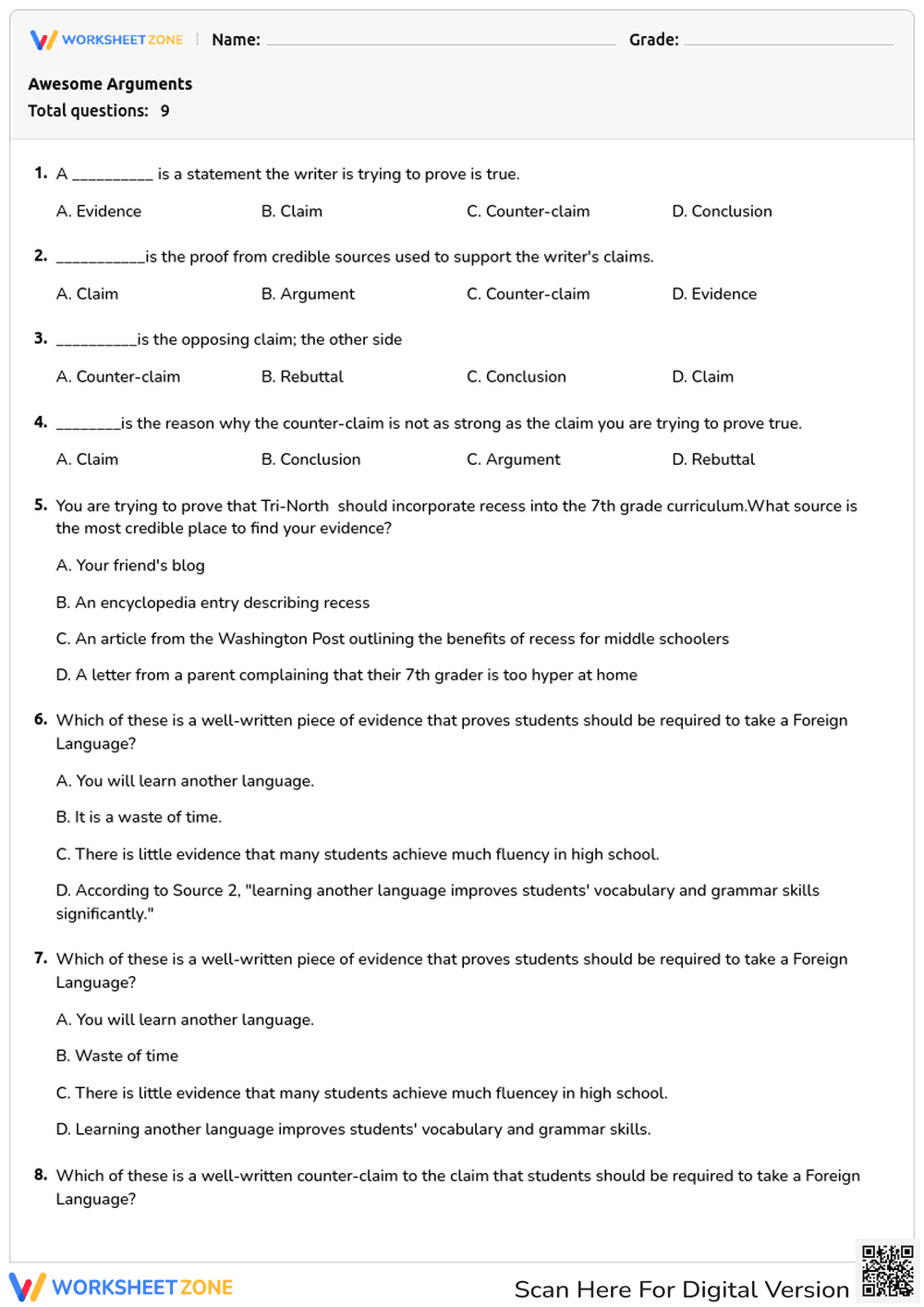
This Grade 7 ELA worksheet helps students master foundational argumentative writing concepts before drafting essays. By identifying claims, evidence, counter-claims, and rebuttals in a multiple-choice format, learners build the vocabulary needed to construct strong arguments and evaluate credible sources.
At a Glance
- Grade: 7 · Subject: ELA
- Standard:
CCSS.ELA-LITERACY.W.7.1— Write arguments to support claims with clear reasons and evidence.- Skill Focus: Argumentative writing concepts
- Format: 2 pages · 9 problems · Answer key included · PDF
- Best For: Formative assessment and review
- Time: 15–20 minutes
Inside this printable resource, educators will find a two-page quiz featuring nine multiple-choice questions. Tasks require students to define terms like claim and rebuttal, select credible sources, and identify well-written evidence. A complete answer key is included to ensure fast grading.
Zero-Prep Workflow
This resource is designed for immediate classroom implementation with minimal teacher setup:
- Print (1 minute): Download the PDF and print double-sided to save paper. The clean layout requires no special formatting.
- Distribute (1 minute): Hand out the quiz as a quick bell-ringer or end-of-lesson check for understanding.
- Review (3 minutes): Use the included answer key to grade submissions rapidly or project it for a whole-class peer-review session.
With under two minutes of total prep time, this worksheet is an excellent addition to any emergency sub plan folder.
Standards Alignment
This worksheet is directly aligned to CCSS.ELA-LITERACY.W.7.1, which requires students to write arguments to support claims with clear reasons and relevant evidence. By testing their ability to distinguish between claims, counter-claims, and credible evidence, the activity reinforces the structural knowledge necessary for standard mastery. Both standard codes can be copied directly into lesson plans, IEP goals, or district curriculum mapping tools.
How to Use It
Deploy this worksheet before beginning a major argumentative essay unit to establish baseline vocabulary, or use it during the drafting phase as a quick formative assessment. As students work through the nine questions, observe whether they struggle to differentiate between a counter-claim and a rebuttal, as this often indicates a need for targeted mini-lessons. The entire activity has an expected completion time range of 15 to 20 minutes, making it perfect for a focused warm-up or exit ticket.
Who It's For
This resource is primarily designed for 7th-grade ELA students, though it serves as an excellent review for 8th graders needing a refresher on essay structure. For students requiring accommodations, the multiple-choice format reduces writing fatigue while still rigorously testing conceptual knowledge. Pair this quiz with a direct instruction lesson on evaluating source credibility or an anchor chart detailing the components of a strong argument.
Mastering the structural components of an argument is a critical prerequisite for advanced middle school writing. Aligned with CCSS.ELA-LITERACY.W.7.1, this resource ensures students can write arguments to support claims with clear reasons and evidence by first learning to identify these elements in isolation. According to Fisher & Frey (2014), providing students with clear, structured opportunities to interact with academic vocabulary significantly improves their ability to apply those concepts in independent writing tasks. By breaking down complex ideas like counter-claims and objective points of view into manageable, multiple-choice questions, educators can accurately gauge comprehension and address misconceptions early. This targeted practice builds the cognitive framework necessary for students to transition from recognizing strong arguments to constructing their own well-reasoned, evidence-based essays across various academic disciplines.


