Worksheets
Lesson Plans
Coloring Pages
Home
Activity:
Topic:
CCSS:
A __________ is a statement the writer is trying to prove is true. : Claim. ___________is the proof from credible sources used to support the writer's claims. : Evidence. __________is the opposing claim; the other side: . An argumentative essay should be written in __________point of view: third person objective
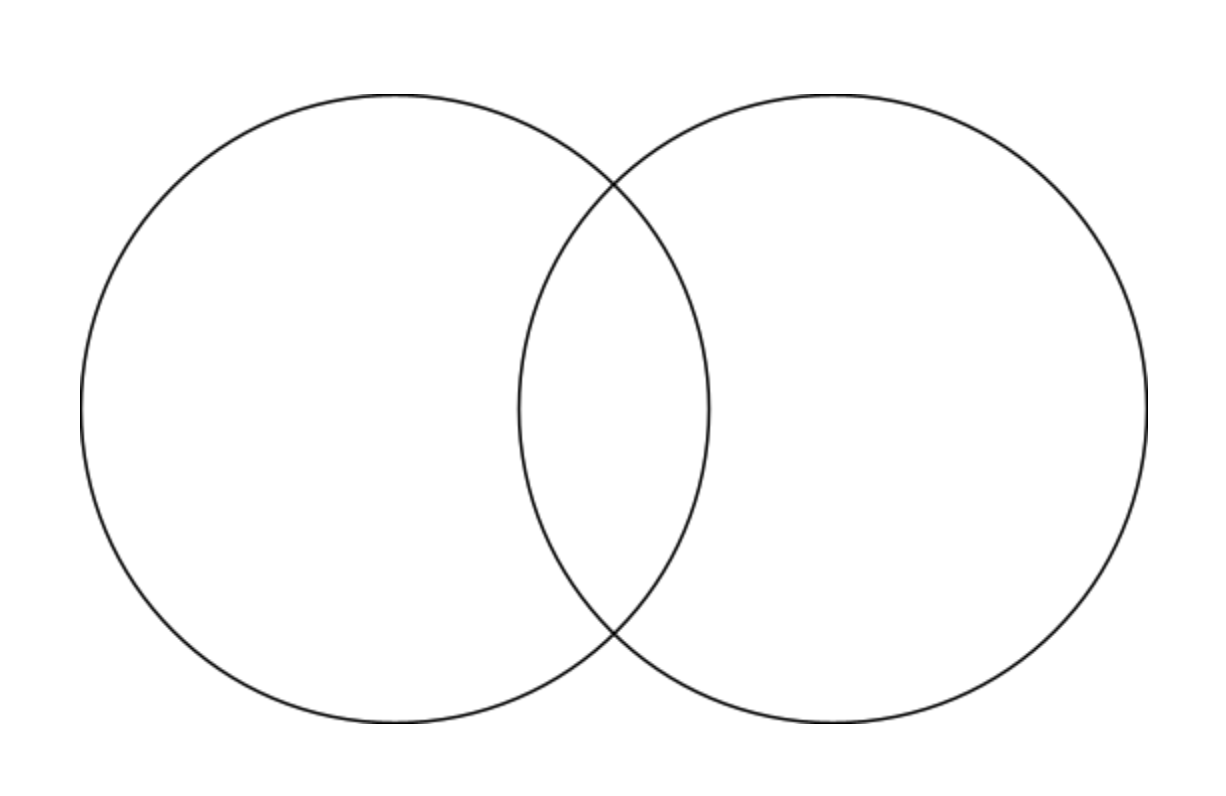
What is a primary source: . What is the main purpose of Venn diagrams in the social studies: To compare and contrast topics or ideas. A historian's job is to ____________ what happened in the past: investigate. What is an example of a secondary source: A movie. What does the word "cite" mean: To use the words or the work of someone else; To quote. A magazine article or an online article IS a primary source: False. A source is something that gives _____________: Information. What is the BEST reason why historians evaluate sources: To decide if a source is trustworthy and credible. What is a Venn diagram used for: Compare and contrast information. Contemporary means ___________: something from the present time or modern or current. True or False: An ancient scroll found in a temple of worship in China IS an example of something contemporary: False. Thinking like a historian means.......: Asking questions about the past. A historian should be able to construct and present _____________ using claims, evidence, and reasoning: arguments. Would a movie based on true events be considered a primary source or secondary source: Secondary source. Which of the following is the BEST reason why historians evaluate sources: To decide if a source is credible or trustworthy. What does it mean to COMPARE: To tell what is the same or similar.. What does it mean to CONTRAST: To tell what is different.. Which graphic organizer can be used for comparing and contrasting: Venn Diagram. Bill and Jack both like to eat pizza. Bill likes pepperoni pizza, but Jack only likes cheese pizza. How are Bill and Jack ALIKE: They both like pizza.. What information will go in the MIDDLE of this Venn Diagram: The way two things are the same or similar. . What information will go on the OUTSIDE of this Venn Diagram: The ways the two are different. . Which one COMPARES an apple and an orange: Both apples and oranges are fruits. . Which one CONTRASTS cats and dogs: Dogs bark, and cats meow. . True or False:An autobiography is a story written by that person. : True
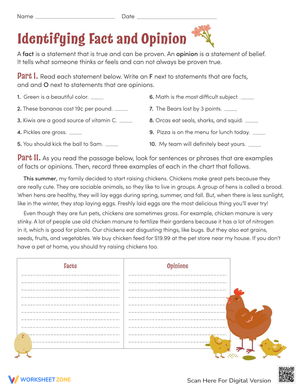
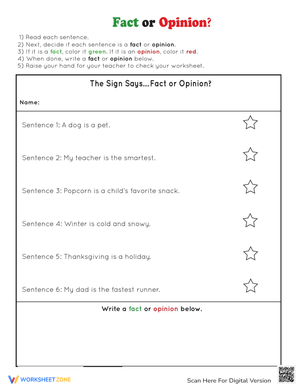
Improve critical thinking skills with this worksheet focused on Identifying Fact and Opinion. Perfect for students! Start learning today! #FactAndOpinion
a preference that prevents one from being impartial; prejudice: bias. Verbal exchange between people with opposite views: Argument. Make reference to; to quote: Cite. A statement that can be proven: Fact. The reason the author created the writing: Author's Purpose. Writing at the beginning of a selection that tells you what will come: Introduction. An opinion you form after thinking about multiple things. Also, an ending or result: Conclusion. A personal judgment that someone thinks is true, but that may be true or false: Opinion. To talk someone into doing or believing something; convince: Persuade. A restatement of a passage or text in somewhat different words so as to simplify or clarify: Paraphrasing. Related to or connected with the present matter; pertinent: Relevant. Sentences in a paragraph or piece of text that explains or supports the main idea of the text: Supporting Details. Believable or plausible: Credible. A problem or disagreement between people, society, or nature: Conflict. Any person, place, or thing by which something is supplied: Source. A reason or plan that guides an action; design or goal: Purpose. Anything that can be used to prove something: Evidence
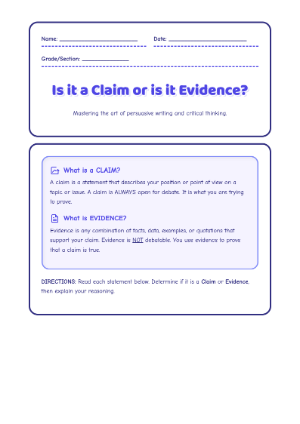
Learn how to support claims with evidence. This Claim and Evidence worksheet enhances critical thinking. Download now for improved argumentation skills!
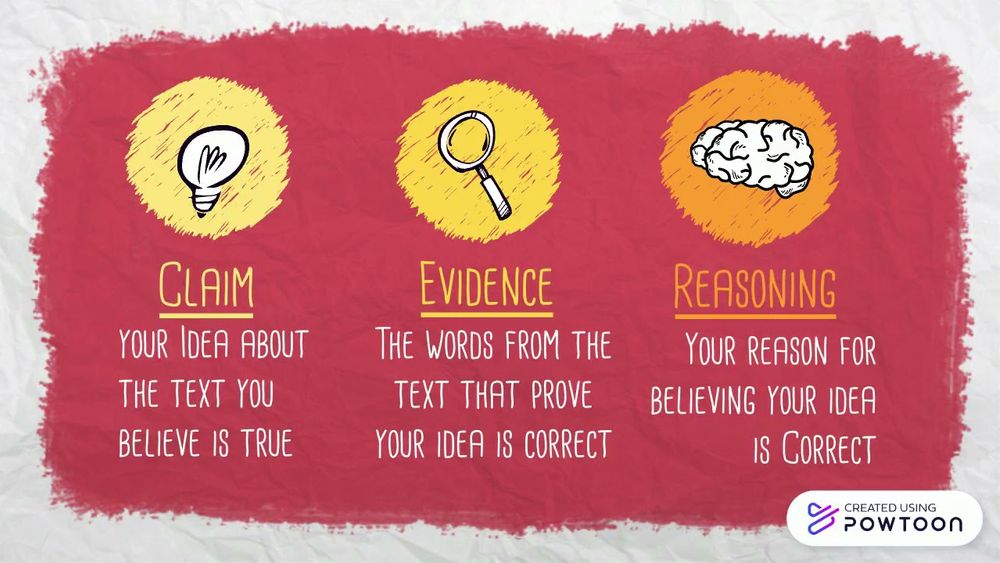
Build strong arguments with claim, evidence, and reasoning! This worksheet offers examples. Download now and improve your argumentation skills instantly!
Master the art of using quotes as evidence with this worksheet! Learn to support your arguments effectively. Download now to enhance your writing skills!
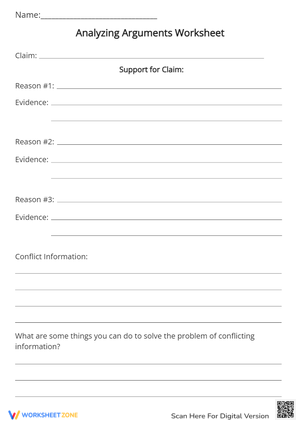
Enhance your critical thinking skills! Learn to craft well-rounded Arguments with our educational worksheet. Perfect for students and educators.
Master Argument Terms! Test your understanding of logic, evidence, and persuasive techniques. Take the Argument Terms quiz and enhance your critical thinking!
A text that uses facts and evidence to support a claim it is making is : Argumentative. How an author feels about a topic: . A sentence that states the purpose of writing: thesis. a writer's position on a problem or issue: claim. The opposite view of the author's is the: . A statement that supports your claim: reason. Facts, statistics, quotes that support a claim: evidence. The people the essay is written for is the: audience. What a text is mostly about; the main idea: Centra idea. A thing that is known or proved to be true: fact
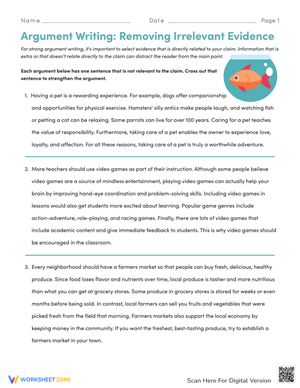
Strengthen your arguments with this Argument Writing worksheet! Learn to remove irrelevant evidence effectively. Start improving your Argument Writing today!
Improve your understanding of persuasive writing with this worksheet. Learn to distinguish persuasive assertions and enhance your critical thinking skills today!
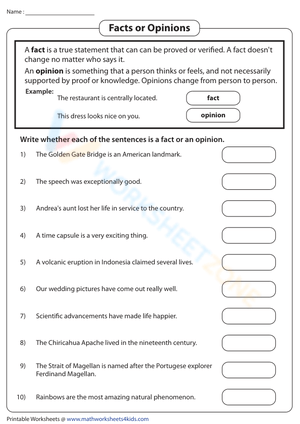
Improve critical thinking with this facts and opinions worksheet! Distinguish between objective statements and personal beliefs. Start learning Facts and Opinions with identification!
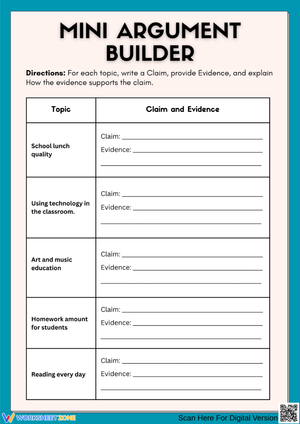
Help students build strong arguments by writing claims, evidence, and reasoning. Ideal for Grades 5–8 to practice persuasive writing and critical thinking skills.
Enhance critical thinking and analytical skills with this facts vs opinions worksheet. Learn to differentiate between facts and opinions effectively!
The type of essay structure that we are talking about is..: argumentative. What is the first paragraph of the essay called: Introduction. What is the second thing you write in the Introduction: Restate the question. What is the third thing that we write into our introduction paragraph: . What is the second paragraph in the essay called: Body paragraph 1. What is the second thing in the set up for the first body paragraph: Reason. What is the third thing in the set up for the first body paragraph: Text Evidence. Since we are using the RACE strategy to write our essays, what two letters in the strategy belong in the body paragraphs: . What is the very last part of the body paragraphs: Explain. True or false: The second body paragraph is paragraph number 3 in the essay: True. True or False: The first body paragraph and the second body paragraph are set up exactly the same way: True. What is the first thing we set up in the conclusion: . What is the second thing that we set up in our conclusion:
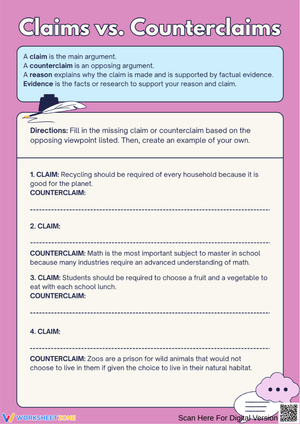
Teach students to identify and write claims and counterclaims with this argument-writing worksheet. Ideal for Grades 6–8 to build critical thinking and persuasive writing skills.
The writer's position on a problem or issue is called the: claim. In order to write a successful argument, you must use ___ to support claims, and ____ to support your reasons: reasons, evidence. When gathering evidence, use credible ___ and take notes: sources. Always make sure to disprove the ___ argument: opposing. This element is the first line of your writing: Hook. Acknowledging why someone may disagree with you is known as this: Counterclaim. This is based on personal experience, quotes, facts and statistics that support your reasons: Reason. This is a debatable statement that forms the main point of your argument: Claim. This helps support your main claim and gives the reader a basis for accepting your main claim: Reason. This element wraps up all loose ends and finishes strong: Conclusion. This is the part of the introduction paragraph that catches readers’ attention: Hook. This shows how you know you’re right: Evidence. This disputes or disagrees with your claim: Counterclaim. This follows your claim: Reason. Introduce this with statements such as, “It may be argued that ….”, “Contrary to evidence…”, “It is true, however, ….” or any other statement that acknowledges conflicting viewpoints: Counterclaim. What type of hook is this?I was living in Arkansas the first time I met prejudice face to face: Personal Anecdote. What type of hook is this?Each year there is one Lego block made for every person in the world. Think about it: Fascinating Fact. One type of hook you can use for writing is called an anecdote. What is the definition of anecdote? : A short story or scene. Which type of hook is this?John Wooden once said, "Never mistake activity for achievement." : Quote
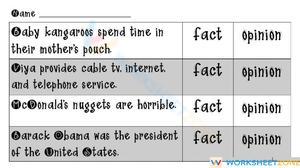
Fact or opinion online worksheet for Grade 4. You can do the exercises online or download the worksheet as pdf.
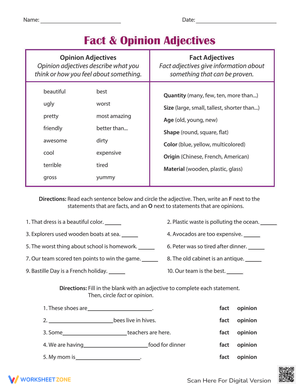
Distinguish fact from opinion with our adjectives worksheet! Enhance critical thinking and language skills. Start analyzing statements today!
Improve critical thinking with this worksheet that distinguishes between facts and opinions! Enhance analytical abilities. Download now and practice Fact or Opinion identification.
the intended readers of specific types of texts : audience. the reason for writing; what the writer hopes to accomplish: purpose. words or phrases that connect ideas, details, or events in writing: transitions. academic writing that shows care and appropriate language: formal style. closely connected or appropriate to what is being done, said, or considered : relevant. able to be believed : credible. state or assert that something is the case : claim. giving credit to the authors of source information: citation. a sentence, in the introduction of an essay, that states the writer’s position or opinion on the topic of the essay: thesis statement. the opening paragraph of an essay, which must get the reader’s attention and indicate the topic: introduction. occurs at the end of an argumentative text to make clear what the writer or speaker wants the audience to think or do: call to action. a paragraph that contains a topic sentence, supporting details and commentary, and a concluding sentence and that is usually part of a longer text: body paragraph. an important topic or problem for debate or discussion: issue. a sentence that states the main idea of a paragraph; in an essay, it also makes a point that supports the thesis statement: topic sentence. the ending of a paragraph or essay, which brings it to a close and leaves an impression with the reader : conclusion. facts or reasoning offered to support a position as being true : argument
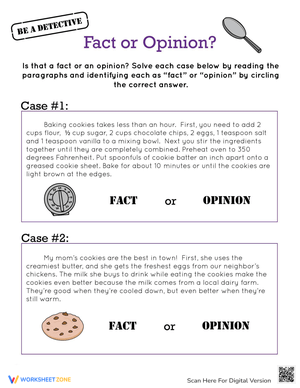
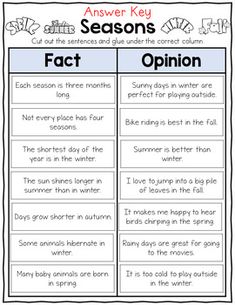
Do your students struggle with the difference between fact or opinion? This fun worksheet (and answer key) will help them practice the difference with questions they'll enjoy!
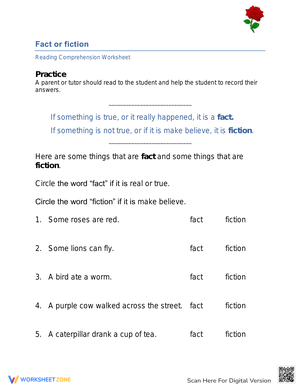
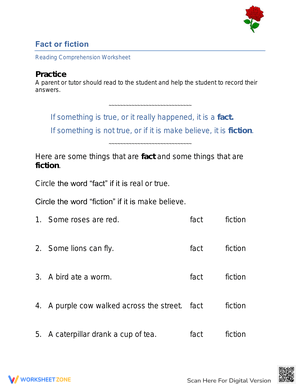
Improve critical thinking with our fact or fiction worksheet! Learn to distinguish fact from fiction. Sharpen your mind and boost analytical skills!
What is a rebuttal: . What is evidence: The available body of facts or information related to a claim or topic.. What is a counterclaim: A statement made by someone that goes against the claim. . What is fallacious reasoning: . What is support: Facts and information that help prove a claim.. What is informational text: A type of nonfiction. Nonfiction includes any text that is factual.. What is argumentative writing: A genre of writing that requires the student to investigate a topic; collect, generate, and evaluate evidence; and establish a position on the topic in a concise manner.. What is an argument: A single claim or statement followed by a series of facts, support, and reasoning presented and defended by the writer.. What is a claim: A statement or assertion that is open to challenge and that requires support. . What is sound reasoning: Reasons that are true, factual, and reasonable.. Propaganda: What is compare and contrast: The viewer is led to believe one product is better than another that is very similar to it, although no real proof is offered. . What is a bandwagon appeal: This technique tries to persuade everyone to join in and do the same thing—to be part of the crowd.. What is a testimonial? : An important person or famous figure endorses a product.. What is repetition: The product name, keyword or phrase, or slogan is repeated several times.
Get started with Claim, Evidence, and Reasoning! This worksheet covers the basics. Download now to improve your argumentation skills effectively!
Challenge your critical thinking skills! Distinguish between fact and fiction with this engaging worksheet. Start fact or fiction practice today!
Words or phrases that connect ideas, sentences, and paragraphs : Transitions. Stating the most important parts of the entire text or essay: Summarize. Taking someone’s words or ideas as if they were your own: plagiarism. Combining factual evidence to support claims: Integrates. The way we write for professional or academic purposes : Formal Writing. Evidence from text to support claim: Supporting Evidence. A justification for something existing or happening: reasons. What part of an argument clarifies to the reader the purposes of the essay or text: introduction. A viewpoint that opposes or goes against the main argument : Counterargument. Conclusion: logical result or generalization. Check all that apply. A credible source:: uses facts. A belief or idea that cannot be proved: opinion. Quoting evidence from the text: citing. A dispute where there is a strong disagreement: Argument. One’s belief of what the truth is : Claim. Check all that applyWhich of the following are reasons to organize an argument: Show your reasoning process. Is this statement a fact or an opinion?Pizza is the best food ever created: Opinion. Is this statement a fact or an opinion?Pizza is a food from Italy that many people enjoy: Fact
Find perfect worksheets
Grade + Topic search
Select your Grade level, Topic and Subject to find worksheets instantly or you can use keyword below to search what you need.
Make your own worksheets