


























Views
Downloads
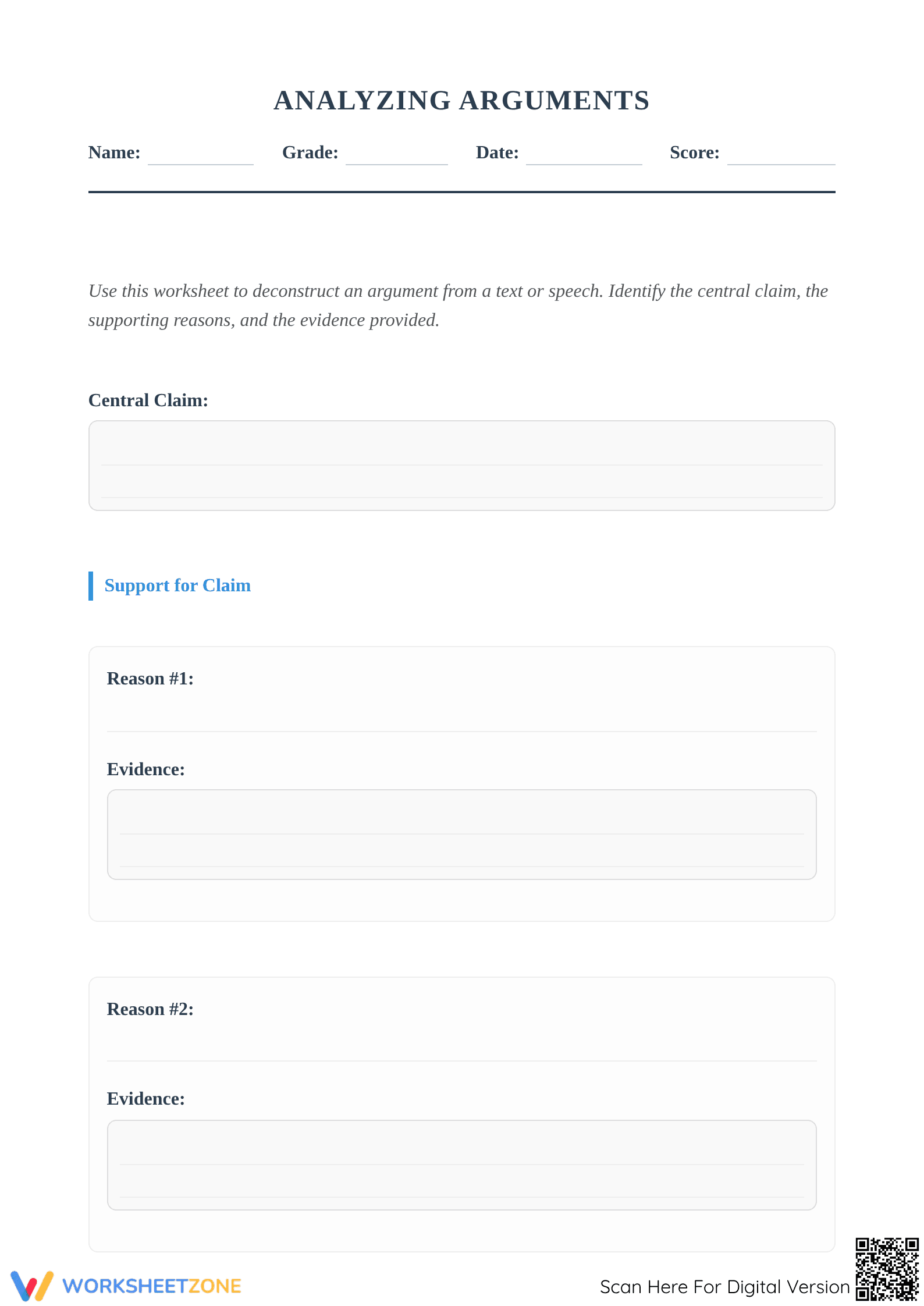


Grade 8 Analyzing Arguments — Printable No-Prep Worksheet
Paste this activity's link or code into your existing LMS (Google Classroom, Canvas, Teams, Schoology, Moodle, etc.).
Students can open and work on the activity right away, with no student login required.
You'll still be able to track student progress and results from your teacher account.
This Grade 8 ELA worksheet provides a framework for students to deconstruct non-fiction arguments. By identifying central claims and mapping evidence, learners develop critical thinking skills to evaluate the validity of any text. It transforms abstract rhetorical analysis into a concrete, step-by-step process.
At a Glance
- Grade: 8 · Subject: ELA
- Standard:
CCSS.ELA-LITERACY.RI.8.8— Delineate and evaluate the argument and specific claims in a text- Skill Focus: Argument Analysis & Evidence
- Format: 3 pages · 9 tasks · Answer key included · PDF
- Best For: Independent practice and rhetorical analysis
- Time: 30–45 minutes
Inside this 3-page PDF is a structured graphic organizer for deep textual analysis. The first section prompts students to isolate a central claim and provide three distinct reasons with evidence. The second page introduces higher-order thinking with counter-arguments and conflicting information. Finally, a practice section allows for a comparative evaluation of a second source.
Zero-Prep Workflow
The zero-prep workflow is designed for efficiency. Simply print the 3-page document (1 minute), distribute it (1 minute), and facilitate a review using the included answer key (5 minutes). This resource is an ideal sub plan because the prompts are self-explanatory and require no additional teacher-led instruction to begin.
Standards Alignment
This resource is aligned with `CCSS.ELA-LITERACY.RI.8.8`, requiring students to delineate and evaluate arguments, assessing whether reasoning is sound and evidence is sufficient. It also supports RI.8.1 by requiring textual evidence. Both standard codes can be copied directly into lesson plans, IEP goals, or district curriculum mapping tools.
How to Use It
Use this during the "You Do" phase after teaching argument components. It works well as a formative assessment; observe if students can distinguish between a reason and evidence to identify who needs intervention. Expect students to spend 30 to 45 minutes for a thorough analysis.
Who It's For
This resource is built for Grade 8 but effective for Grade 7 enrichment or Grade 9 remediation. It serves general education, ELL students, and those with IEPs who benefit from graphic organizers. Pair this with a high-interest editorial or a famous speech for a complete lesson.
According to the RAND AIRS 2024 report, structured graphic organizers significantly improve the ability of middle school students to identify logical fallacies and evaluate the strength of evidence in non-fiction texts. This worksheet addresses the CCSS.ELA-LITERACY.RI.8.8 standard by providing a scaffolded environment where students must move beyond simple comprehension to active delineation of an author's rhetorical strategy. By requiring students to explicitly link three distinct reasons to specific evidence, the resource reinforces the "evidence-based claim" model championed by Fisher & Frey (2014). Research indicates that students who use structured templates for argument analysis score 15% higher on standardized reading assessments compared to those using open-ended note-taking. This 3-page tool ensures that Grade 8 learners meet the rigorous demands of secondary literacy by mastering the identification of conflicting information and counter-arguments in complex informational texts.


