


























Views
Downloads
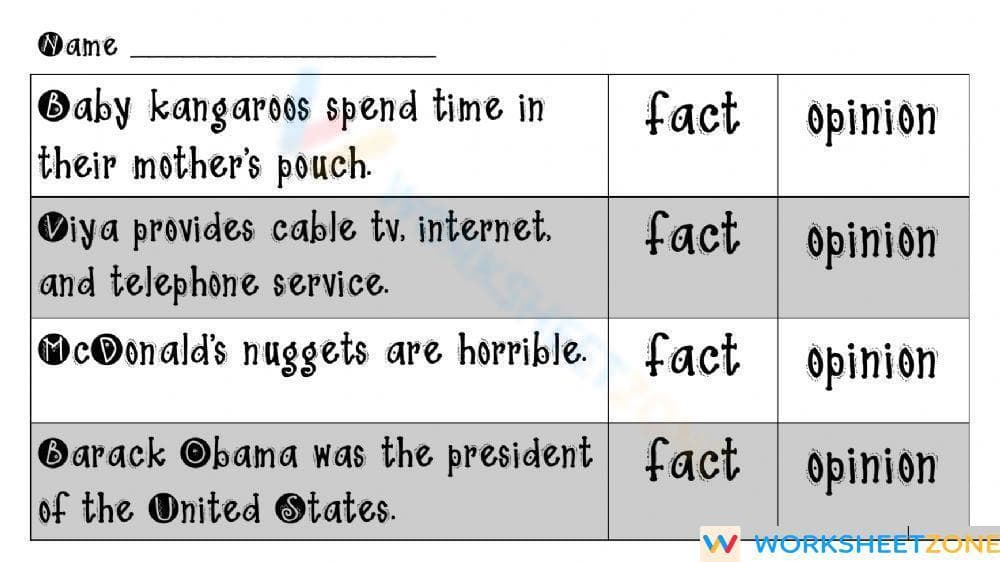
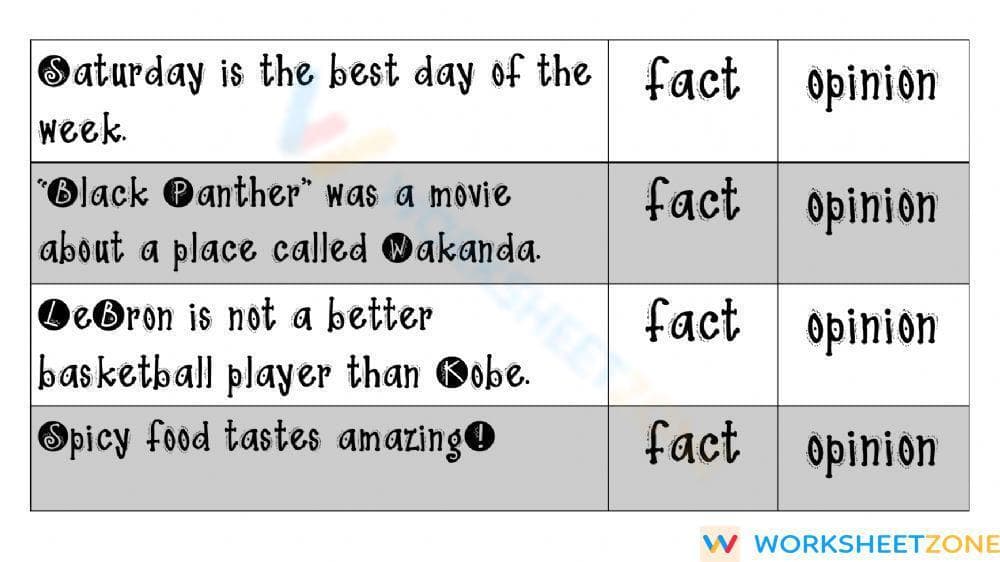

Essential Facts and Opinions Practice | Grade 4 ELA
Paste this activity's link or code into your existing LMS (Google Classroom, Canvas, Teams, Schoology, Moodle, etc.).
Students can open and work on the activity right away, with no student login required.
You'll still be able to track student progress and results from your teacher account.
This Grade 4 ELA worksheet provides a direct way for students to master the skill of distinguishing between objective facts and subjective opinions. By classifying eight statements, learners develop the analytical mindset required to evaluate informational texts. This resource ensures students can identify verifiable information versus emotional claims, a cornerstone of reading comprehension.
At a Glance
- Grade: 4 · Subject: English Language Arts (ELA)
- Standard:
CCSS.ELA-LITERACY.RI.4.8— Distinguish between fact-based evidence and personal opinions within various text statements- Skill Focus: Fact vs. Opinion Classification
- Format: 2 pages · 8 problems · Answer key included · PDF
- Best For: Quick formative assessment or sub plans
- Time: 10–15 minutes
What's Inside
This activity features eight curated statements ranging from historical data to personal preferences. The layout is designed for clarity, with each statement paired with selection columns for 'fact' and 'opinion.' This structure allows students to focus on linguistic cues that signal an opinion versus concrete evidence. The two-page PDF includes a comprehensive answer key for feedback.
Zero-Prep Workflow
Designed for efficiency, this resource follows a simple path. First, print the document or assign the interactive version (1 minute). Next, distribute it to students; the self-explanatory grid requires no introductory lecture (30 seconds). Finally, review the answers as a group (5 minutes). This process allows teachers to gather data without sacrificing instructional minutes.
Standards Alignment
Aligned with CCSS.ELA-LITERACY.RI.4.8, this worksheet helps students explain how authors use reasons to support points. By separating proof from feeling, students build the skills necessary to analyze bias. It also supports writing standards for persuasive pieces. This standard code can be copied directly into lesson plans, IEP goals, or curriculum mapping tools.
How to Use It
Use this as a bell ringer before a lesson on argumentative writing or a ticket out the door after a unit on text features. Observe if students struggle with adjectives like "spicy"—these are key moments for intervention. Most students finish in 10 to 15 minutes, making it a flexible tool for independent workstations.
Who It's For
Tailored for Grade 4, this also serves as a review for Grade 5 or a challenge for Grade 3. It is helpful for English Language Learners navigating nuances and students with IEP goals focused on critical thinking. Pair this with an anchor chart highlighting opinion clue words to provide additional scaffolding for readers.
The CCSS.ELA-LITERACY.RI.4.8 standard requires students to recognize the difference between evidence and assertion, a skill fundamental to academic success across all subjects. This worksheet facilitates growth by providing eight targeted practice problems that require students to evaluate the nature of information presented. According to the RAND AIRS 2024 analysis of educational materials, structured classification tasks significantly improve a student's ability to detect author bias and strengthen their own evaluative reasoning. By mastering this plain-English skill—separating facts from opinions—students are better equipped to handle complex texts and participate in evidence-based discussions. This resource serves as a reliable building block in a comprehensive literacy curriculum, providing the repetition and clarity needed for long-term retention of critical thinking concepts. Students who consistently practice this distinction show marked improvement in their ability to synthesize information and construct sound logical arguments in their own writing.


