


























0
Views
0
Downloads

Save
0 Likes
Share
Identify Facts and Opinions Worksheet
0 Views
0 Downloads
Paste this activity's link or code into your existing LMS (Google Classroom, Canvas, Teams, Schoology, Moodle, etc.).
Students can open and work on the activity right away, with no student login required.
You'll still be able to track student progress and results from your teacher account.
Information
Description
What It Is:
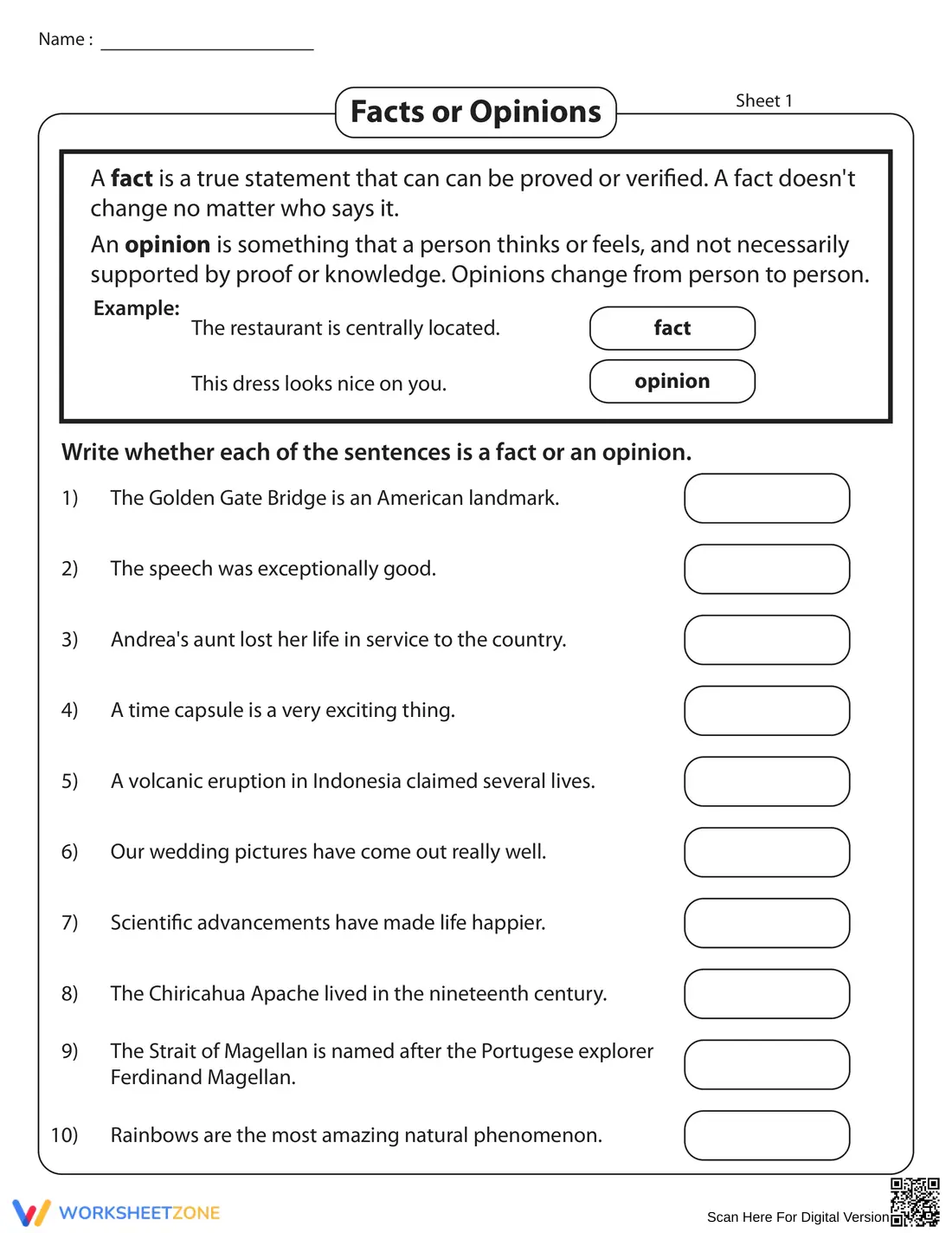
This is a worksheet focused on teaching the difference between facts and opinions. It begins with definitions of 'fact' and 'opinion,' followed by examples where students identify whether a statement is a fact or opinion. The main activity consists of ten sentences that students must classify as either fact or opinion, writing their answer in a provided space next to each sentence. Sentences include topics ranging from historical facts to subjective feelings.
Grade Level Suitability:
This worksheet is suitable for grades 3-5. The language and concepts are simple enough for elementary students to understand, while the sentence structure and topics require some reading comprehension skills typically developed in these grades. The worksheet helps develop critical thinking skills necessary at these grade levels.
Why Use It:
This worksheet helps students learn to distinguish between factual statements and personal opinions. It improves reading comprehension, critical thinking, and the ability to analyze information objectively. This skill is crucial for evaluating sources and forming informed opinions.
How to Use It:
Begin by reviewing the definitions of 'fact' and 'opinion' at the top of the worksheet. Discuss the example statements. Then, read each of the ten sentences carefully. Determine if each sentence is a fact (something that can be proven) or an opinion (a belief or feeling). Write 'fact' or 'opinion' in the blank space provided next to each sentence.
Target Users:
This worksheet is designed for elementary school students, particularly those in grades 3-5. It is also beneficial for students who need extra practice in reading comprehension, critical thinking, and differentiating between facts and opinions. It can be used in a classroom setting or for homeschooling.
This is a worksheet focused on teaching the difference between facts and opinions. It begins with definitions of 'fact' and 'opinion,' followed by examples where students identify whether a statement is a fact or opinion. The main activity consists of ten sentences that students must classify as either fact or opinion, writing their answer in a provided space next to each sentence. Sentences include topics ranging from historical facts to subjective feelings.
Grade Level Suitability:
This worksheet is suitable for grades 3-5. The language and concepts are simple enough for elementary students to understand, while the sentence structure and topics require some reading comprehension skills typically developed in these grades. The worksheet helps develop critical thinking skills necessary at these grade levels.
Why Use It:
This worksheet helps students learn to distinguish between factual statements and personal opinions. It improves reading comprehension, critical thinking, and the ability to analyze information objectively. This skill is crucial for evaluating sources and forming informed opinions.
How to Use It:
Begin by reviewing the definitions of 'fact' and 'opinion' at the top of the worksheet. Discuss the example statements. Then, read each of the ten sentences carefully. Determine if each sentence is a fact (something that can be proven) or an opinion (a belief or feeling). Write 'fact' or 'opinion' in the blank space provided next to each sentence.
Target Users:
This worksheet is designed for elementary school students, particularly those in grades 3-5. It is also beneficial for students who need extra practice in reading comprehension, critical thinking, and differentiating between facts and opinions. It can be used in a classroom setting or for homeschooling.


