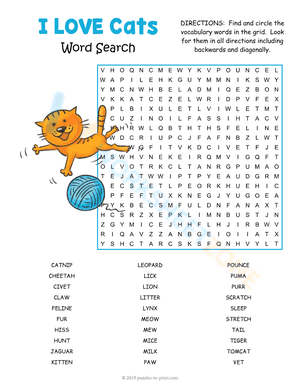
If you're building out a pets, farm animals, or community helpers unit for kindergarten through second grade, a cat-themed word search gives you a printable activity that reinforces the specific vocabulary students are learning without any extra prep on your end. Instead of a generic worksheet, this puzzle ties directly to the animal names, adjectives, and action words that show up in read-alouds, science mini-lessons, and morning meeting discussions about pets. Elementary teachers reach for word searches more than teachers at any other grade band, and the reason is practical: they take almost no setup time and slot into whatever gap in the schedule shows up.
A cat word search works well as a standalone handout during an animals unit, but it also pairs naturally with a short cat-themed picture book or nonfiction passage. Have students preview the word list before reading, then complete the search afterward as a quick check that they recognized the words in context. That small sequencing choice turns a filler activity into an actual vocabulary touchpoint tied to your lesson objective.
Using It as a Warm-Up or Early-Finisher Task
Early-finisher systems live or die on whether the backup activity actually reinforces something. A cat word search is a strong candidate because it requires no teacher explanation, no manipulatives, and no correction key beyond a quick visual scan. Keep a small stack in your early-finisher bin during a pets or animals unit, and rotate in a new themed search each week so students aren't just repeating the same puzzle.
As a warm-up, hand out the word search during the first five minutes of class while you take attendance or handle morning logistics. Students circle words as they arrive, which gives you a built-in, low-stakes way to start the period with vocabulary already active in their heads before the main lesson begins.
Differentiating for ESL Students and Early Readers
ESL and special education teachers report particular value in word searches because students can work at their own pace without the pressure of a timed activity or a group discussion. Before handing out the puzzle, pre-teach the target words with picture cards or a quick point-and-say routine so students are matching a known word to its letter pattern rather than decoding cold. For students still building letter recognition, shorten the word list to four or five high-frequency cat vocabulary terms instead of the full set.
Published classroom research comparing vocabulary instruction methods found that students who practiced target words through word-find puzzle activities showed greater vocabulary mastery gains than students who received the same words through lecture-based instruction alone, suggesting the active visual search process itself supports retention beyond passive exposure.
Frequently Asked Questions
1. What grade levels benefit most from a cat word search worksheet?
Kindergarten through second grade tends to get the most direct value, since these puzzles reinforce the sight words and animal vocabulary typical of early literacy units. Older elementary students can still use a cat word search for review, ESL support, or as an early-finisher task during a themed unit.
2. How can teachers use a word search to build vocabulary rather than just filling time?
Pre-teach the target words before handing out the puzzle, then follow up with a sentence, drawing, or discussion prompt that requires students to use a word they found. That before-and-after structure turns passive recognition into an active vocabulary practice cycle.
3. How should teachers support struggling readers or ESL students with word search puzzles?
Shorten the word list, pre-teach vocabulary with picture cards, and let students work at their own pace without a timer. Because the activity doesn't require spoken or written output, it lowers the stakes for students still building confidence with English vocabulary.
4. Can a cat word search be tied to specific classroom standards or literacy goals?
It works best as a supplement to a broader vocabulary or animals-themed unit rather than a standalone standards-aligned task. Use it to reinforce the specific vocabulary already tied to your unit's literacy or science objectives, then pair it with a writing or discussion follow-up to capture more formal evidence of learning.















 Interactive Worksheet Maker
 Quiz Maker
 Word Search Maker
 Crossword Puzzle Maker
 Word Scramble Generator
 Sentence Scramble Generator
 Handwriting Worksheet Generator
 Name Tracing Generator
 Fill In The Blank Generator