































Essential Cat Care Vocabulary Word Search | Grades 7–8 ELA

Paste this activity's link or code into your existing LMS (Google Classroom, Canvas, Teams, Schoology, Moodle, etc.).
Students can open and work on the activity right away, with no student login required.
You'll still be able to track student progress and results from your teacher account.
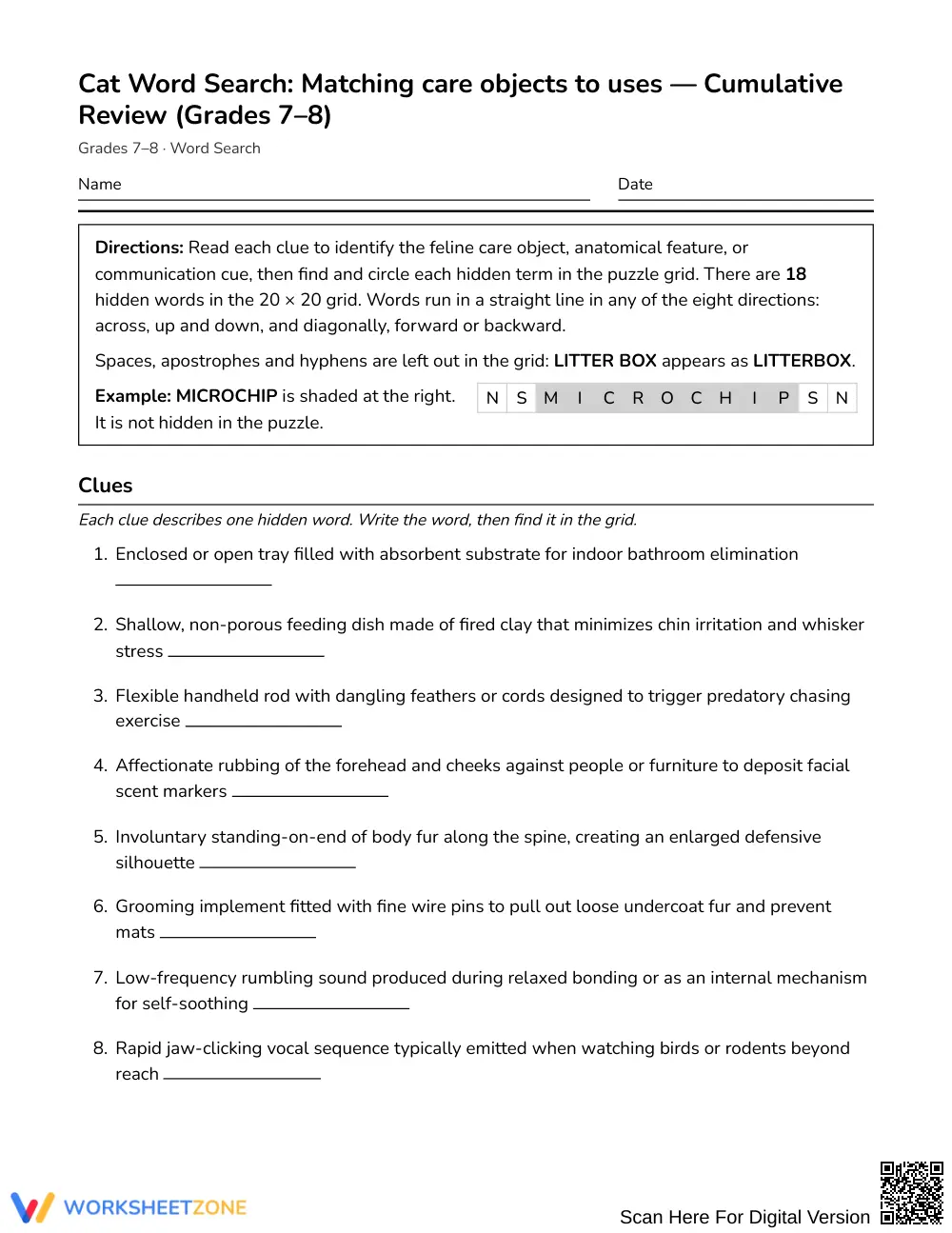
This Grades 7–8 vocabulary word search reinforces domain-specific terminology by challenging learners to match feline care objects and biological terms to their functional uses. Students read contextual definitions to identify 18 essential terms—including anatomical adaptations, behavioral signals, and grooming implements—before locating them within a complex letter grid to solidify orthographic recall.
At a Glance
- Grade: Grades 7–8 · Subject: English Language Arts
- Standard: Not standards-assessed — vocabulary enrichment
- Skill Focus: Matching feline care objects and biological terms to uses
- Format: 3 pages · 18 words · Answer key included · PDF
- Best For: Vocabulary review and sub plans
- Time: 25–35 minutes
What's Inside
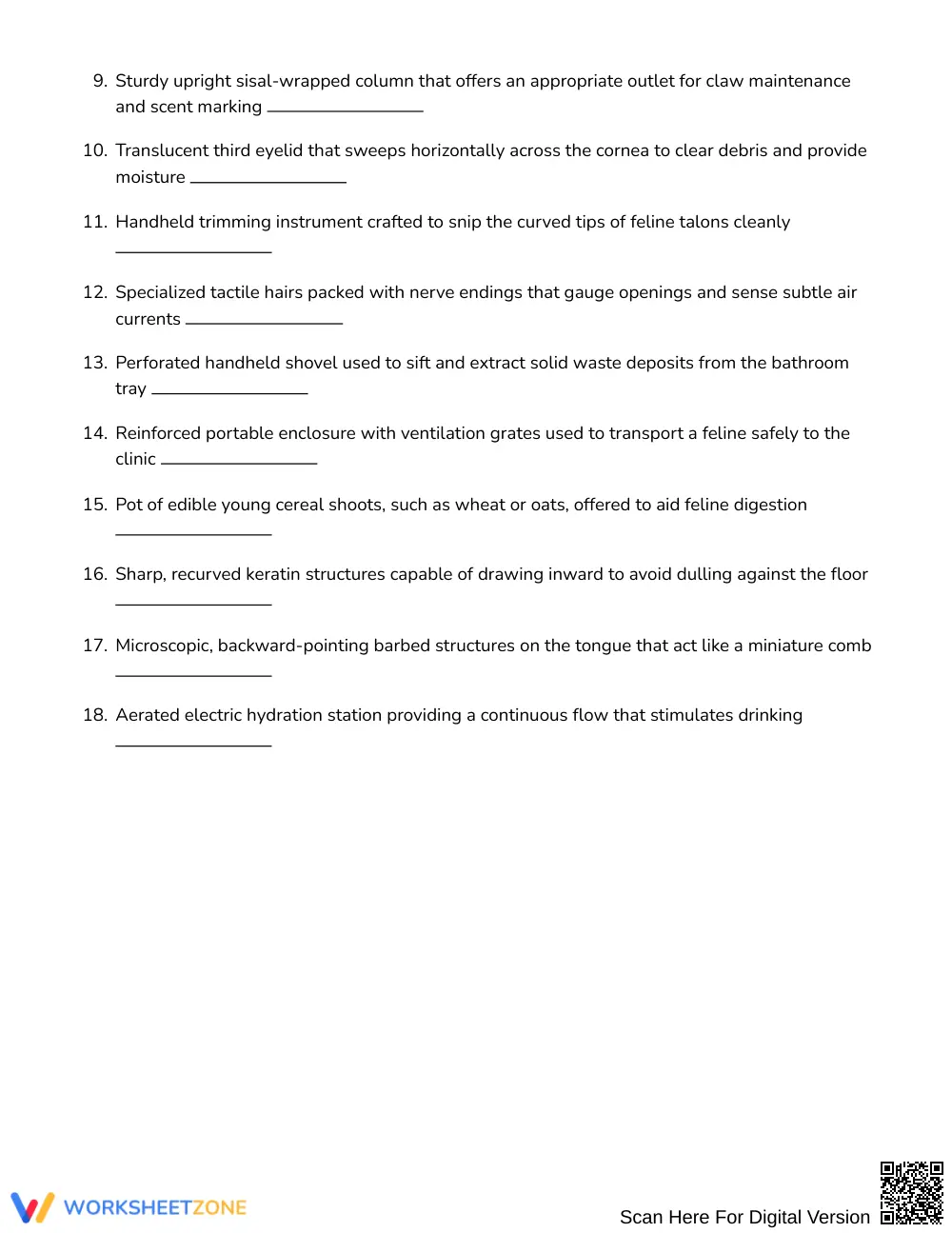
The 3-page printable activity presents 18 distinct clues detailing the practical function or biological purpose of feline tools, anatomical structures, and communicative behaviors. A shuffled word bank provides spelling support without revealing direct clue pairings. A comprehensive 4-page answer key provides full visual solutions highlighting each hidden term for rapid grading.
Puzzle Structure and Mechanics
The puzzle is built around a dense 20 by 20 letter grid designed to encourage rigorous visual scanning. Hidden words appear in all eight compass directions: north, northeast, east, southeast, south, southwest, west, and northwest. Students read each functional clue, deduce the appropriate term from the shuffled bank, and search along horizontal, vertical, and forward or backward diagonal paths to circle each target.
Standards Alignment
This resource serves as targeted vocabulary enrichment and is not aligned to an assessed standard. It builds secondary-level domain-specific literacy by asking students to analyze descriptive definitions and synthesize technical vocabulary spanning animal care, behavioral science, and feline morphology.
How to Use It
Deploy this activity after direct instruction on technical text analysis or animal biology as an independent synthesis task. Alternatively, file it as an emergency zero-prep substitute plan or fast-finisher assignment. During seatwork, observe whether students identify terms directly from clue definitions or rely entirely on letter hunting; encourage students to define words mentally before scanning. Typical completion takes 25 to 35 minutes.
Who It's For
This puzzle is structured for middle school students in Grades 7–8 who require engaging reinforcement of specialized expository vocabulary. Support emerging readers by allowing peer pairs to decipher challenging clues, or challenge advanced learners to use three terms in original scientific sentences. It pairs naturally with an informational reading passage on veterinary science or animal husbandry.
According to Fisher & Frey (2014), intentional exposure to specialized vocabulary through definitional clues and contextual word retrieval strengthens semantic networks and long-term memory consolidation in adolescent learners. This vocabulary enrichment resource engages Grades 7–8 students in matching 18 feline care objects, anatomical adaptations, and behavioral cues to their functional descriptions. By integrating descriptive clues with a 20 by 20 word search grid, the activity requires students to evaluate technical definitions before executing orthographic searches. Rather than participating in passive puzzle completion, learners actively process domain-specific terminology such as nictitating membrane, retractile claws, and vibrissae. This dual-processing approach deepens conceptual comprehension across informational reading and life science topics, providing teachers with an effective, zero-prep supplemental tool for secondary English Language Arts classrooms.


