





























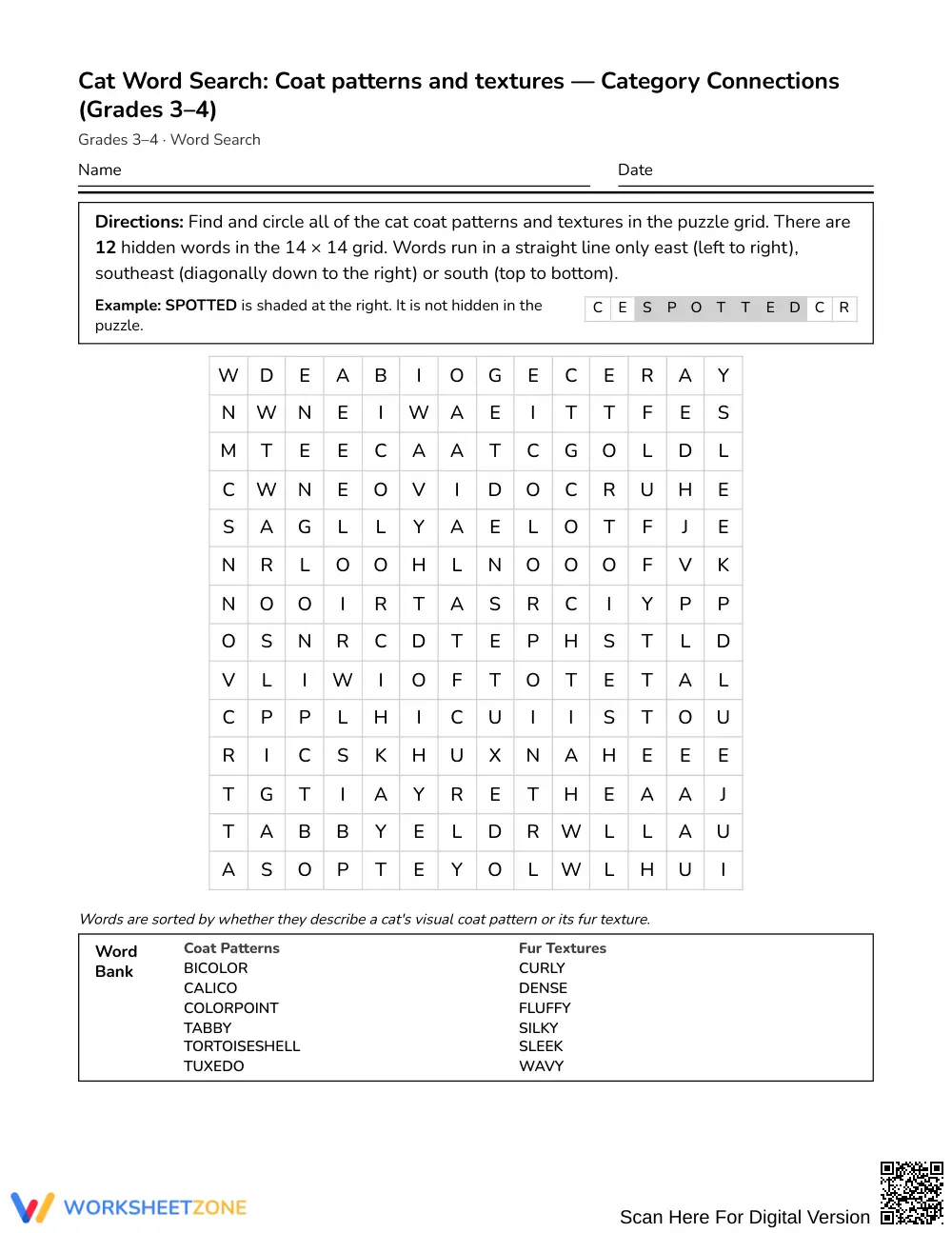


Complete Cat Coat Word Search | Grades 3–4 ELA

Paste this activity's link or code into your existing LMS (Google Classroom, Canvas, Teams, Schoology, Moodle, etc.).
Students can open and work on the activity right away, with no student login required.
You'll still be able to track student progress and results from your teacher account.
This printable word search introduces elementary students to specific feline terminology through an engaging vocabulary activity. Learners locate 12 words that classify descriptive terms into coat patterns and fur textures. Designed for immediate classroom use, this activity strengthens word recognition, spelling precision, and semantic categorization without requiring advance preparation from teachers.
At a Glance
- Grade: Grades 3–4 · Subject: ELA
- Standard: Not standards-assessed — vocabulary enrichment
- Skill Focus: Coat patterns and textures
- Format: 1 pages · 12 words · Answer key included · PDF
- Best For: Vocabulary enrichment and early finishers
- Time: 15–20 minutes
What's Inside
This 1-page printable resource features a clean letter grid paired with a categorized word list containing 12 target vocabulary words. Terms are divided into visual coat patterns such as calico, tuxedo, and tortoiseshell, alongside distinct fur textures like sleek, fluffy, and dense. Accompanying student clues provide clear descriptive definitions for every term, supported by a 3-page comprehensive answer key that clearly highlights word locations.
Puzzle Mechanics and Structure
Students search for hidden vocabulary within a structured 14 x 14 letter grid. Target words run in three specific directions: horizontally east (E), diagonally southeast (SE), and vertically south (S), providing an accessible visual search path for upper-elementary readers. The categorized word bank prompts students to connect each term to its physical meaning before scanning the letter rows, reinforcing both letter-sequence processing and conceptual comprehension.
Standards Alignment
This activity is designed purely for vocabulary enrichment and is not aligned to a specific grade-level standard. It supports foundational literacy by broadening descriptive adjective usage and scientific observation skills. Teachers can comfortably incorporate this exercise into language arts units, feline-themed informational reading modules, or cross-curricular science studies without reporting standard-specific mastery metrics.
How to Use It
This activity functions effectively as an independent warm-up during an informational text unit on domestic animals, or as an independent task during literacy rotations. For formative assessment, observe whether students read full words across designated search vectors or randomly guess letter combinations, noting which learners utilize the category headers to confirm word meanings. Most students complete the full 14 x 14 grid within 15 to 20 minutes.
Who It's For
This puzzle is ideal for third- and fourth-grade students expanding their descriptive vocabularies, as well as English language learners benefiting from thematic category anchors. It serves as an engaging fast-finisher activity or emergency substitute plan. Pair this printable directly with an informational reading passage on domestic cat breeds or an anchor chart featuring feline physical characteristics.
According to research highlighted in Fisher & Frey (2014), intentional exposure to domain-specific vocabulary within categorized contexts enhances lexical storage and text comprehension among developing readers. Providing structured activities centered on thematic word relationships allows third- and fourth-grade students to consolidate orthographic patterns while learning nuanced descriptive terminology. Although non-evaluative and designed for vocabulary enrichment rather than formal standards assessment, this 12-word exercise reinforces orthographic mapping through systematic visual scanning across predictable spatial orientations. Guided sorting by semantic categories—such as distinguishing tactile fur textures from visual coat pigmentation—deepens conceptual retention, offering practical literacy reinforcement that bridges informal reading engagement with structured lexical acquisition.


