




























Views
Downloads
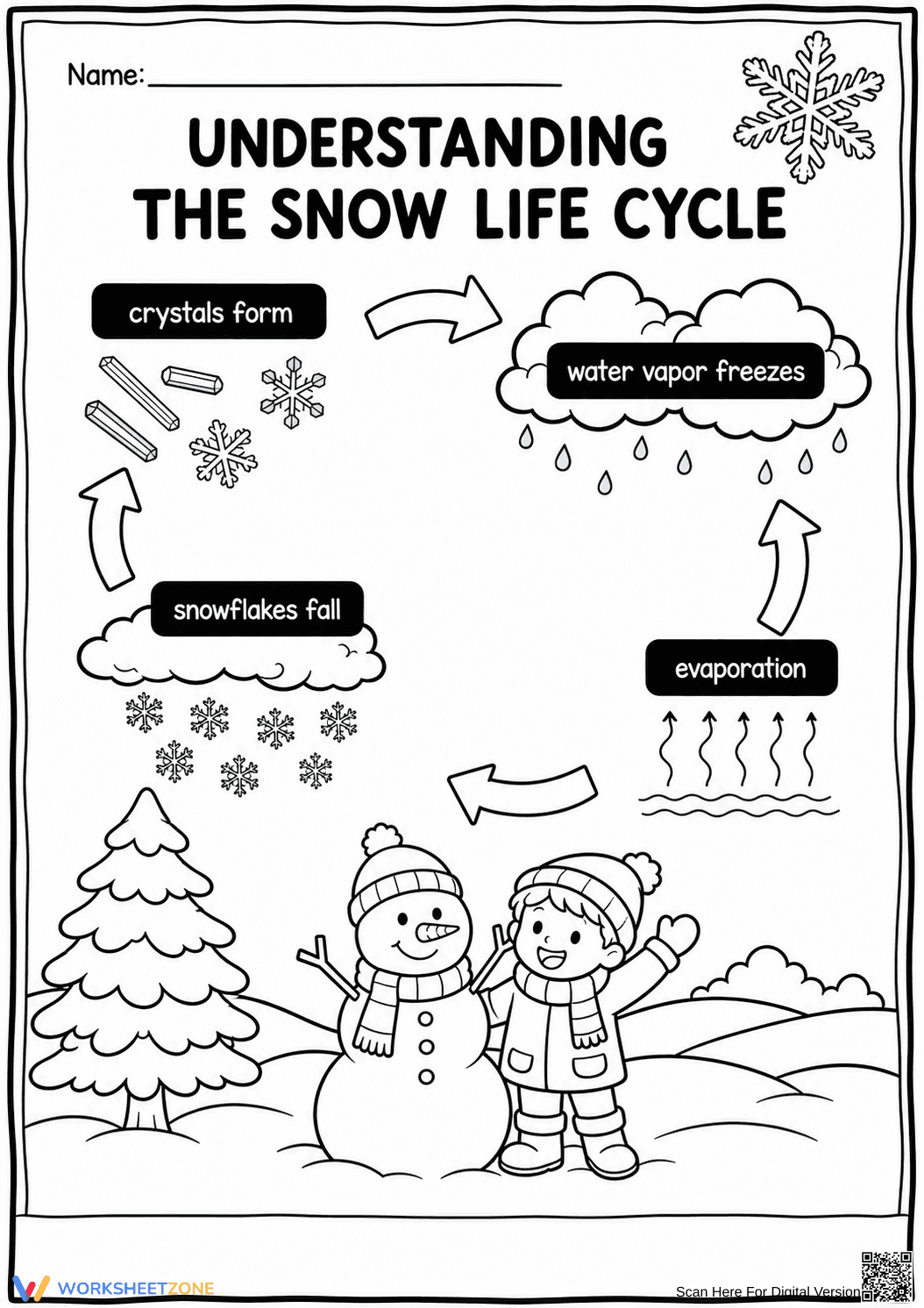

Printable Snow Life Cycle Worksheet | Grade 2 Science

Paste this activity's link or code into your existing LMS (Google Classroom, Canvas, Teams, Schoology, Moodle, etc.).
Students can open and work on the activity right away, with no student login required.
You'll still be able to track student progress and results from your teacher account.
This Grade 2 science worksheet introduces students to the fascinating process of snow formation. By examining a clear, visual model of the snow life cycle, young learners will understand how water vapor freezes, forms crystals, falls as snowflakes, and eventually evaporates.
At a Glance
- Grade: 2 · Subject: Science
- Standard:
2-ESS2-3— Identify where water is found and its solid or liquid forms- Skill Focus: Water cycle and phase changes
- Format: 1 page · 4 stages · No answer key needed · PDF
- Best For: Independent practice and visual learning
- Time: 15–20 minutes
Inside this single-page resource, educators will find a beautifully illustrated diagram detailing the four main stages of the snow life cycle. The page features clear labels for water vapor freezing, crystal formation, falling snowflakes, and evaporation. Directional arrows guide students through the continuous cycle, while a winter scene provides an engaging coloring opportunity.
This resource is designed for immediate classroom implementation with a zero-prep workflow.
- Print (1 minute): Download the PDF and print a class set. The design is ink-friendly.
- Distribute (1 minute): Hand out pages with crayons. No complex instructions required.
- Review (3 minutes): Walk through the four stages before letting students color independently.
Total teacher preparation takes under two minutes, making this an excellent option for sub plans.
This worksheet is aligned to primary standard 2-ESS2-3: Obtain information to identify where water is found on Earth and that it can be solid or liquid. By tracing the path from vapor to solid snow crystals and back to vapor through evaporation, students visualize these critical phase changes. Both standard codes can be copied directly into lesson plans, IEP goals, or district curriculum mapping tools.
Teachers can utilize this diagram during direct instruction on weather patterns. As you introduce each phase of snow formation, have students color the corresponding section to build a visual connection. Alternatively, use it as an end-of-lesson review where students explain the cycle to a partner. As a formative assessment tip, listen to student conversations to ensure they correctly sequence the transition from vapor to crystal. Expected completion time ranges from 15 to 20 minutes.
This resource is ideal for primary elementary students, particularly second graders exploring earth science and weather. The visual nature of the diagram provides excellent differentiation for English Language Learners and visual learners who benefit from seeing scientific processes illustrated rather than just reading about them. It pairs perfectly with a read-aloud book about winter weather.
Understanding phase changes and weather patterns is a foundational element of early elementary science education. This resource supports standard 2-ESS2-3 by helping students identify where water is found and its solid or liquid forms. According to a ScienceDirect TpT Analysis, integrating visual models and coloring activities into science instruction significantly improves vocabulary retention and conceptual understanding for young learners. When students actively engage with a diagram by coloring and tracing the directional flow of a cycle, they build stronger cognitive maps of abstract processes like evaporation and crystallization. This snow life cycle worksheet leverages these evidence-based visual learning strategies to make complex earth science concepts accessible and engaging, ensuring students develop a robust understanding of how water transforms within our natural environment.


