


























Views
Downloads

Snowflake Life Cycle — Printable Grade 2 Science Worksheet
Paste this activity's link or code into your existing LMS (Google Classroom, Canvas, Teams, Schoology, Moodle, etc.).
Students can open and work on the activity right away, with no student login required.
You'll still be able to track student progress and results from your teacher account.
This Grade 2 science worksheet guides students through the sequential stages of snowflake formation, from water vapor to crystalline structure. By combining artistic illustration with descriptive writing, learners develop a concrete understanding of how atmospheric conditions create unique ice crystals. It bridges the gap between creative expression and scientific observation while reinforcing essential sequencing vocabulary.
At a Glance
- Grade: 2 · Subject: Science
- Standard:
2-ESS2-3— Obtain information to identify where water is found on Earth as solid or liquid- Skill Focus: Sequencing and descriptive writing
- Format: 1 page · 4 problems · Answer key not required · PDF
- Best For: Winter science units and literacy centers
- Time: 20–30 minutes
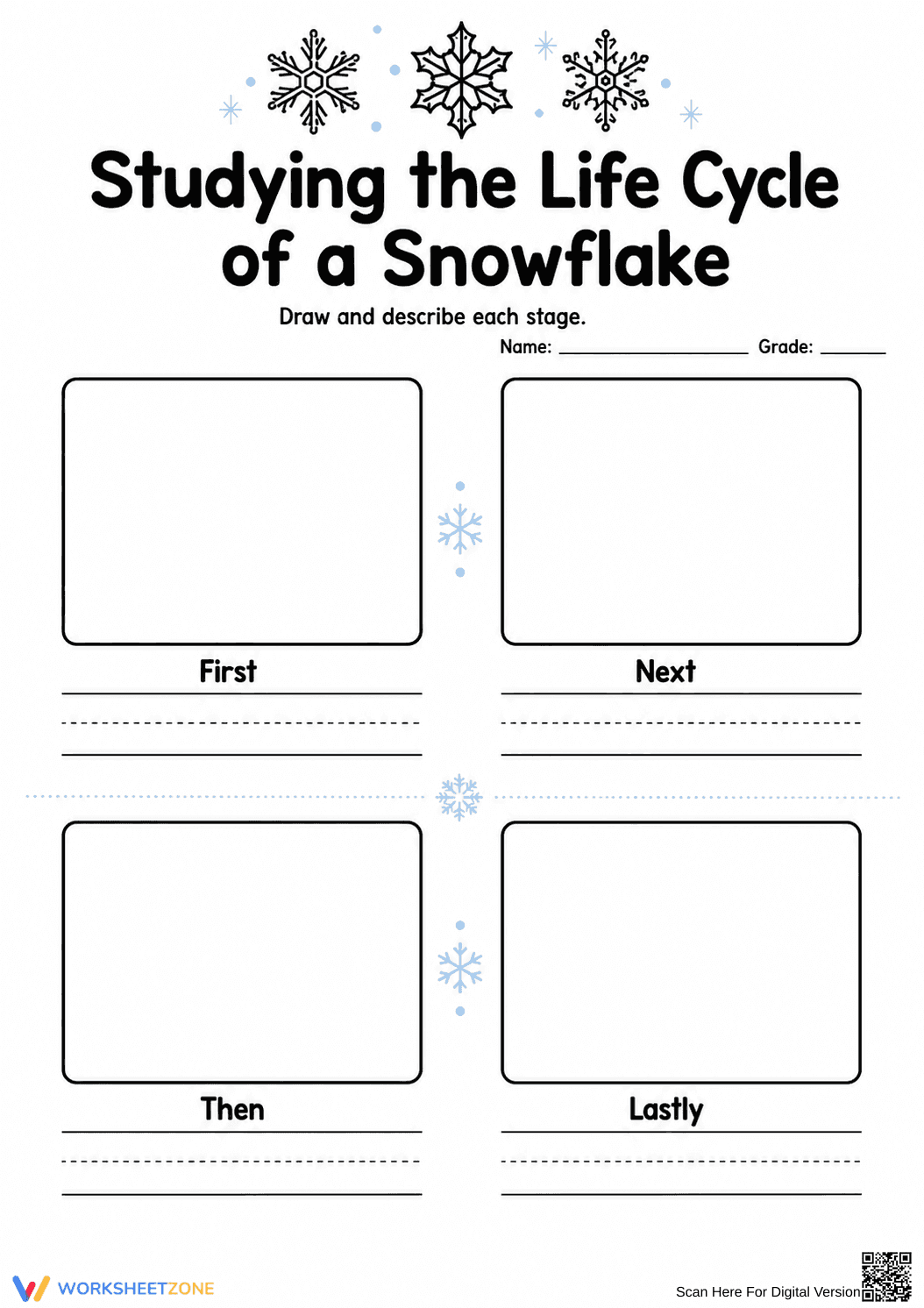
The worksheet features a clean, four-panel layout designed for maximum student engagement. Each panel includes a dedicated drawing box for visual representation and primary-ruled lines for written descriptions. The page is anchored by transition words—First, Next, Then, and Lastly—to scaffold the writing process. This single-page PDF requires no additional materials beyond basic classroom supplies like pencils and crayons, making it a versatile addition to any winter-themed curriculum.
The zero-prep design allows for immediate classroom implementation. Teachers can print the document in less than 30 seconds. Distribution takes approximately 1 minute, as the instructions are self-contained and require minimal verbal explanation. Reviewing student work is streamlined by the four-stage structure, allowing for quick formative assessment of both scientific accuracy and writing fluency. Total teacher preparation time is under 2 minutes, making it an ideal choice for sub plans or morning work.
This resource aligns with `2-ESS2-3`, focusing on the identification of water in its solid form. By documenting the transition from vapor to ice, students explore physical changes in the environment. Additionally, it supports CCSS.ELA-LITERACY.W.2.3 by requiring a logical sequence of events. Both standard codes can be copied directly into lesson plans, IEP goals, or district curriculum mapping tools.
Use this worksheet as a concluding activity after a read-aloud about weather or a lesson on the water cycle. It serves as an excellent formative assessment to check if students understand the chronological order of crystallization. For a hands-on extension, have students observe real frost or ice cubes before completing their drawings. Expect completion within 25 minutes during a standard science block or independent work period.
This resource is ideal for second-grade general education classrooms, homeschool environments, and English Language Learners who benefit from visual scaffolds. The structured prompts provide necessary support for emerging writers who are learning to organize their thoughts. It pairs naturally with a weather-themed anchor chart or a short video clip demonstrating crystal growth under a microscope.
The use of sequential graphic organizers, such as the four-stage layout in this snowflake life cycle worksheet, is a proven strategy for enhancing cognitive retention in early elementary learners. According to Fisher & Frey (2014), providing students with structured transition prompts like "First" and "Next" reduces the cognitive load associated with writing, allowing them to focus more deeply on the scientific content. This worksheet specifically addresses the 2-ESS2-3 standard by requiring students to visualize and describe the transition of water into its solid crystalline state. Research from the RAND AIRS 2024 report suggests that integrating drawing with writing significantly improves conceptual mapping for complex natural processes. By requiring 4 distinct stages of observation, this resource ensures that students move beyond surface-level recognition to a more robust understanding of atmospheric science and chronological storytelling in a classroom-ready format.


