


























Views
Downloads

Printable Finding Ratios Worksheet | Grade 3-4 Math Guide
Paste this activity's link or code into your existing LMS (Google Classroom, Canvas, Teams, Schoology, Moodle, etc.).
Students can open and work on the activity right away, with no student login required.
You'll still be able to track student progress and results from your teacher account.
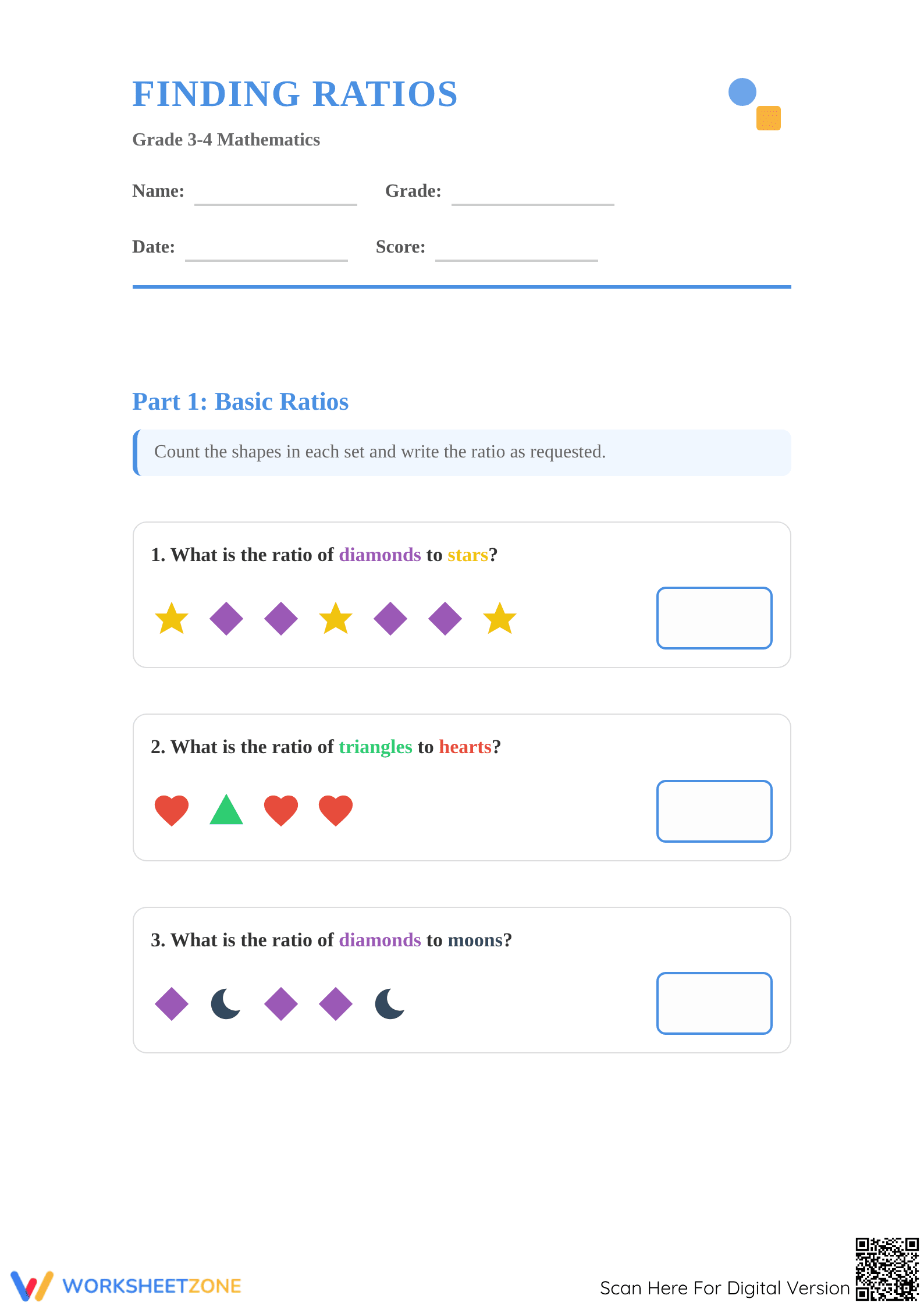
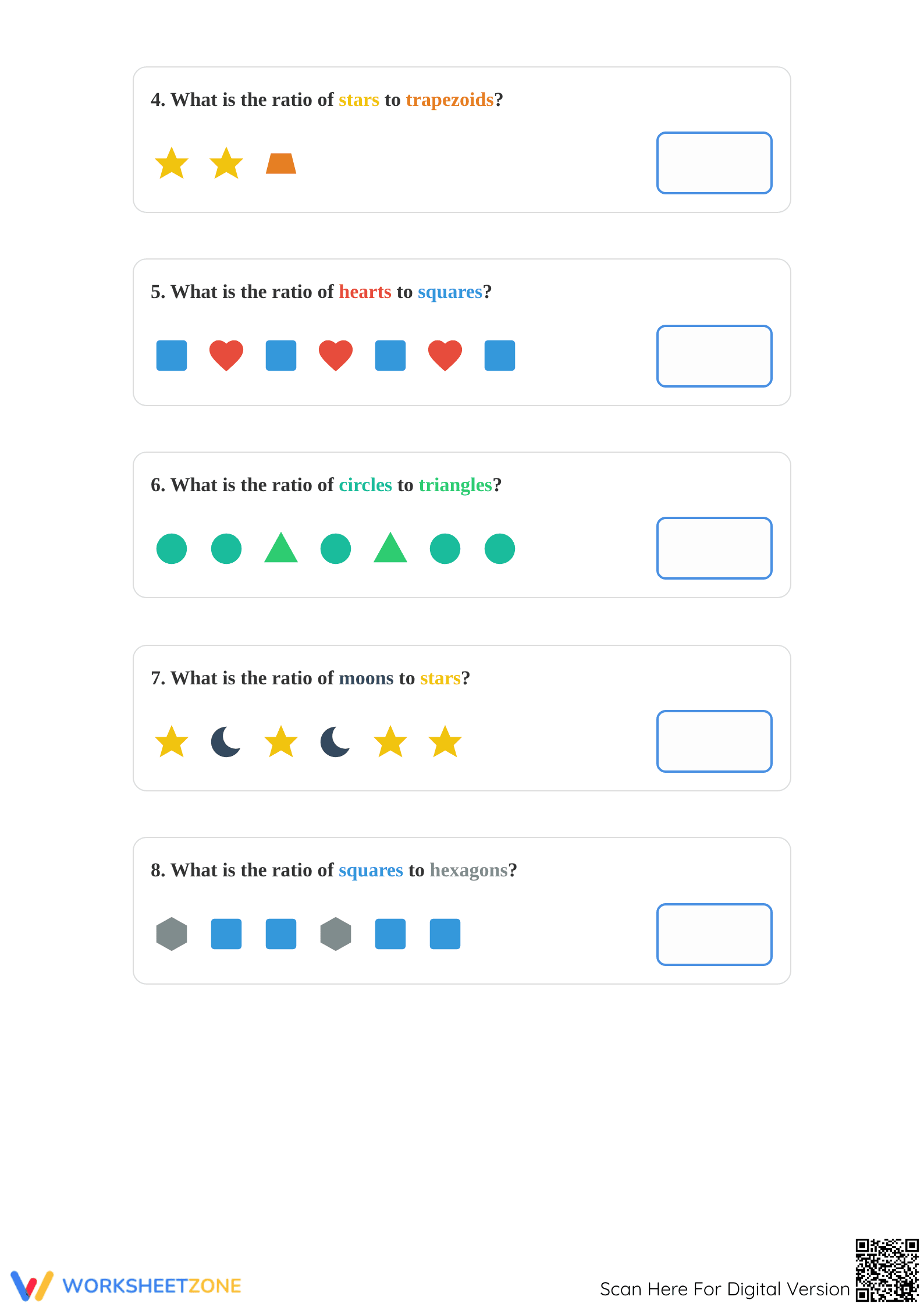
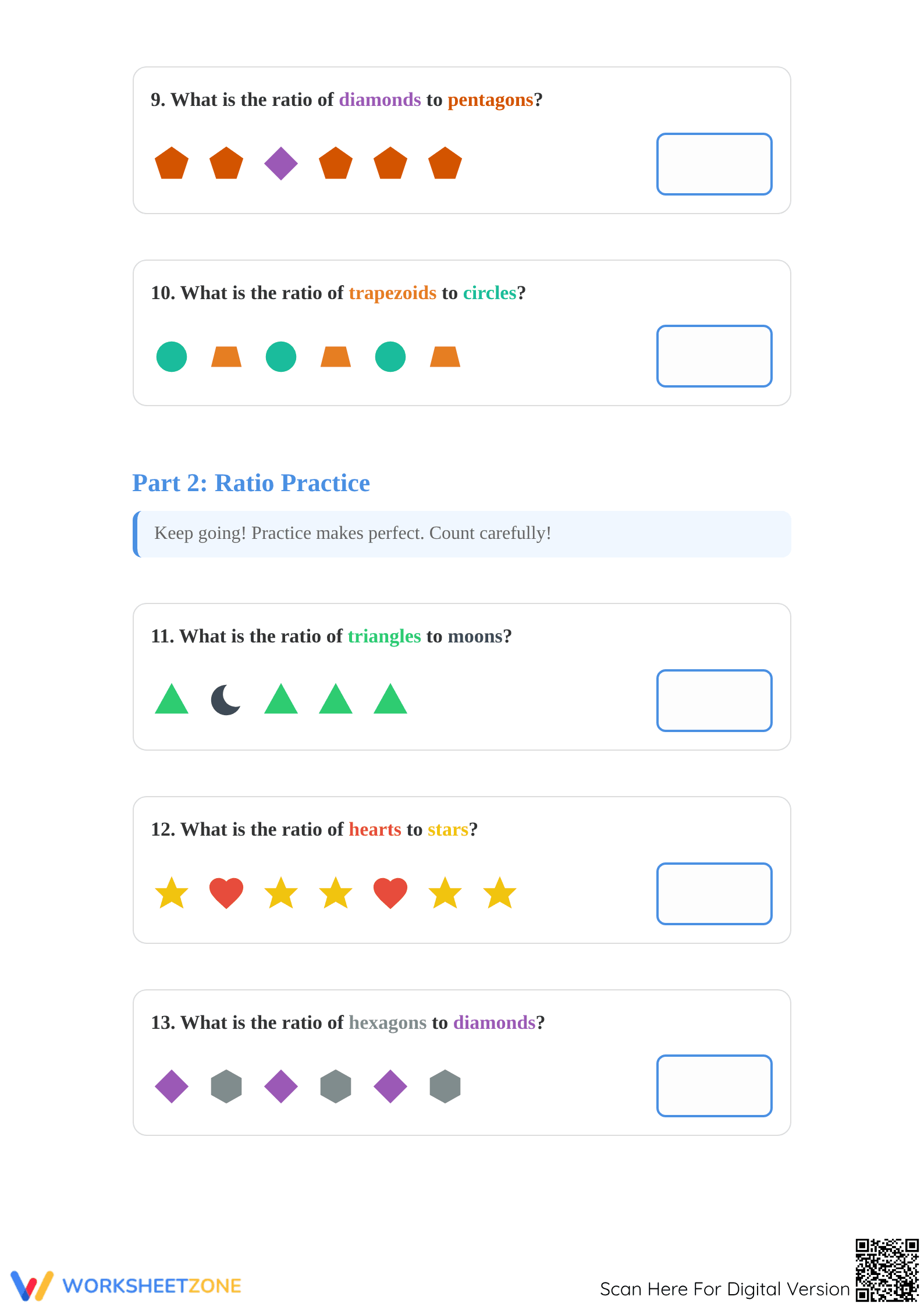
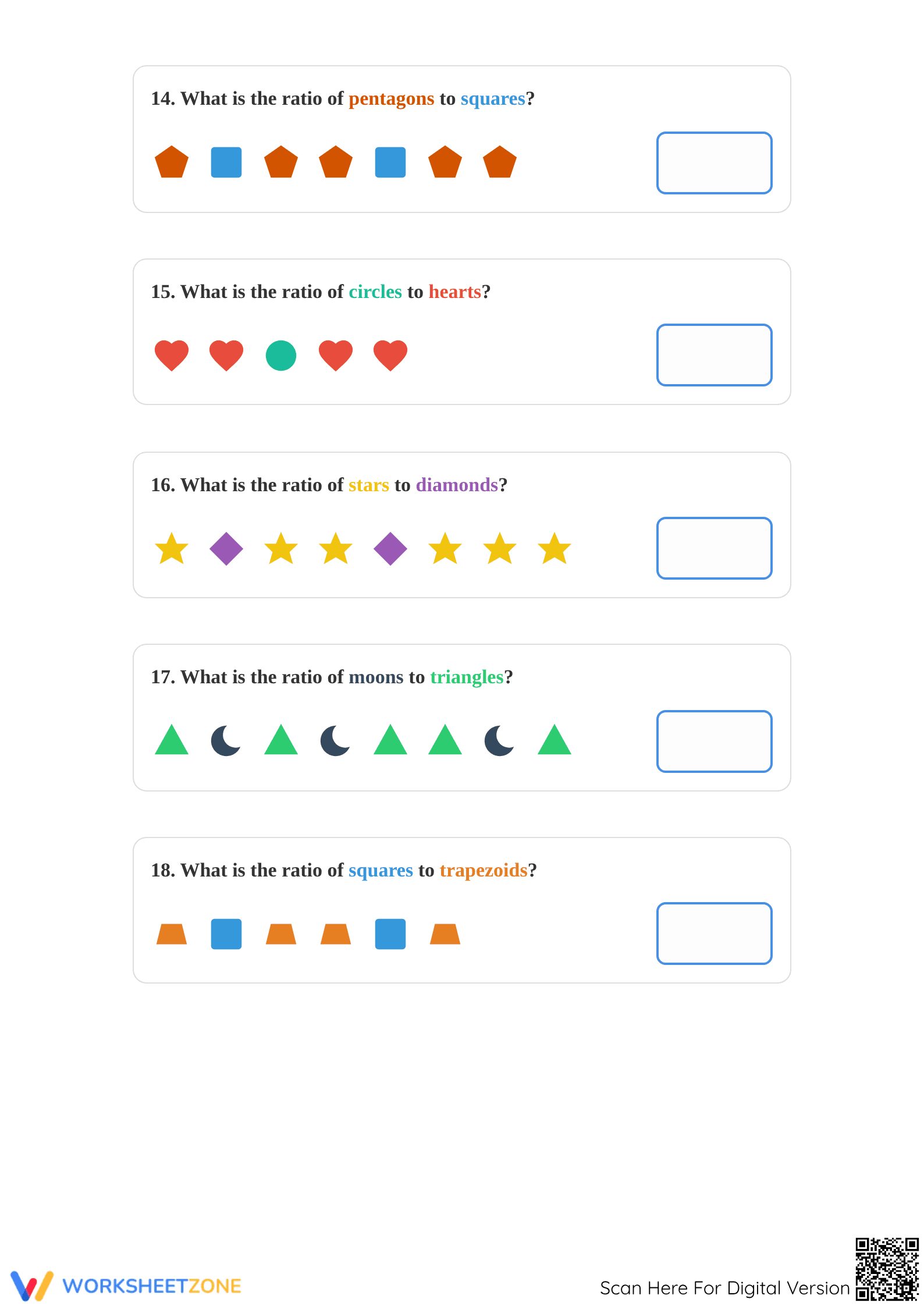
Students master the fundamental concept of proportional reasoning through this comprehensive "Finding Ratios" practice set. By translating visual sets of shapes into mathematical ratios, learners bridge the gap between concrete counting and abstract comparisons. This resource provides a structured pathway for students to express relationships between two quantities, ensuring a solid foundation for future mathematical success.
At a Glance
- Grade: 3–4 · Subject: Math
- Standard:
CCSS.MATH.CONTENT.6.RP.A.1— Understand the concept of a ratio and use ratio language to describe relationships- Skill Focus: Visual Ratio Identification
- Format: 5 pages · 20 problems · Answer key included · PDF
- Best For: Introductory Ratio Practice & Skill Reinforcement
- Time: 25–35 minutes
What's Inside
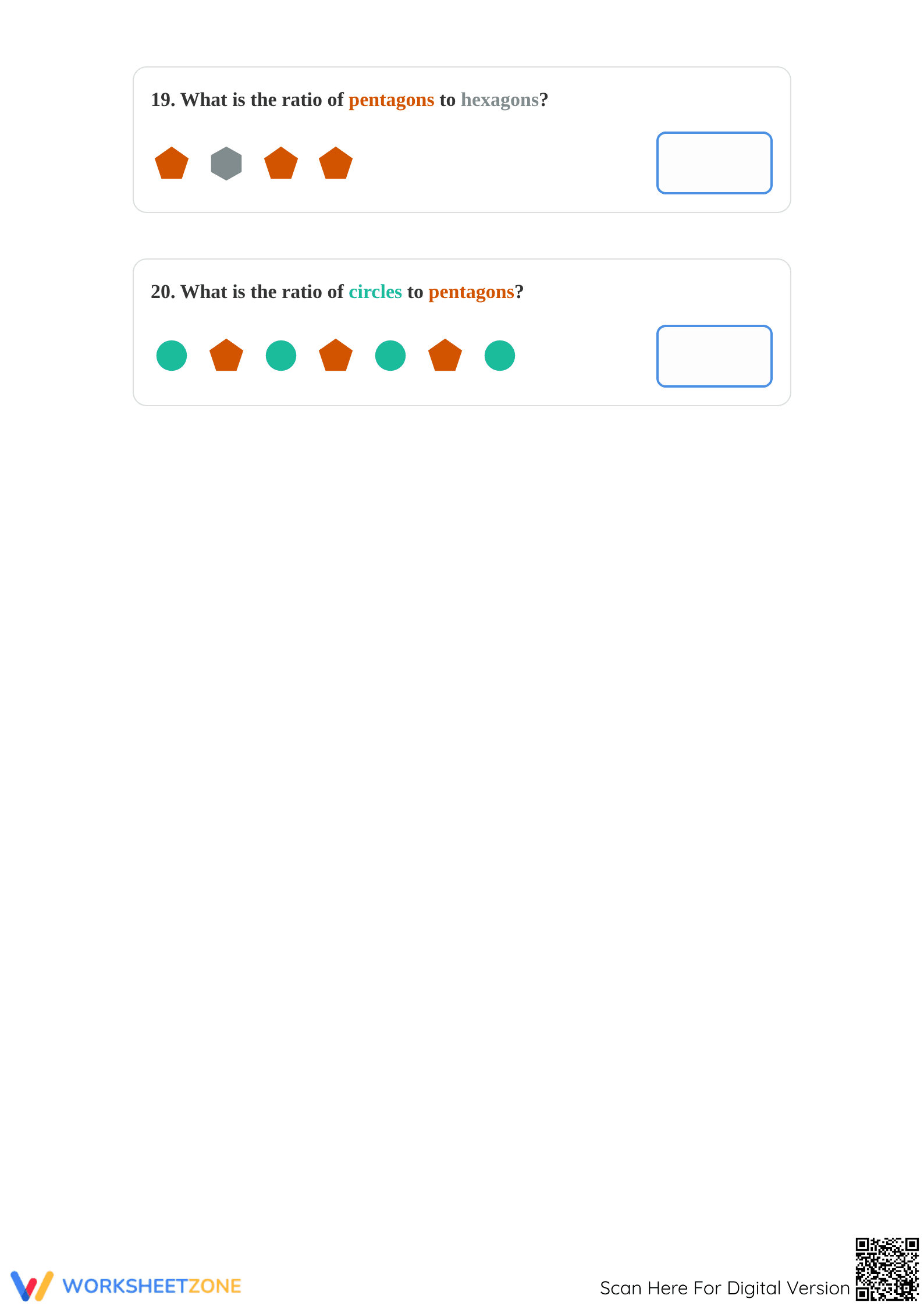
This practice packet contains five pages featuring 20 distinct problems divided into two sections: "Basic Ratios" and "Ratio Practice." Each problem provides a unique set of colorful geometric shapes—including diamonds, stars, triangles, hearts, and hexagons—and asks students to determine the ratio of one shape to another. A full answer key facilitates rapid grading and student self-correction.
Zero-Prep Workflow
The simplified design allows for rapid implementation. First, print the document (30 seconds). Second, distribute the five-page packet to students (1 minute) for independent or guided seatwork. Finally, review the answers as a class using the included key (5 minutes) to clarify the importance of ratio order and the various ways to write a comparison.
Standards Alignment
This resource aligns with CCSS.MATH.CONTENT.6.RP.A.1. This visual approach serves as a critical bridge for 3rd and 4th graders learning multiplicative comparison or early division concepts. Both standard codes can be copied directly into lesson plans, IEP goals, or district curriculum mapping tools to ensure all instructional minutes map back to core learning objectives.
How to Use It
Use this worksheet as a formative assessment after introducing the definition of a ratio. As students work through the 20 problems, observe if they correctly identify which quantity comes first in the description. It also functions effectively as a math center activity for students who have finished their primary assignments early and need supplemental enrichment.
Who It's For
This resource is designed for Grade 3 and 4 students starting their journey into proportional thinking. The heavy reliance on visual cues makes it an excellent choice for English Language Learners and students with IEPs who benefit from concrete representations. It pairs naturally with an anchor chart showing the three ways to write a ratio (x:y, x to y, x/y).
According to the RAND AIRS 2024 analysis of mathematical instructional materials, the use of visual manipulatives and representational objects is paramount for establishing early proportional reasoning in elementary learners. This worksheet utilizes visual shape counting to satisfy CCSS.MATH.CONTENT.6.RP.A.1, allowing students to practice the plain-English skill of describing a relationship between two quantities using ratio language. By providing 20 repetitive but varied tasks, the resource aligns with the "Gradual Release of Responsibility" model championed by Fisher & Frey (2014), moving students from simple one-to-one counting to complex multi-shape comparisons. Research indicates that early exposure to these concepts significantly reduces cognitive load when students encounter abstract algebraic ratios in middle school. This worksheet serves as a verified tool for building the conceptual schema necessary for long-term mastery of ratios and proportions.


