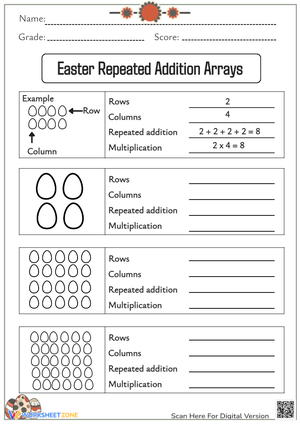
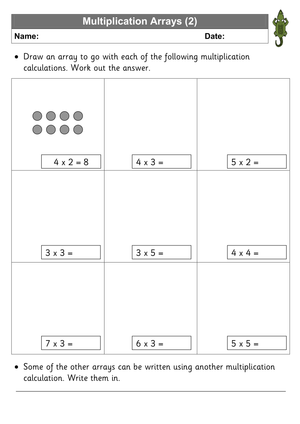
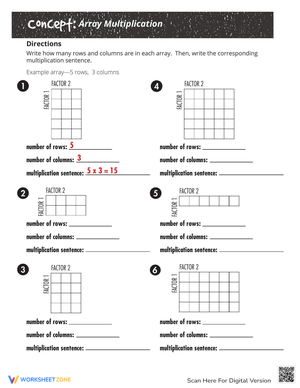
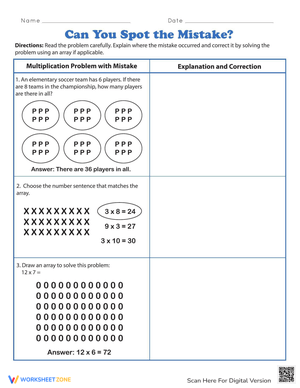
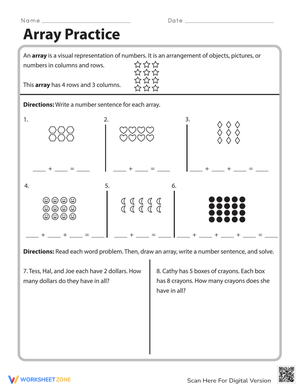
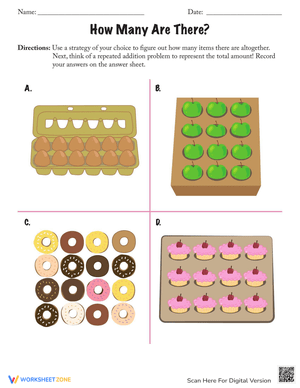
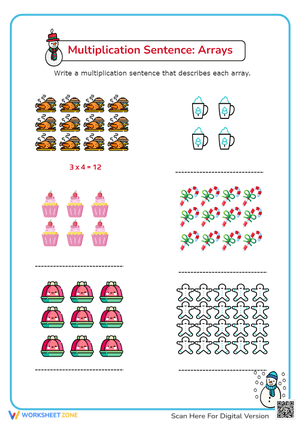
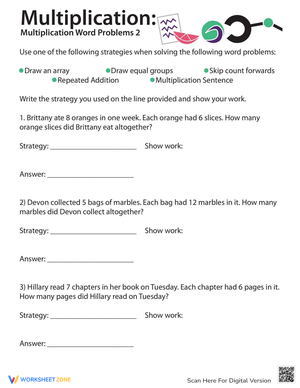
Multiplication arrays worksheets should not be introduced as a single skill in isolation. They follow a specific standards progression that starts in grade 2 and expands in grade 3. CCSS.MATH.CONTENT.2.OA.C.4 asks second graders to use addition to find the total number of objects arranged in rectangular arrays with up to 5 rows and 5 columns, which caps the complexity of the array while students are still counting by addition.
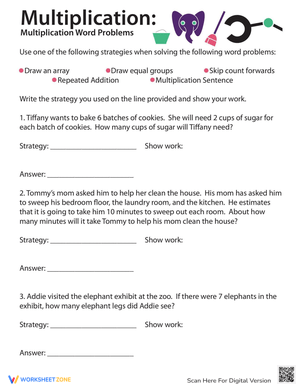
By grade 3, the expectation grows. CCSS.MATH.CONTENT.3.OA.A.1 has students interpret products of whole numbers as the total number of objects in equal groups, including arrays, moving them from counting toward true multiplicative reasoning. CCSS.MATH.CONTENT.3.OA.A.3 then requires students to use multiplication and division within 100 to solve word problems involving equal groups, arrays, and measurement quantities, which is where array worksheets start to look like the word problems students will see on assessments.
A useful planning detail is the explicit row-and-column cap in grade 2: worksheets should stay within 5 rows and 5 columns so students can verify totals by skip counting or repeated addition without the array becoming too large to check by hand.
Sequencing Worksheets from Grade 2 to Grade 3
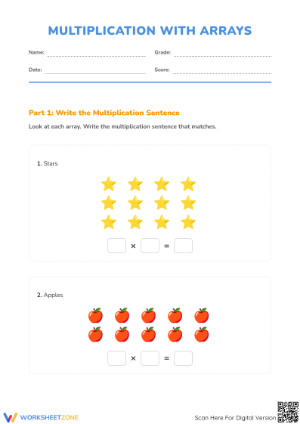
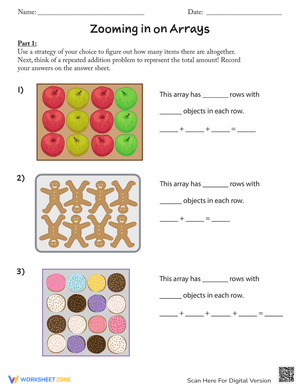
Effective use of multiplication arrays worksheets depends on sequencing them deliberately rather than handing out random array practice sheets. Start grade 2 students with arrays capped at 5 by 5, paired with addition sentences underneath each array so students connect the visual to the numeric total. As students grow comfortable, remove the addition scaffold and ask them to write the total directly.
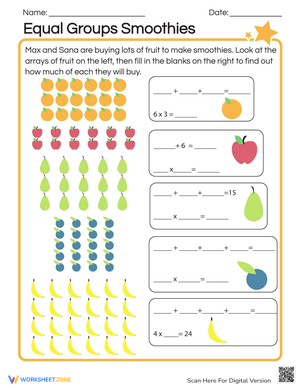
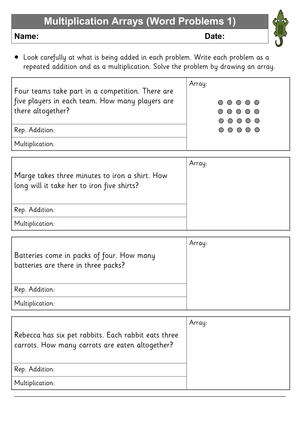
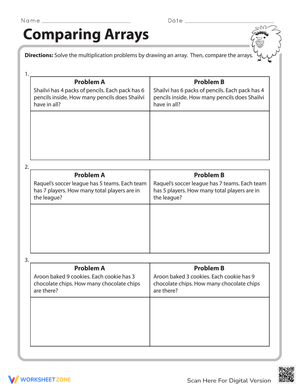
In grade 3, expand the array size beyond 5 by 5 and pair each array with both a multiplication sentence and a related word problem. This keeps the array connected to the grade 3 expectation that students interpret products within the context of equal groups and arrays, not as an abstract fact drill.
- Grade 2: arrays capped at 5 rows by 5 columns with addition support
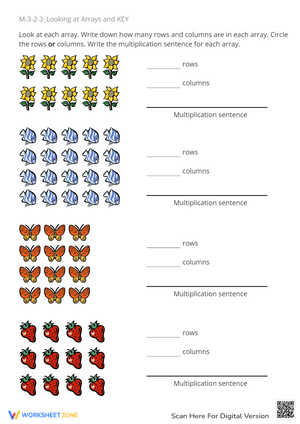
- Grade 2 to grade 3 transition: same array sizes, multiplication sentence added
- Grade 3: larger arrays with products within 100, tied to word problems
Arrays Make the Commutative Property Visible
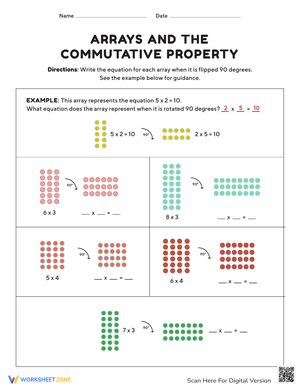
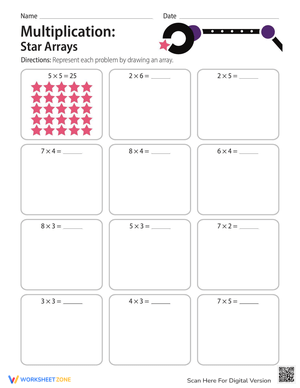
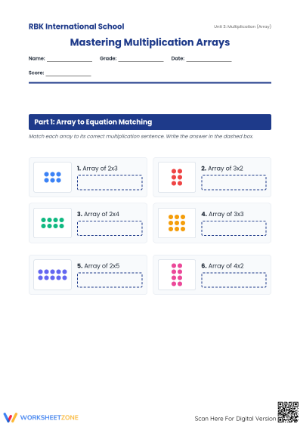
One of the strongest instructional reasons to use array worksheets is that they make the commutative property of multiplication visible without requiring a formal explanation. When a student rotates an array of 3 rows by 7 columns, they can see it becomes 7 rows by 3 columns, and the total stays the same. This visual proof is far more convincing to a young learner than being told that order does not matter in multiplication.
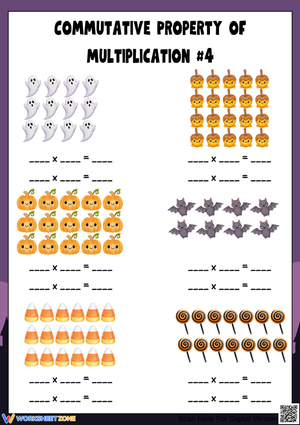
Worksheets that ask students to draw both orientations of the same array, then write both multiplication sentences underneath, reinforce this property in a way that sticks. It also reduces the common student misconception that 3 x 7 and 7 x 3 are separate facts to memorize independently.
Bridging Arrays to Area Models
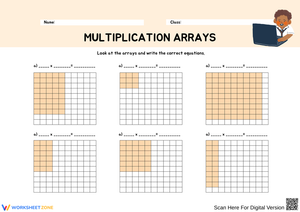
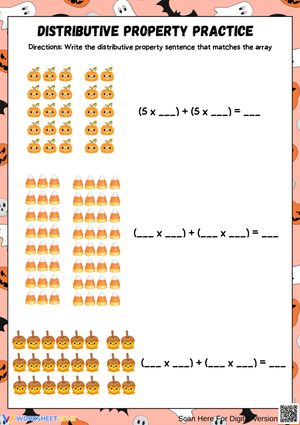
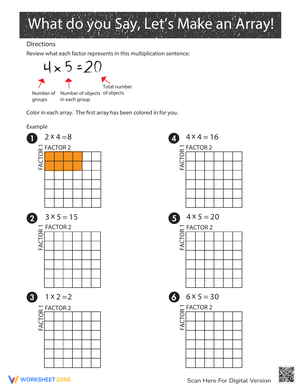
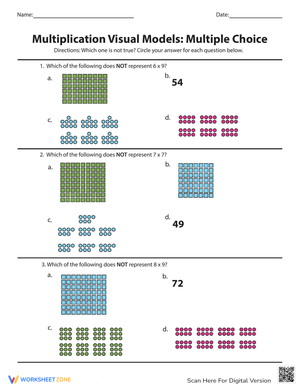
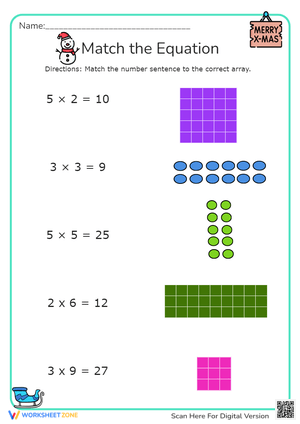
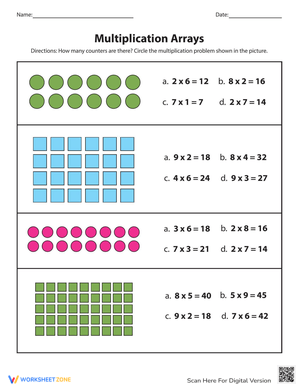
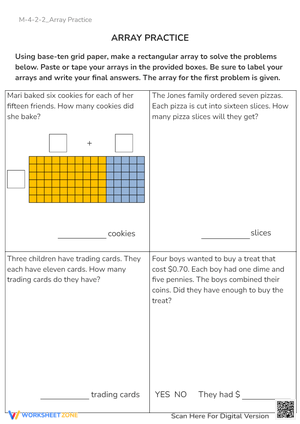
Arrays and area models share the same rows-times-columns structure, which makes array worksheets a natural bridge to the area model of multiplication that students will use with larger numbers in later grades. A worksheet that shows a grid of unit squares next to a dot array of the same dimensions helps students see that counting squares and counting dots follow the identical logic.
This connection is worth building early, even in grade 3, because it previews the area model students will rely on for multi-digit multiplication. Teachers who introduce this link now save instructional time later when area models appear without a familiar starting point.
Classroom Implementation
To implement multiplication arrays worksheets effectively, pair each worksheet with a short verbal check: ask a student to explain what the rows and columns represent before they write a multiplication sentence. This catches students who fill in an answer without connecting it to the visual model.
Rotate worksheet formats across a unit so students see arrays represented as dot grids, grid paper squares, and simple line drawings. This variety keeps students from associating multiplication only with one specific picture format, which supports better transfer to the word problems required by grade 3 standards.
Use array worksheets as a quick formative check partway through a lesson. If a student can correctly build and label an array in under two minutes, that is a strong signal they are ready for equal-groups word problems; if they struggle, keep them on array construction with concrete counters a bit longer before moving to abstract number sentences.
Frequently Asked Questions
1. What grade level are multiplication arrays worksheets appropriate for?
Multiplication arrays worksheets are most directly tied to grade 2 and grade 3. Grade 2 worksheets should stay within 5 rows and 5 columns per CCSS.MATH.CONTENT.2.OA.C.4, while grade 3 worksheets can expand to products within 100 per CCSS.MATH.CONTENT.3.OA.A.3.
2. How do arrays differ from equal-groups models when teaching multiplication?
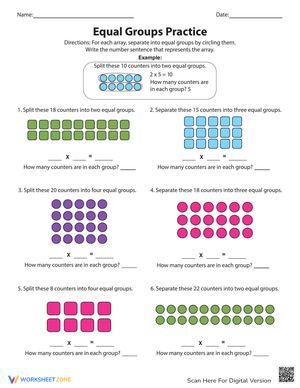
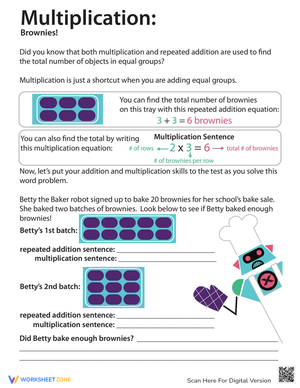
Both arrays and equal-groups models represent the same multiplication idea, but arrays organize objects into strict rows and columns, while equal-groups models can show objects clustered in circles or other shapes. CCSS.MATH.CONTENT.3.OA.A.1 treats arrays as one specific type of equal-groups representation.
3. How can teachers use array worksheets to prep students for area-model multiplication?
Pair dot arrays with grid-paper worksheets of the same dimensions so students see that counting squares in a grid follows the same rows-times-columns logic as counting dots in an array. This early connection makes the later area model for multi-digit multiplication feel familiar rather than new.
4. What CCSS standards do multiplication arrays worksheets support?
Multiplication arrays worksheets primarily support CCSS.MATH.CONTENT.2.OA.C.4 in grade 2, and CCSS.MATH.CONTENT.3.OA.A.1 and CCSS.MATH.CONTENT.3.OA.A.3 in grade 3, all of which reference arrays explicitly within the operations and algebraic thinking domain.
5. How should teachers use arrays with students who are struggling with multiplication facts?
Give struggling students blank grids and physical counters so they build arrays themselves rather than only interpreting pre-drawn ones. Watching how a student constructs and labels their own array reveals whether the gap is in counting, skip counting, or translating the count into a multiplication sentence, which points to a more targeted next step than fact drills alone.













 Interactive Worksheet Maker
 Quiz Maker
 Word Search Maker
 Crossword Puzzle Maker
 Word Scramble Generator
 Sentence Scramble Generator
 Handwriting Worksheet Generator
 Name Tracing Generator
 Fill In The Blank Generator