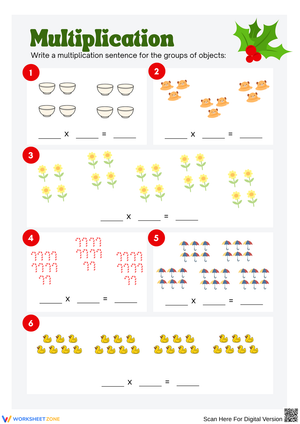
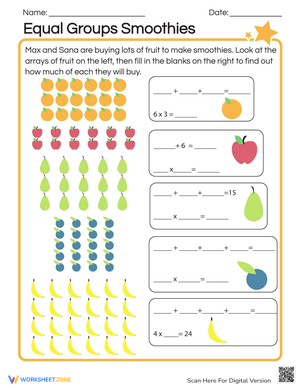
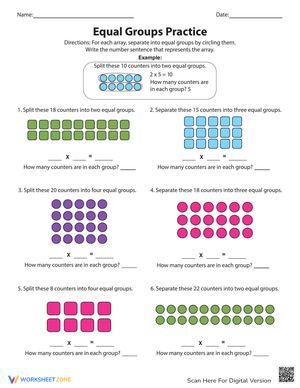
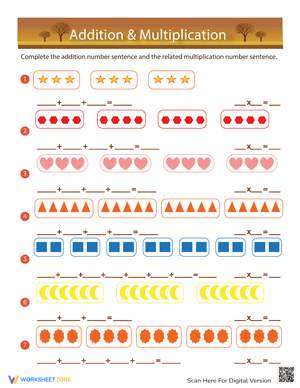
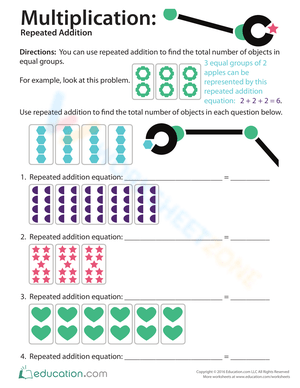
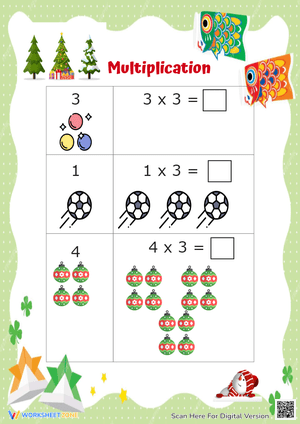
These multiplication as equal groups worksheets give 2nd and 3rd graders a structured visual bridge between repeated addition and the multiplication sentence — the exact transition most students need before times tables make sense. Each worksheet pairs drawn-group models with equation-writing practice so students build the concept, not just the procedure.
What Each Worksheet Targets
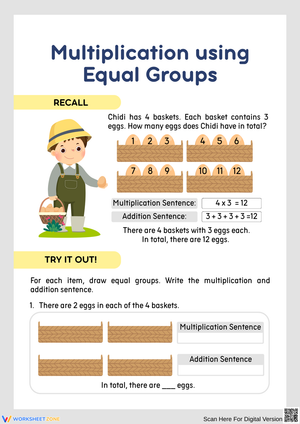
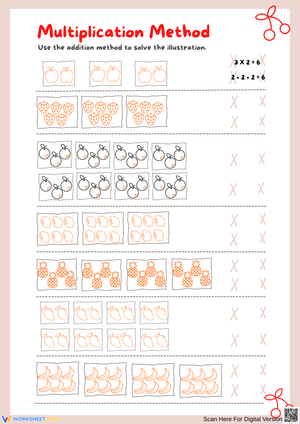
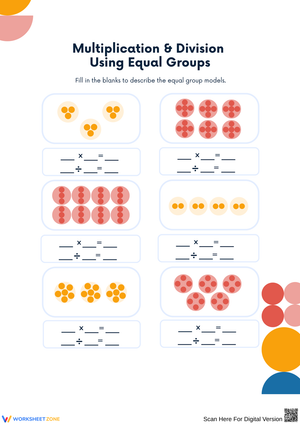
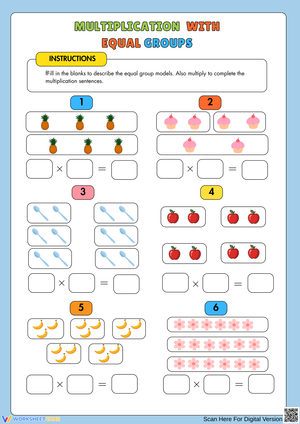
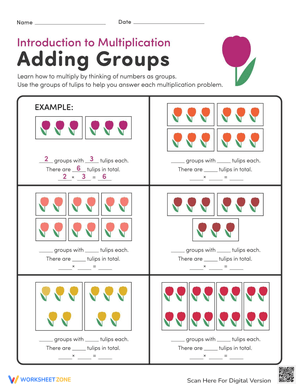
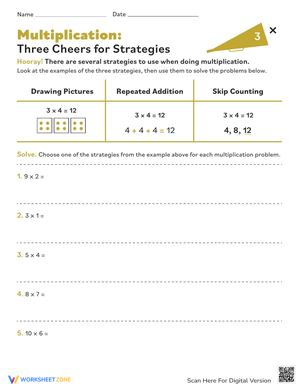
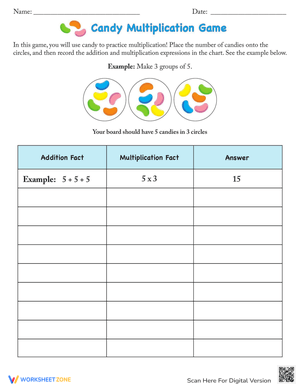
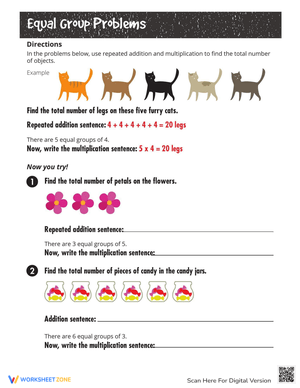
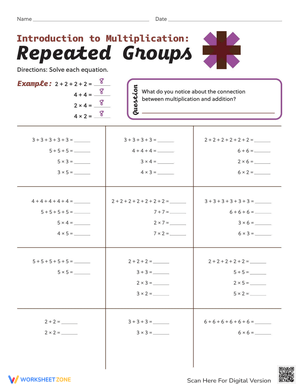
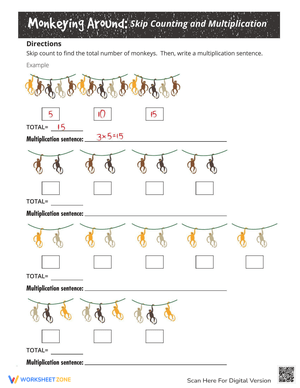
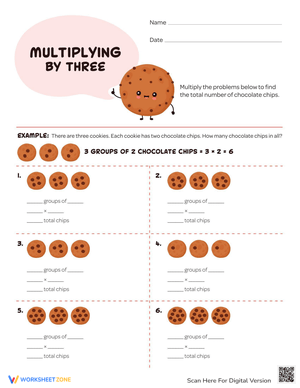
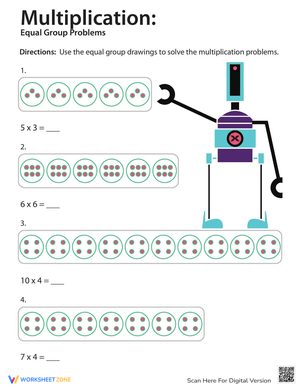
The set focuses on the specific sub-skills that early multiplication instruction requires in sequence. Students draw circles to represent groups, place a counted number of dots or marks inside each, and then write both the repeated addition sentence and the corresponding multiplication equation side by side. That side-by-side structure is deliberate: it asks students to see 3 + 3 + 3 + 3 and 4 × 3 as two ways of saying the same thing before they're asked to use only the second form. Later worksheets in the set reverse the process — students read a multiplication sentence and draw the groups it describes, which shifts them from interpreting a model to producing one.
- Drawing equal groups from a given multiplication expression
- Writing repeated addition sentences from drawn models
- Translating addition sentences into multiplication equations
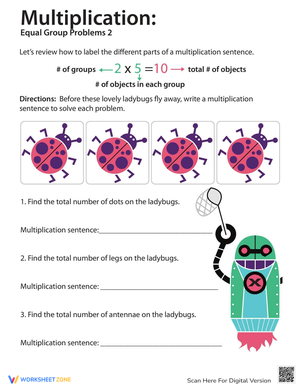
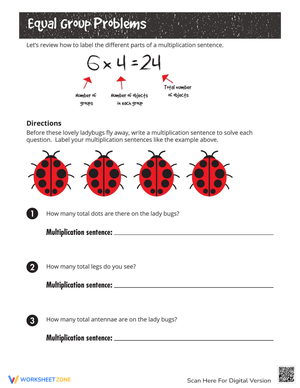
- Labeling the number of groups and the size of each group separately
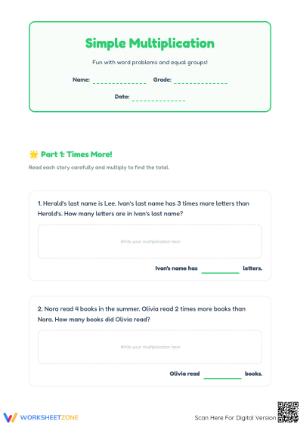
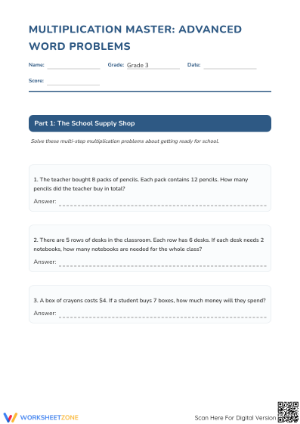
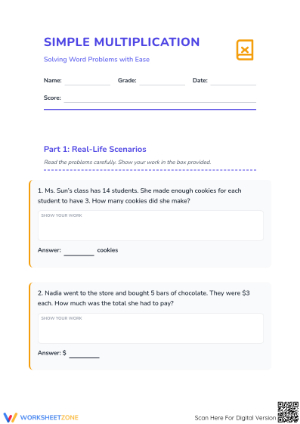
- Interpreting word problems that describe grouping situations
Why This Format Works for This Skill at This Grade
Multiplication is abstract in a way that addition is not. When a student adds 4 + 4, she can hold up fingers. When she multiplies 4 × 4, the operation itself has no intuitive physical gesture. Equal groups restore that concreteness. Drawing the circles and filling them in is a low-cognitive-load entry point: the student manages the quantity inside one group at a time rather than trying to hold the entire product in working memory. Once that physical act of drawing is automatic, the written equation that follows it carries meaning the student constructed herself — which is what moves a fact from memorized to understood.
Research on early number sense consistently shows that students who skip the representational stage and go straight to symbolic multiplication are more likely to confuse factors when word problems change the surface structure. These worksheets keep students in that representational stage long enough for the concept to stabilize.
Frequent Student Errors Worth Watching For
The most consistent error in this skill — and the one that causes the most downstream trouble — is swapping the number of groups with the group size. When a student sees 5 × 3, she frequently draws three circles with five dots each instead of five circles with three dots each. The product is the same, so the answer looks correct, and many teachers mark it correct without noticing. But this confusion surfaces badly in third-grade word problems: "There are 5 baskets. Each basket holds 3 apples. How many apples in all?" A student who has been drawing the factors in the wrong order will set up the model incorrectly and lose the thread of the story context.
The fix is linguistic before it's procedural. Train students to read 5 × 3 aloud as "five groups of three" every time — not "five times three." Requiring them to write the word groups above the circles on their worksheet (not just draw them) slows the process down just enough to make the structure visible. Several worksheets in the set include that labeling step explicitly; for the others, it's worth adding as a verbal expectation during whole-class modeling.
Building These Worksheets Into Your Lesson Plans
The most effective placement for these is the guided-practice phase of a new lesson, not homework. Equal groups is a concept that needs live error-correction the first several times students work with it. Projecting a worksheet on the board and drawing through the first two problems together — narrating the group-size distinction aloud as you draw — gives students a model they can refer back to when they work independently. After that shared anchor, students complete the rest of the worksheet while you circulate. The problems at the top of each worksheet are simpler (smaller numbers, fewer groups) so you can gauge quickly who needs a pull-aside and who's ready to work ahead.
For math centers, pair the worksheets with physical counters or two-color chips. Students who build the groups with manipulatives before drawing them make significantly fewer factor-order errors than students who go straight to pencil. The tactile step isn't busywork — it slows the process enough that students are still thinking about group structure rather than just counting to a product. Once a student can draw the model correctly without using the manipulatives first, she's ready to move toward more symbolic practice.
Adjusting the Worksheets for a Range of Learners
For students who are still shaky on the concept, restrict the independent work to expressions with a group size of 2 or 3 and no more than 5 groups. The visual becomes unmanageable when a student is drawing 6 groups of 8 dots and hasn't yet internalized what the groups represent. Smaller numbers let you isolate the conceptual understanding from the counting challenge. Provide a number line alongside the worksheet so those students can verify their repeated addition without losing the thread of the group model.
Students who grasp equal groups quickly often stall when asked to write the equation because they've understood the picture but haven't made the symbolic connection automatic. For those students, add a challenge step: after writing the multiplication sentence, write the related division sentence. This isn't a separate topic — it's a natural extension that keeps fast finishers thinking about the relationship between operations rather than just coloring in dots. It also previews the inverse relationship they'll need in 3rd grade without formally introducing division before it's taught.
Standard Alignment
These worksheets address CCSS 2.OA.C.4 (using addition to find the total number of objects arranged in rectangular arrays and writing an equation) and the early groundwork for 3.OA.A.1, which defines multiplication as the total number of objects in equal groups. Instructionally, 2.OA.C.4 is where most teachers introduce the grouping language — "rows of," "groups of" — that students will need when 3.OA.A.1 formalizes it as multiplication. Using these multiplication as equal groups worksheets during second grade means students arrive in third grade with the visual model already familiar, so the introduction of the × symbol lands on existing conceptual footing rather than starting from scratch.
Frequently Asked Questions
At what point in a multiplication unit should I introduce these worksheets?
Use them at the very start — before any symbolic notation, before the word "multiplication" appears on its own. Begin with the drawing task: given a picture of groups, students write only the repeated addition sentence. Once that's solid, introduce the multiplication sentence as the shorthand version. Students who see the symbol first and the groups later often treat the groups as an afterthought rather than the meaning behind the equation.
What's the difference between equal groups and array models, and should I teach both?
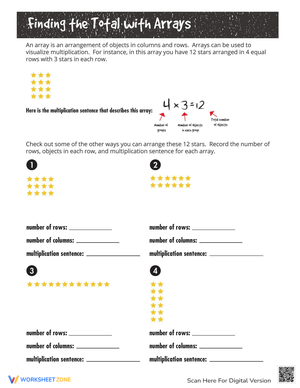
Equal groups use separate circles or containers with items inside — the groups are visually distinct. Arrays organize the same items into rows and columns where the grouping structure is implied by position. Most students find equal groups easier to draw and interpret first because the boundary of each group is explicit. Arrays come later and connect more directly to area models and the commutative property. Teaching equal groups first gives students the conceptual language ("groups of") they'll need to make sense of arrays when you introduce them.
My students get the drawing right but write the multiplication sentence with the factors reversed. Is that a problem?
Yes, in context it is. The commutative property means the product is the same, but the meaning is different — and that matters for word problems. A student who writes 3 × 5 when the model shows 5 groups of 3 has stopped reading the structure and is just recording two numbers she sees. Address it by returning to the verbal: "How many groups? That number goes first." Consistent language during instruction is more effective than marking it wrong after the fact.
Can these worksheets be used for intervention with older students who missed this concept?
Yes, with a framing adjustment. A 4th grader working on multiplication facts who still doesn't have a clear model for what the operation means can use these worksheets without embarrassment if they're presented as a strategy lesson rather than a remediation. Focus the session on the factor-order insight and the connection to word problems rather than on the drawing itself — older students often find the drawing juvenile, but the conceptual gap the drawing addresses is real.













 Interactive Worksheet Maker
 Quiz Maker
 Word Search Maker
 Crossword Puzzle Maker
 Word Scramble Generator
 Sentence Scramble Generator
 Handwriting Worksheet Generator
 Name Tracing Generator
 Fill In The Blank Generator