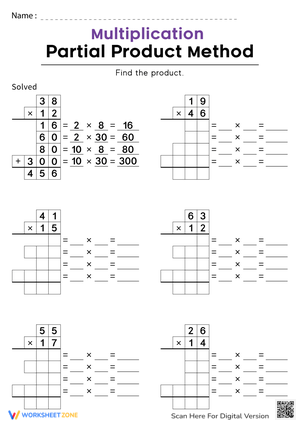
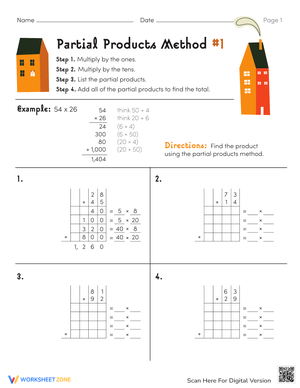
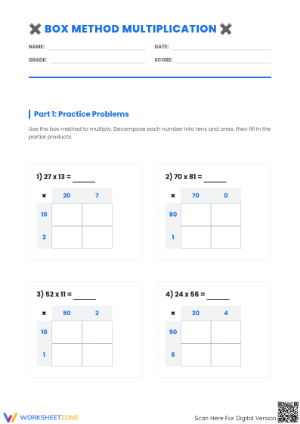
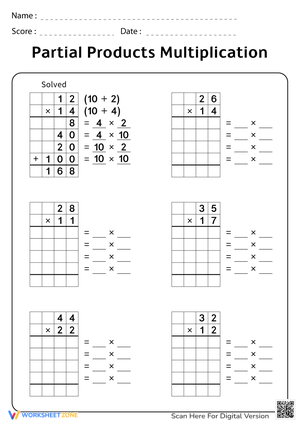
These partial products worksheets give fourth-grade teachers structured practice materials for one of the most conceptually demanding transitions in upper-elementary math — the move from visual area models to efficient numerical multiplication. Each worksheet targets the distributive property and place value reasoning that students need before the standard algorithm makes any sense.
What Each Worksheet Builds
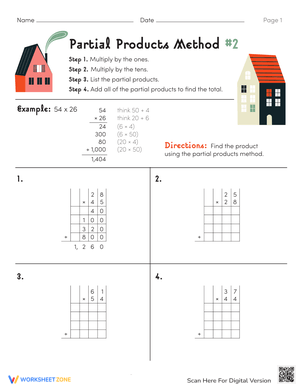
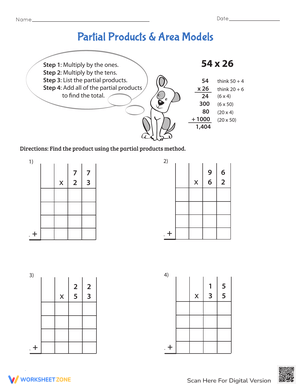
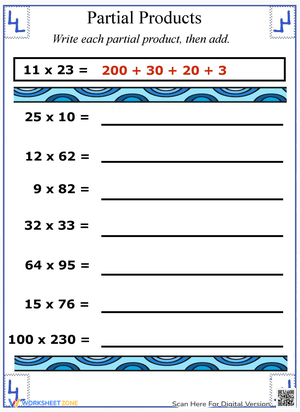
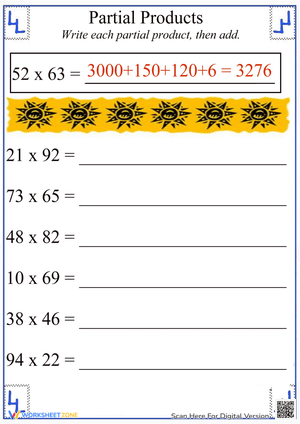
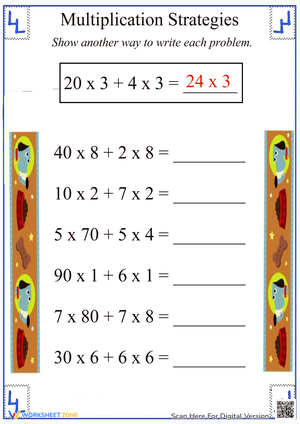
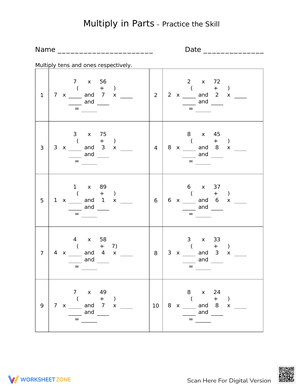
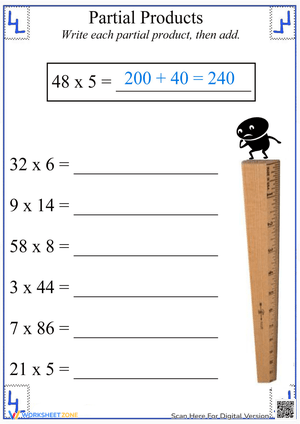
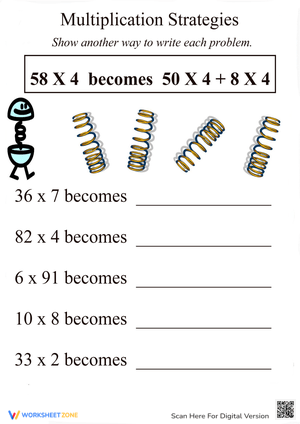
The core skill across the set is breaking factors into expanded form and multiplying each part separately before adding. A student working through 47 × 6, for instance, writes 40 × 6 = 240 and 7 × 6 = 42, then combines them. That sequencing — decompose, multiply by place value, sum — is what every worksheet reinforces, problem after problem, until it becomes the students' default reasoning before they ever see a regrouping step.
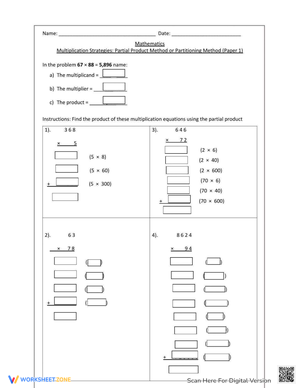
The set progresses in complexity. Early worksheets focus on two-digit by one-digit problems, where students can manage the decomposition with confidence. Later worksheets move into three-digit by one-digit and two-digit by two-digit problems, which require tracking four partial products instead of two. At that stage, alignment and organization become as important as the multiplication itself.
Frequent Student Errors Worth Watching For
The single most persistent error is place value collapse on the tens row. A student multiplying 30 × 4 writes 12 instead of 120 — not because they forgot to multiply, but because they dropped the zero and treated 30 as if it were 3. This happens consistently around the third or fourth problem of a new problem type, once the novelty wears off and automaticity kicks in too early. Some worksheets in the set scaffold against this by formatting the tens row with a placeholder zero pre-printed in the ones column, which forces students to register magnitude before they write anything.
The second error pattern shows up at the addition stage. A student can execute every partial product correctly and still get the wrong final answer because they added 240 and 42 in a misaligned column. Graph-paper formatting in the worksheets addresses this directly — students who cannot hold place value in their handwriting stop losing points on arithmetic they actually understand.
Why This Format Works for This Skill at This Grade
Fourth grade is where multiplication stops being a recall task and becomes a reasoning task. Students who have solid facts still struggle with 34 × 7 because the problem requires them to hold two things in mind simultaneously: the place value of each digit and the operation. The partial products format reduces cognitive load by externalizing the decomposition step — students write out 30 × 7 and 4 × 7 as separate recorded lines rather than holding both in working memory while executing the standard algorithm's compressed regrouping steps. Once the logic is visible on paper repeatedly, the internal structure of multi-digit multiplication becomes clearer, and the standard algorithm stops looking like an arbitrary sequence of rules.
This is also why the worksheets work better as guided or semi-independent practice than as pure homework at the beginning of a unit. The format needs a teacher nearby, at least initially, to catch the place value collapse error before it becomes a habit.
How to Build These Worksheets Into Your Lesson Plans
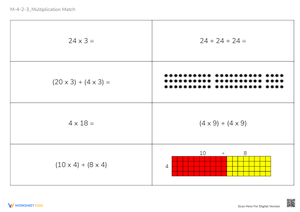
The most effective placement is immediately after a whole-group area model lesson, when students have just drawn rectangles partitioned by place value and labeled each section. Assign a partial products worksheet the same day and ask students to work the first two problems side by side with a rough area model sketch on scratch paper. The goal is for them to see that the 240 they're writing in the numerical format is the same region they were shading in the box. Once that connection is visible, you can pull the area model away on problems three and four.
For small-group intervention, pick problems from the middle of the set — two-digit by one-digit problems with a tens digit of 4 or higher, where the place value zero error is most likely to surface. Work two problems aloud together before releasing students to the remaining ones independently. The last five minutes of that block are enough to check alignment errors before they leave.
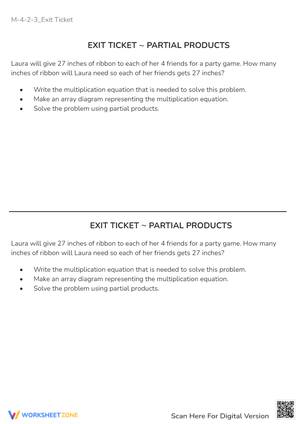
Exit ticket use is straightforward: pull one problem from the current worksheet, one level harder than what students practiced, and watch whether they decompose correctly or revert to single-digit thinking. That one problem tells you more than scanning a completed page.
Adapting the Set for a Range of Learners
Students who are still shaky on basic facts struggle with partial products practice because each problem requires three or four separate fact retrievals in sequence. For those students, allow a multiplication chart during the decomposition worksheets so the cognitive work stays on the place value structure rather than stalling at 7 × 8. Remove the chart once fact fluency catches up — the partial products habit will already be established.
For students who move through two-digit by one-digit problems quickly, the two-digit by two-digit worksheets in the set introduce a genuine new challenge: now there are four partial products to track — ones × ones, ones × tens, tens × ones, tens × tens — and the addition at the end involves three and four addends. A natural extension is having those students solve a problem using partial products, then solve the same problem using the standard algorithm, and write one sentence explaining why both answers match. That comparison task reveals whether they understand the compression that the algorithm performs or are just executing steps.
Standard Alignment
These worksheets align with 4.NBT.B.5, which requires students to multiply a whole number up to four digits by a one-digit number, and to multiply two two-digit numbers, using strategies based on place value and properties of operations. The standard explicitly expects students to illustrate and explain their calculations — partial products fulfills that expectation more directly than the standard algorithm, since every step is written out and labeled by place value. The set also supports 3.OA.B.5 at the foundational level, particularly the distributive property, which underpins the decomposition logic students use in every problem.
Frequently Asked Questions
Are these worksheets appropriate for fifth grade, or are they strictly a fourth-grade resource?
The set works well in fifth grade as a review or reteach tool, particularly at the start of the year for students who learned the standard algorithm without understanding it. The two-digit by two-digit problems are especially useful for building the conceptual base students need before decimal multiplication, where place value reasoning becomes critical again.
How many partial products does a two-digit by two-digit problem produce?
Four. Each digit in the first factor is multiplied by each digit in the second factor, with every product recorded at its actual place value. So 34 × 27 produces 4 × 7 = 28, 30 × 7 = 210, 4 × 20 = 80, and 30 × 20 = 600, which sum to 918. The worksheets format these four rows explicitly so students see the full accounting before they add.
Do students need to know their multiplication facts before using these worksheets?
Ideally yes, but it is not a hard prerequisite. Students who are still consolidating facts can use the worksheets successfully with a reference chart. The goal of partial products practice is place value structure, and a fact chart keeps the focus there rather than letting fact retrieval block the reasoning. Pull the chart away as fluency develops.
Can these worksheets be used with students who have already learned the standard algorithm?
Yes, and it is often worth doing. Students who learned the algorithm procedurally — without understanding what the carried digit represents — frequently have gaps that show up in decimal or algebraic contexts. Working through partial products worksheets retroactively makes the algorithm's structure legible. Most students find the comparison clarifying rather than confusing.













 Interactive Worksheet Maker
 Quiz Maker
 Word Search Maker
 Crossword Puzzle Maker
 Word Scramble Generator
 Sentence Scramble Generator
 Handwriting Worksheet Generator
 Name Tracing Generator
 Fill In The Blank Generator