


























Views
Downloads

Printable Counting Coins Worksheet | Grade 2 Math
Paste this activity's link or code into your existing LMS (Google Classroom, Canvas, Teams, Schoology, Moodle, etc.).
Students can open and work on the activity right away, with no student login required.
You'll still be able to track student progress and results from your teacher account.
This comprehensive money math worksheet helps second-grade students master the essential skill of counting mixed U.S. coins. By progressing from basic identification to complex word problems, students build the financial literacy needed for real-world transactions. This resource ensures learners can confidently calculate totals using pennies, nickels, dimes, and quarters to reach specific cent values.
At a Glance
- Grade: 2 · Subject: Math
- Standard:
CCSS.MATH.CONTENT.2.MD.C.8— Solve word problems involving quarters, dimes, nickels, and pennies using appropriate symbols- Skill Focus: Mixed coin counting and money application
- Format: 4 pages · 18 problems · Answer key included · PDF
- Best For: Independent practice or small group instruction
- Time: 25–35 minutes
Inside this four-page PDF packet, you will find a structured learning journey featuring visual coin bags, matching exercises, and realistic word problems. The worksheet includes clear illustrations of pennies, nickels, dimes, and quarters for easy identification. A complete answer key is provided, allowing teachers or parents to quickly verify student calculations and provide immediate feedback on cent totals.
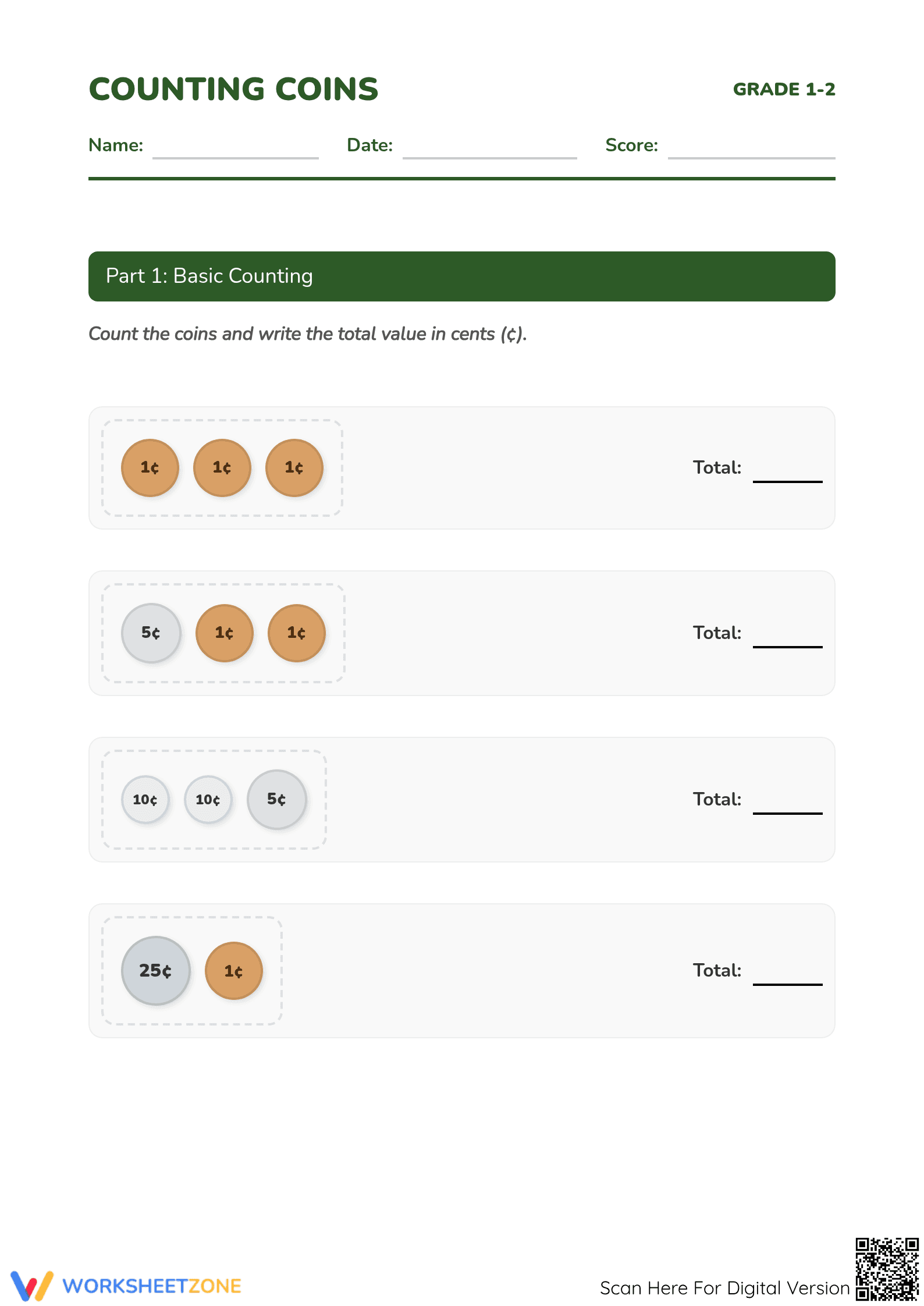
- Guided Practice: Four basic counting sets where students total small groups of identical or similar coins using clear visual cues and dedicated total lines.
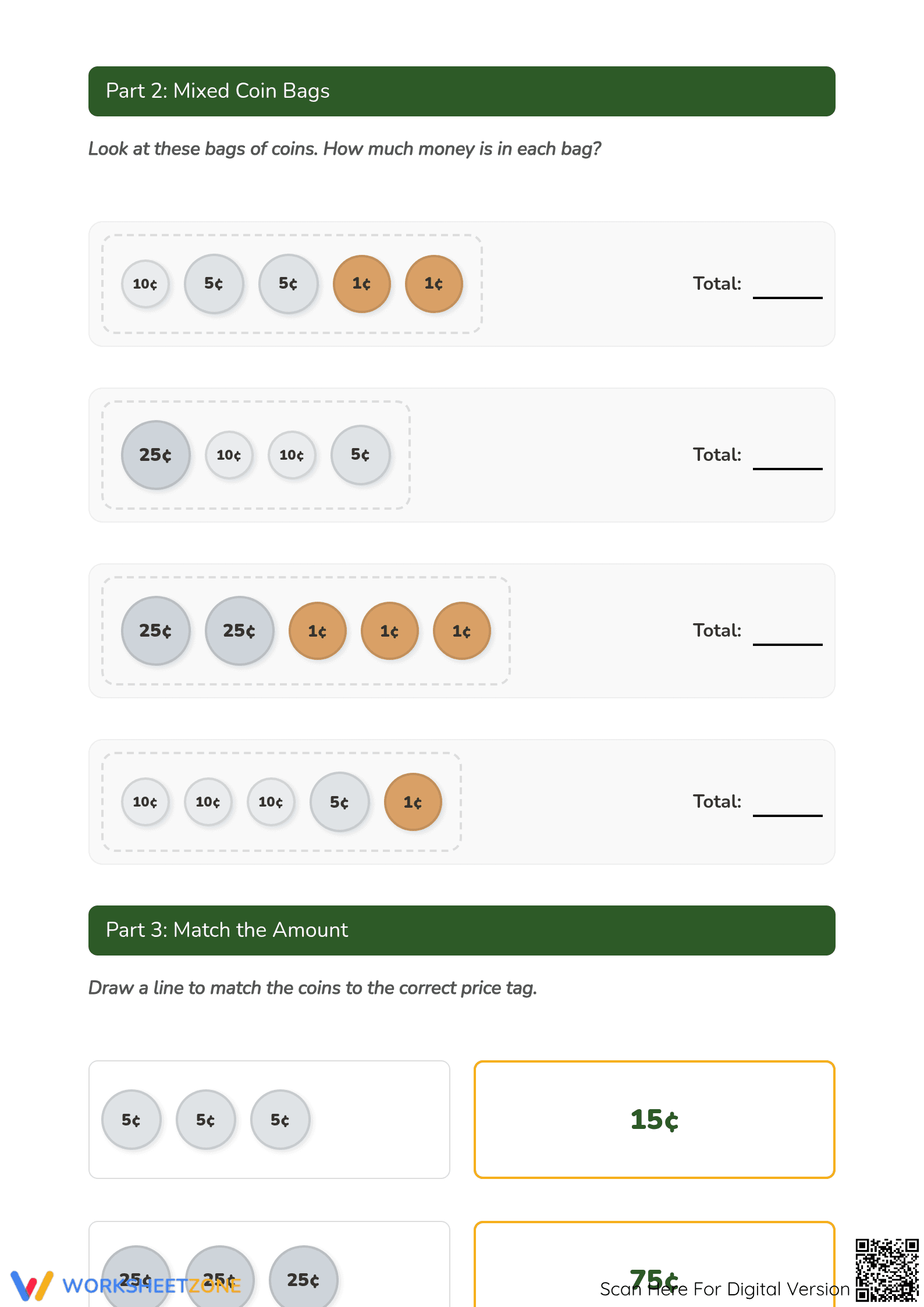
- Supported Practice: Mixed coin bags and matching tasks with seven problems that require switching between different denominations and values to find correct totals.
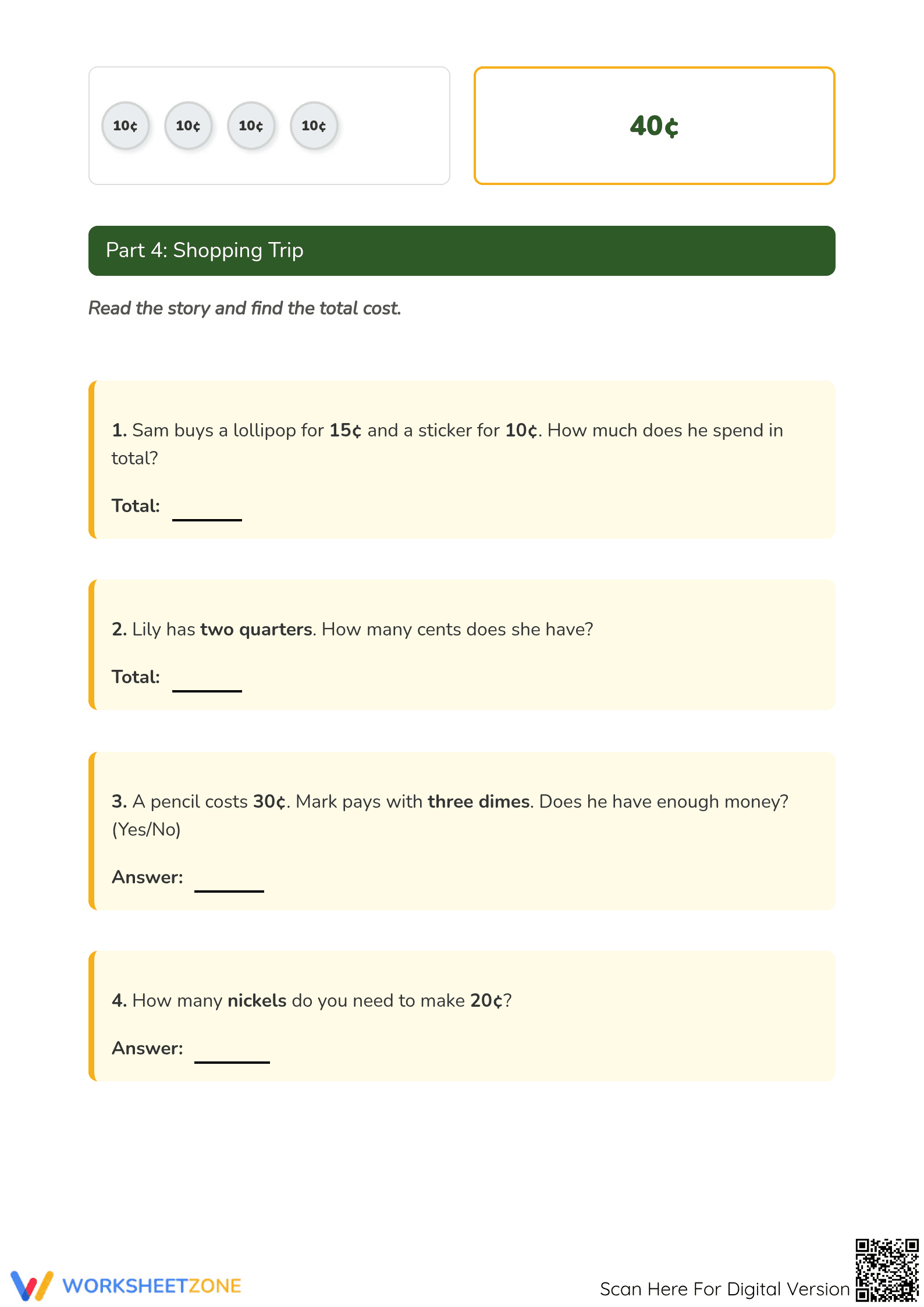
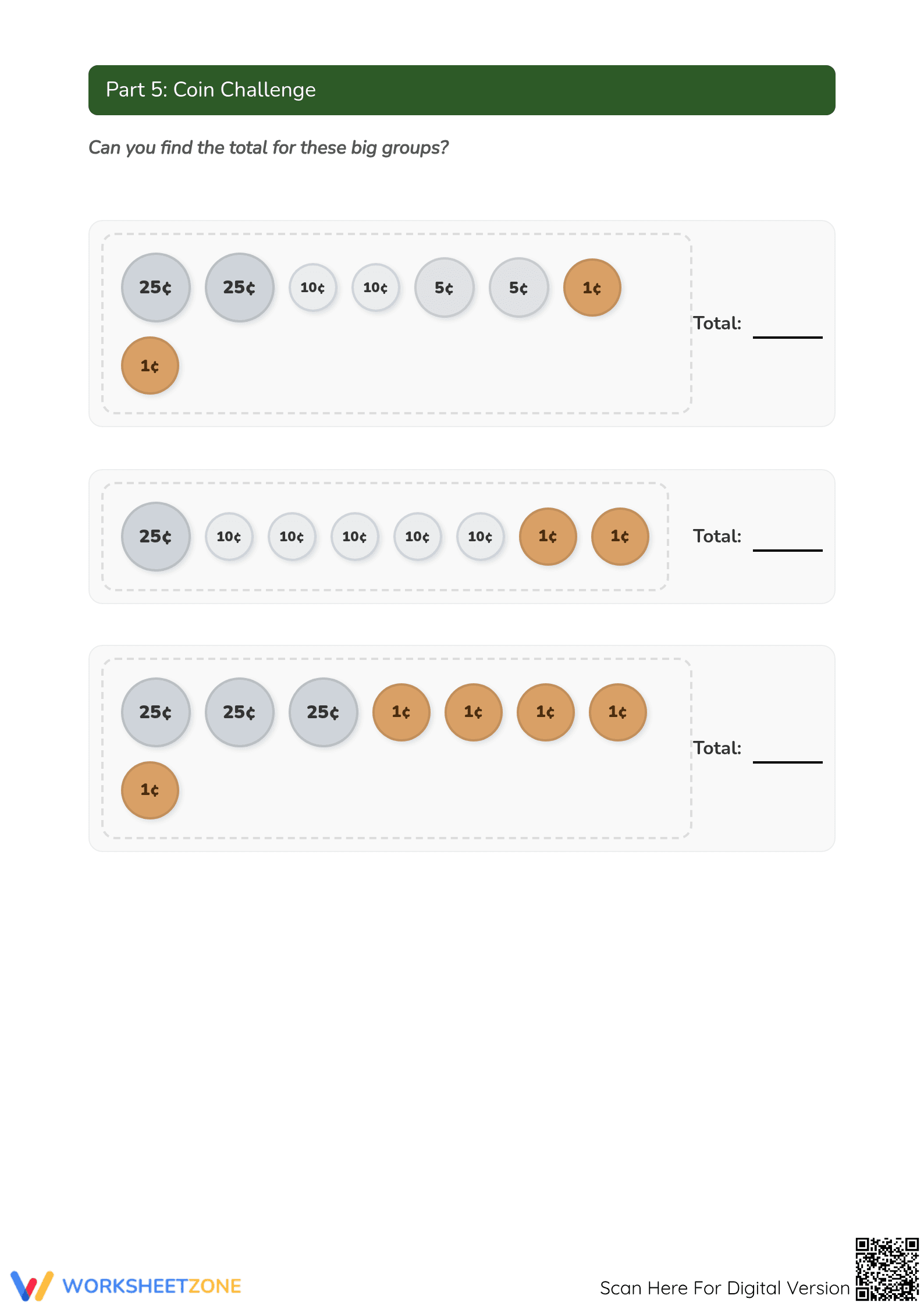
- Independent Practice: Seven advanced tasks including word problems in a 'Shopping Trip' context that ask students to apply their knowledge to multi-step real-world scenarios.
This structure follows a gradual-release model to ensure students move confidently from teacher-led modeling to independent mastery of currency calculations.
The primary focus is CCSS.MATH.CONTENT.2.MD.C.8, which requires students to solve word problems involving dollar bills, quarters, dimes, nickels, and pennies, using $ and ¢ symbols appropriately. This also supports Grade 1 foundational skip-counting by fives and tens. Both standard codes can be copied directly into lesson plans, IEP goals, or district curriculum mapping tools.
Use this as a summative assessment or scaffolded direct instruction. Have students use physical coins alongside the worksheet to bridge concrete and abstract math. Observe if students count the largest denominations first to check for efficiency. Completion typically takes 30 minutes, providing a clear snapshot of student proficiency in currency summation.
This resource is ideal for Grade 2 students, though it serves as enrichment for Grade 1 or review for Grade 3. It pairs well with a classroom 'store' or a coin value anchor chart during financial literacy units.
Aligned with the rigorous expectations of CCSS.MATH.CONTENT.2.MD.C.8, this worksheet focuses on the critical transition from coin identification to functional mathematical application. Research from the NAEP highlights that early competency in identifying and summing currency values is a significant predictor of future success in decimal-based operations and general algebraic thinking. By requiring students to interpret word problems in a "Shopping Trip" context, the resource leverages the "situated cognition" framework described by Fisher & Frey (2014), which posits that learning is most effective when embedded within authentic, relatable scenarios. This specific 18-task set provides the exact volume of practice recommended by EdReports 2024 for building procedural fluency without overwhelming the learner. Teachers can rely on this vetted structure to bridge the gap between basic number sense and complex financial literacy, ensuring that every Grade 2 student develops a robust understanding of cents and currency symbols.


