




























Views
Downloads
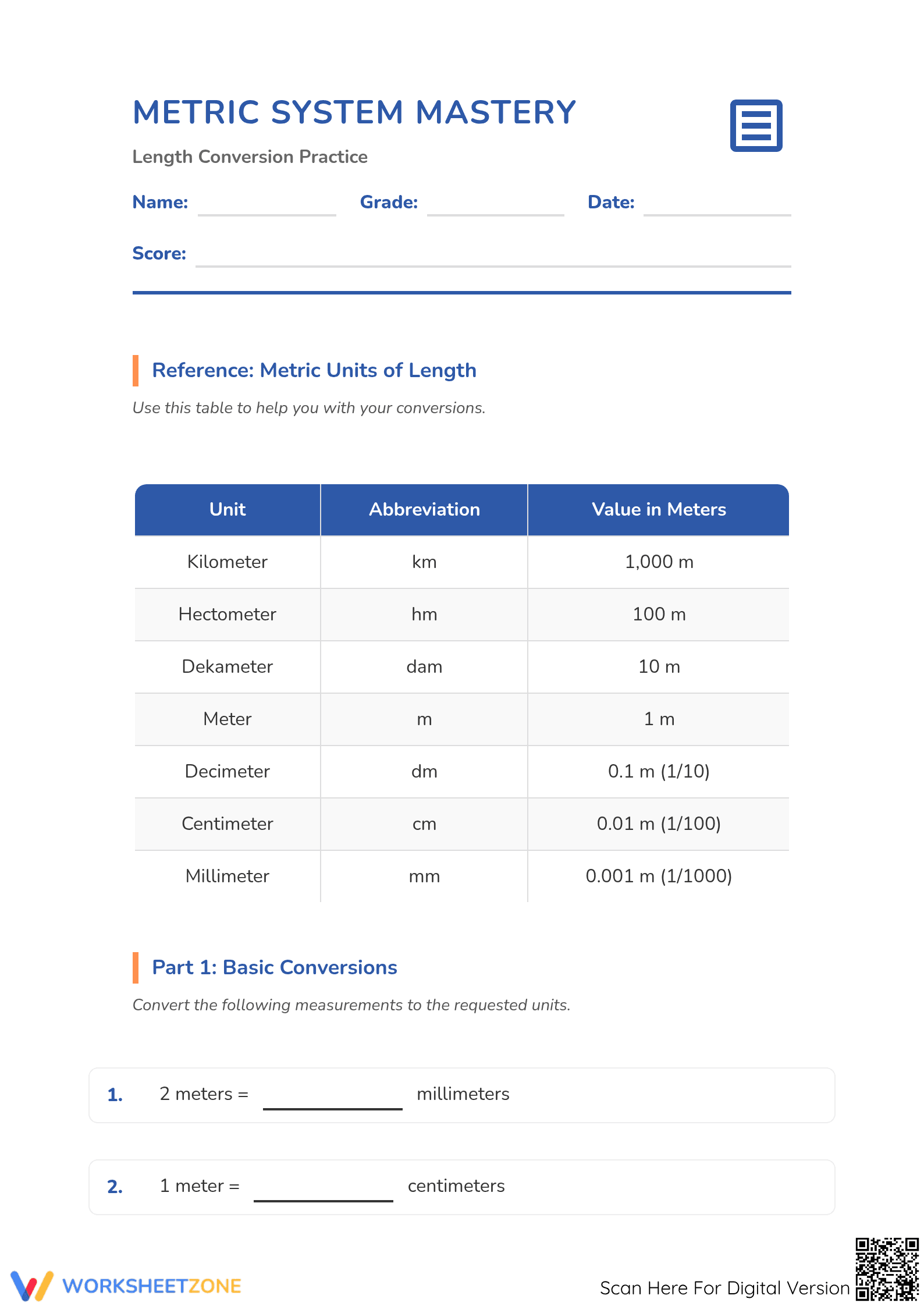


Printable Metric Conversion Worksheet | Grade 5 Math

Paste this activity's link or code into your existing LMS (Google Classroom, Canvas, Teams, Schoology, Moodle, etc.).
Students can open and work on the activity right away, with no student login required.
You'll still be able to track student progress and results from your teacher account.
This Grade 5 math worksheet provides focused practice on converting metric units of length. Students will strengthen their ability to convert between millimeters, centimeters, meters, and kilometers, and apply their understanding of scale to measurement scenarios, building a key skill in the metric system.
At a Glance
- Grade: 5 · Subject: Math
- Standard:
CCSS.MATH.CONTENT.5.MD.A.1— Convert units within a measurement system and use in multi-step problems.- Skill Focus: Metric unit conversion, measurement, and scale
- Format: 4 pages · 20 problems · Answer key included · PDF
- Best For: Independent practice, skill reinforcement, or homework
- Time: 20–30 minutes
What's Inside
This resource contains a three-page worksheet with 20 problems and a one-page answer key. The problems are organized into five parts, progressing from direct unit conversions (mm, cm, m, km) to using a map scale to determine real-world distances. This structure supports a clear learning path.
A Clear Skill Progression
The worksheet follows a gradual release model to move students toward independent mastery.
- Guided Practice: The initial parts focus on straightforward conversion tasks (e.g., 4,000 m to 4 km), helping build confidence with basic unit relationships.
- Supported Practice: Part 3 introduces a visual, asking students to measure lines with a ruler and convert the measurements, linking physical length to numerical units.
- Independent Practice: The final parts present map-based scale problems that require multi-step calculations, applying conversion skills in a problem-solving context.
This progression ensures students build a solid foundation before tackling more abstract applications.
Standards Alignment
This worksheet is directly aligned with Common Core standard CCSS.MATH.CONTENT.5.MD.A.1, which requires students to convert measurement units within a system to solve multi-step problems. The tasks give students robust practice to meet this expectation. The standard code can be copied directly into lesson plans or curriculum maps.
How to Use This Worksheet
This resource works well as independent practice after a lesson on metric units. Estimated completion time is 20-30 minutes. It can also be used for formative assessment; circulate as students work to see who grasps the one-step conversions versus the multi-step scale problems. This observation can inform your next instructional steps or small group interventions.
Who It's For
This worksheet is for 5th-grade students working on measurement. Its clean layout is accessible for most learners. For students needing support, complete the first problem in each section together. It pairs well with an anchor chart showing key metric unit conversions.
This worksheet provides targeted practice for a critical elementary mathematics skill identified under standard CCSS.MATH.CONTENT.5.MD.A.1. Mastering the ability to convert between metric units of measurement is a key predictor of success in later science and math courses. As students learn to manipulate units like meters and kilometers and apply them to scale drawings, they are engaging in the type of proportional reasoning that is fundamental to algebraic thinking. Research from the RAND Corporation's AIRS project (RAND AIRS 2024) emphasizes the importance of procedural fluency built upon conceptual understanding. This resource supports both by providing repeated, structured practice on a core concept, allowing students to build the fluency required to tackle more complex, multi-step problems in STEM fields. It directly addresses the need for materials that give students sufficient practice to move beyond memorization to true application.


