


























Views
Downloads

Printable Metric Units Conversion Worksheet | Grade 4 Math
Paste this activity's link or code into your existing LMS (Google Classroom, Canvas, Teams, Schoology, Moodle, etc.).
Students can open and work on the activity right away, with no student login required.
You'll still be able to track student progress and results from your teacher account.
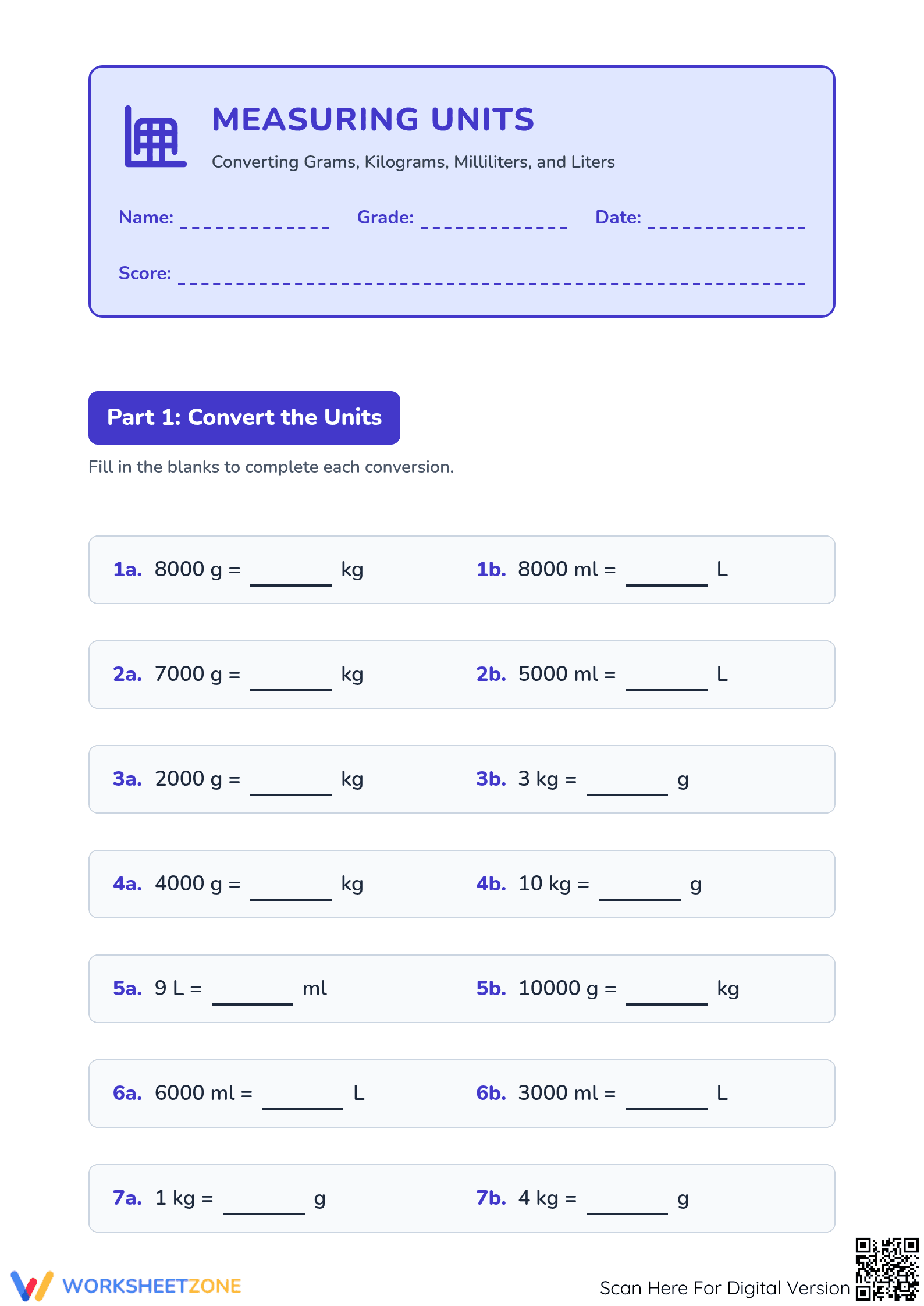
This Grade 4 metric conversion worksheet provides a comprehensive environment for students to master the relationships between weight and liquid volume units. By focusing on grams, kilograms, milliliters, and liters, the resource ensures students develop a fluent understanding of base-10 measurement systems. It bridges the gap between abstract number manipulation and practical, real-world application.
At a Glance
- Grade: 4 · Subject: Math
- Standard:
4.MD.A.1— Know relative sizes of measurement units and express larger units as smaller ones- Skill Focus: Metric unit conversion (g/kg, ml/L)
- Format: 3 pages · 44 problems · Answer key included · PDF
- Best For: Small group instruction and independent mastery
- Time: 25–35 minutes
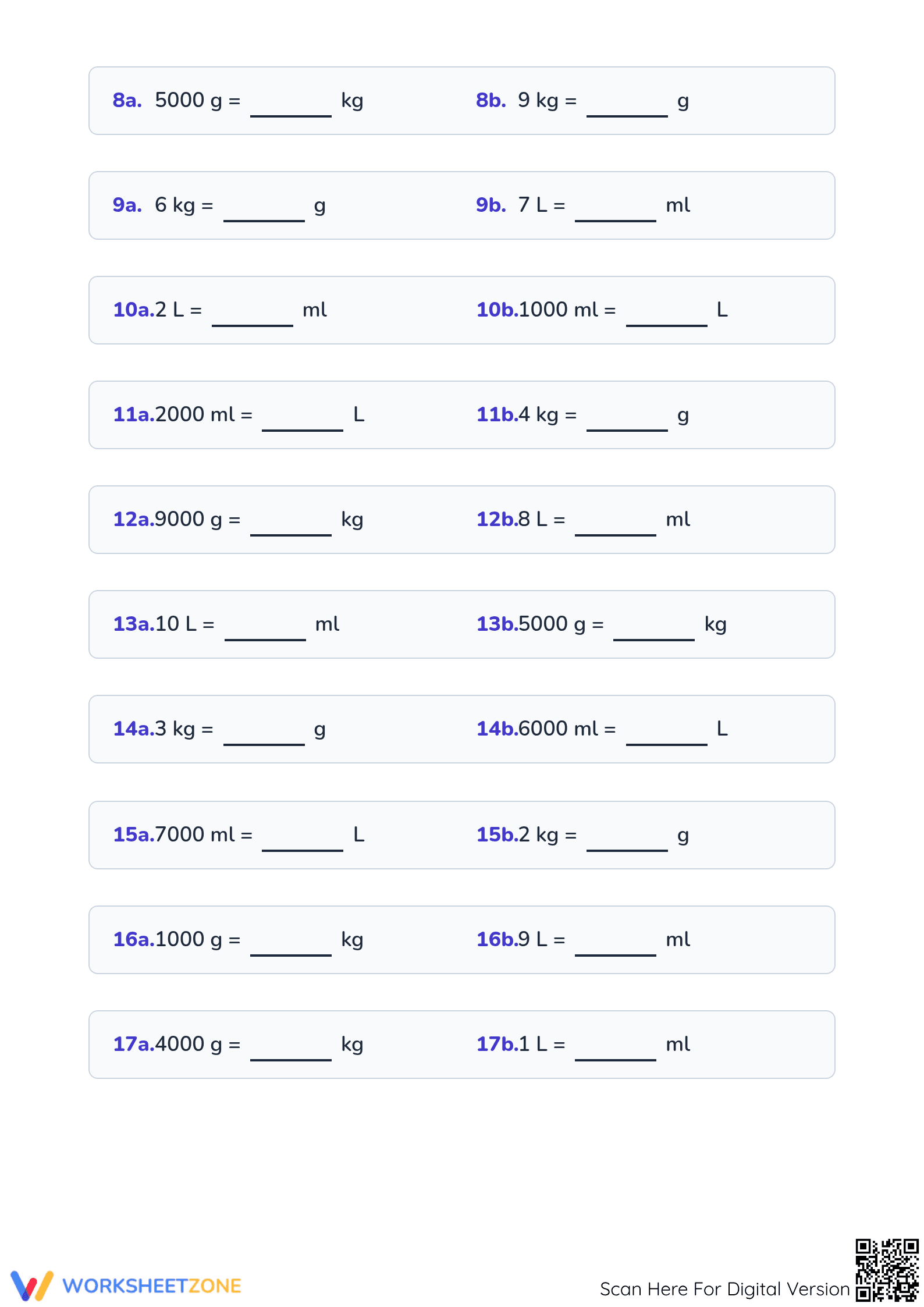
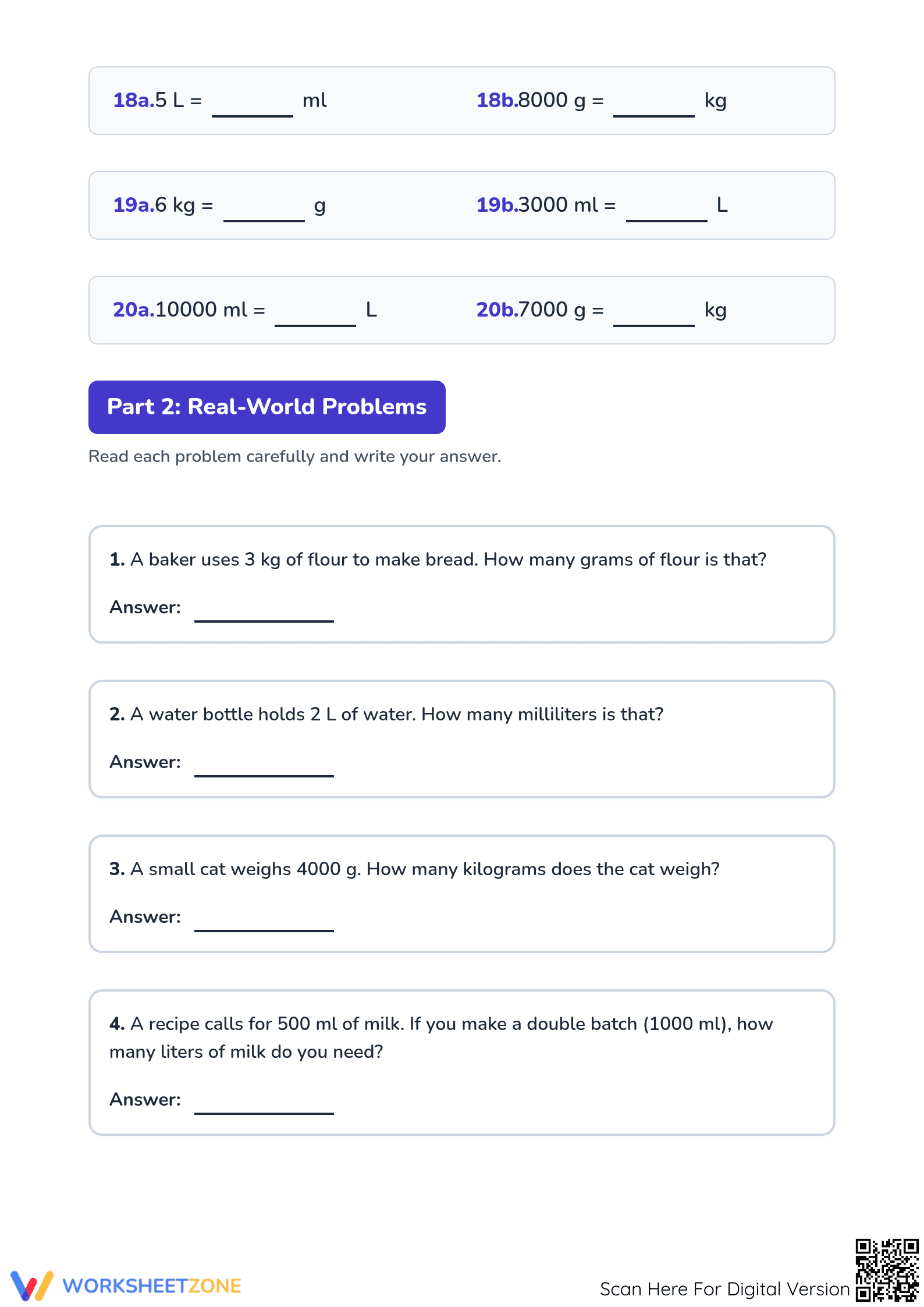
Inside this three-page PDF, teachers will find a structured dual-part approach to measurement. Part 1 features 40 direct conversion tasks ranging from simple single-digit kg to g shifts to larger five-digit values. Part 2 transitions students into cognitive application with 4 multi-step word problems involving baking, hydration, and animal weights. A complete answer key is provided for immediate grading.
Skill Progression
- Guided Practice: The initial section presents 14 conversion equations where students move from larger to smaller units and vice-versa, reinforcing the 1000-to-1 ratio.
- Supported Practice: Problems 15 through 40 introduce higher numeric values and varied starting units, requiring students to maintain accuracy across many repetitions.
- Independent Application: The final four word problems remove the equation scaffolding, forcing students to identify the necessary conversion within a narrative context.
The worksheet follows a gradual release of responsibility model, moving from computational fluency to higher-order situational problem-solving.
Standards Alignment
This resource is explicitly aligned to 4.MD.A.1: "Know relative sizes of measurement units within one system of units including km, m, cm; kg, g; lb, oz.; l, ml; hr, min, sec." It also supports 4.MD.A.2 by applying these conversions to word problems. Both standard codes can be copied directly into lesson plans, IEP goals, or district curriculum mapping tools.
How to Use It
Use this worksheet during the "independent practice" phase of a measurement unit after students have modeled conversions with metric weights or graduated cylinders. Alternatively, assign the word problem section as a "ticket out the door" to assess readiness for the unit test. Most students will complete the full three-page set within 35 minutes of focused work.
Who It's For
This printable is designed for fourth-grade students, but provides excellent remediation for fifth-graders struggling with decimal shifts or enrichment for advanced third-graders. It pairs naturally with a metric measurement anchor chart or a hands-on lab where students weigh classroom objects to verify their estimates.
According to a ScienceDirect TpT Analysis, high-volume practice opportunities in early math are critical for moving skills from working memory to long-term retrieval. This worksheet addresses that need by providing 44 distinct opportunities to interact with the metric system, specifically targeting the 1,000-base ratio essential for standard 4.MD.A.1. Fisher & Frey (2014) emphasize that such structured practice is most effective when it includes both decontextualized computation and contextualized word problems, as seen in this resource. By requiring students to transition between kilograms, grams, milliliters, and liters, the material builds the cognitive flexibility required for middle school science and advanced mathematics. The inclusion of a full answer key further supports instructional efficiency, allowing for rapid feedback—a key factor in student growth according to NAEP data. Teachers can utilize this self-contained summary to justify the inclusion of high-repetition practice within modern, standards-aligned curriculum frameworks.


