


























Views
Downloads

Essential Grade 6 Triangle Perimeter and Height Worksheet
Paste this activity's link or code into your existing LMS (Google Classroom, Canvas, Teams, Schoology, Moodle, etc.).
Students can open and work on the activity right away, with no student login required.
You'll still be able to track student progress and results from your teacher account.
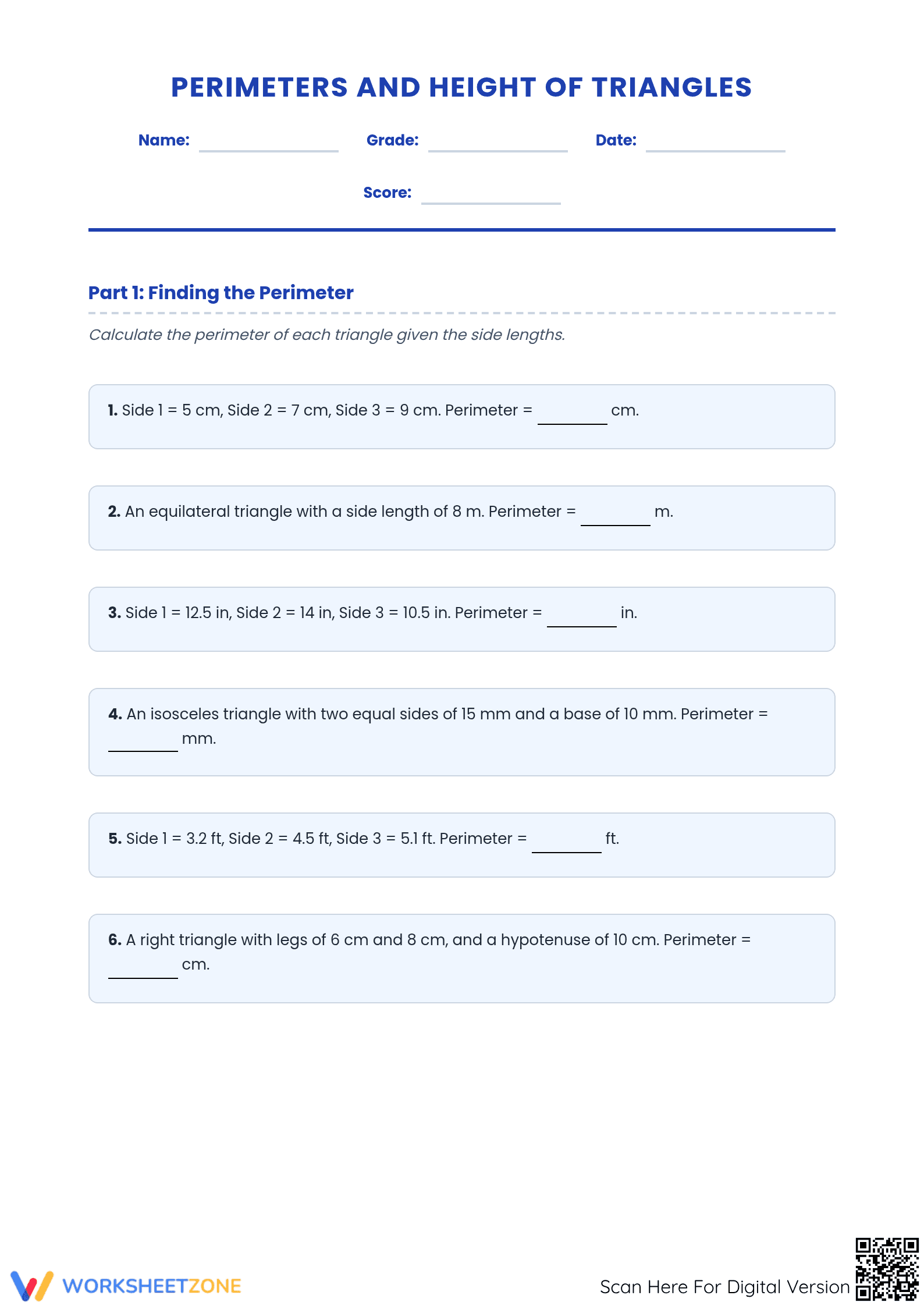
Strengthen geometric proficiency with this comprehensive Grade 6 worksheet focused on the perimeters and height of triangles. Students will practice identifying essential dimensions and performing calculations to determine the boundary measurements and vertical heights of various triangular shapes. This resource ensures students build the procedural fluency necessary for more advanced area and volume formulas in middle school mathematics.
At a Glance
- Grade: 6 · Subject: Math
- Standard:
CCSS.MATH.CONTENT.6.G.A.1— Find the area of right triangles and other triangles by identifying height- Skill Focus: Perimeter calculation and height identification
- Format: 4 pages · 12 problems · Answer key included · PDF
- Best For: Geometry unit practice and formative assessment
- Time: 25–35 minutes
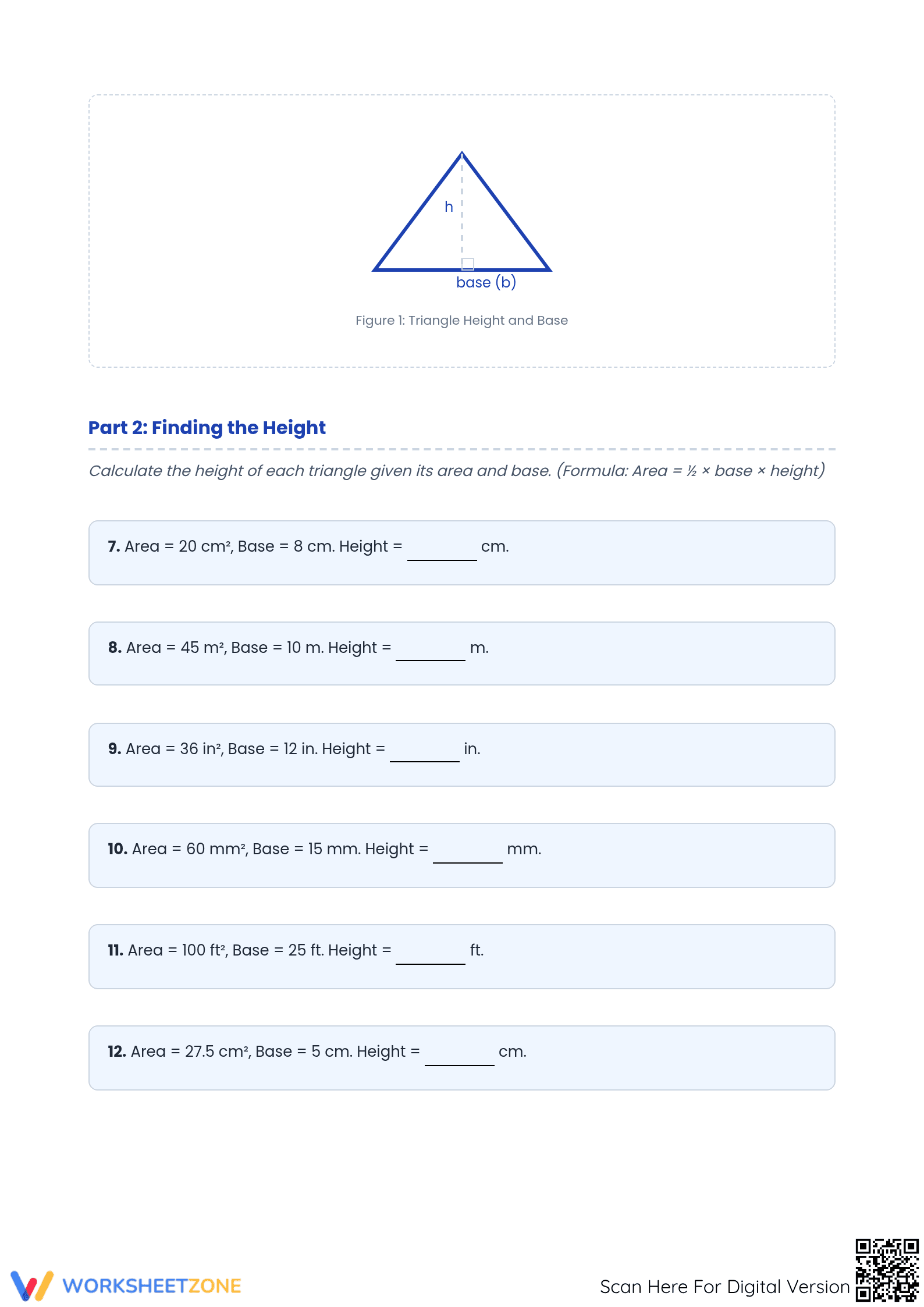
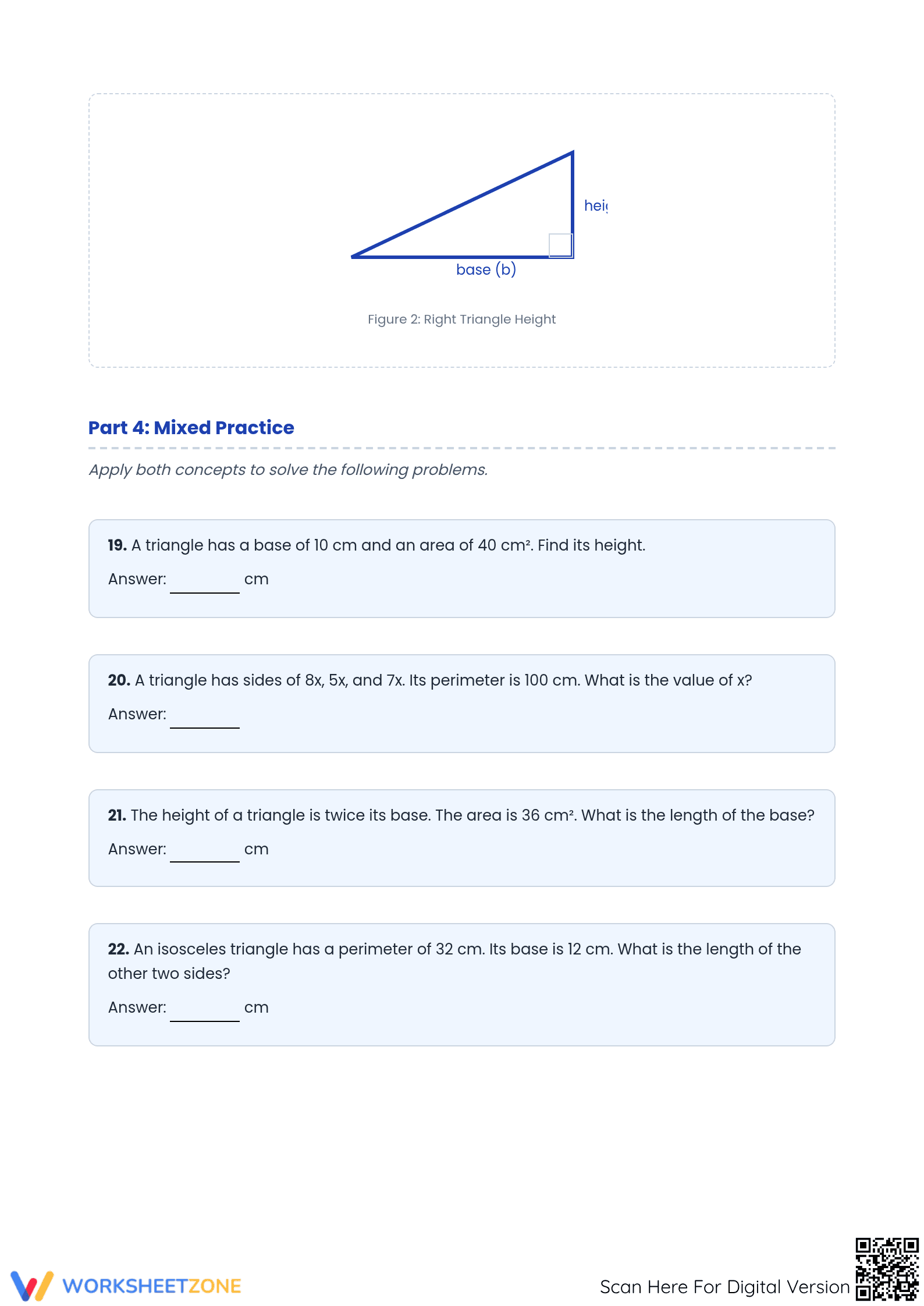
What's Inside: This 4-page PDF contains a series of structured problems requiring students to calculate triangle perimeters by summing side lengths and identifying the perpendicular height. The worksheet includes clear diagrams of various triangle types, including right-angled, isosceles, and scalene variations. A complete answer key is provided to facilitate quick grading and immediate student feedback.
Skill Progression
- Guided Practice: The initial tasks provide labeled triangles where students identify the three sides and the altitude, calculating perimeters with explicit prompts.
- Supported Practice: Middle sections introduce mixed triangle types with varying orientations, requiring students to distinguish between slant heights and true perpendicular heights.
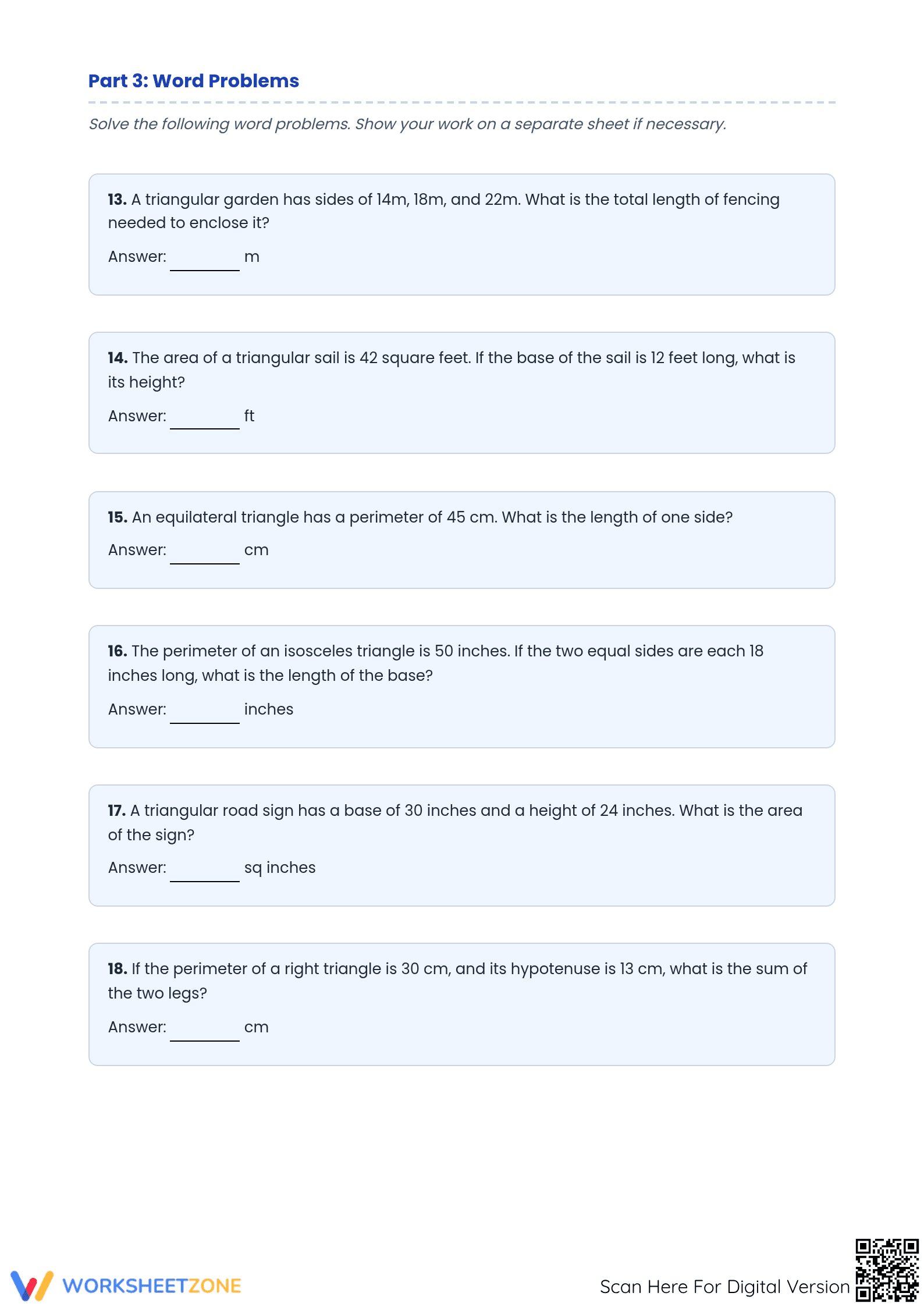
- Independent Practice: The final page presents complex scenarios and multi-step problems where students must apply their knowledge to solve for missing dimensions before finding the total perimeter.
This sequence follows the gradual-release model, moving from direct computation to conceptual identification of geometric properties.
Standards Alignment
This resource aligns with `CCSS.MATH.CONTENT.6.G.A.1`, which focuses on finding the area of right triangles, other triangles, special quadrilaterals, and polygons by composing into rectangles or decomposing into triangles and other shapes. Understanding the relationship between perimeter and the perpendicular height is a foundational step in mastering this standard. Both standard codes can be copied directly into lesson plans, IEP goals, or district curriculum mapping tools.
How to Use It
This worksheet is ideal for use during the independent practice portion of a geometry lesson. Assign it after demonstrating how to locate the height of a triangle relative to its base. As a formative assessment tip, observe whether students mistakenly use the side length as the height in non-right triangles. Most students will complete the 12 problems in approximately 30 minutes.
Who It's For
This practice set is designed for Grade 6 students but serves as an excellent review for Grade 7 or 8 students needing a refresher on polygon attributes. It is particularly helpful for students who benefit from clear visual aids and a predictable problem structure. Pair this with a reference anchor chart showing the difference between perimeter and area for maximum instructional impact.
According to the Fisher & Frey (2014) framework for gradual release of responsibility, structured practice in geometric measurement is critical for transition from concrete to abstract spatial reasoning. This Grade 6 worksheet on triangle perimeter and height directly supports CCSS.MATH.CONTENT.6.G.A.1 by requiring students to identify dimensions and apply additive and multiplicative properties to solve real-world geometry problems. The clear layout and varied problem sets allow for the I Do, We Do, You Do instructional sequence, ensuring students build procedural fluency before moving to complex area calculations. Research indicates that frequent, focused practice in identifying triangle attributes like base and height significantly reduces cognitive load during multi-step geometric tasks. Teachers can utilize this 4-page resource to bridge the gap between basic polygon properties and the sophisticated area formulas required in middle school mathematics, providing a solid foundation for future studies in trigonometry and calculus.


