


























0
Views
0
Downloads

0.0
0
Save
0 Likes
Share
Perimeter of a Parallelogram Using Base, Height, and Angle
0 Views
0 Downloads
Paste this activity's link or code into your existing LMS (Google Classroom, Canvas, Teams, Schoology, Moodle, etc.).
Students can open and work on the activity right away, with no student login required.
You'll still be able to track student progress and results from your teacher account.
Information
Description
What It Is:
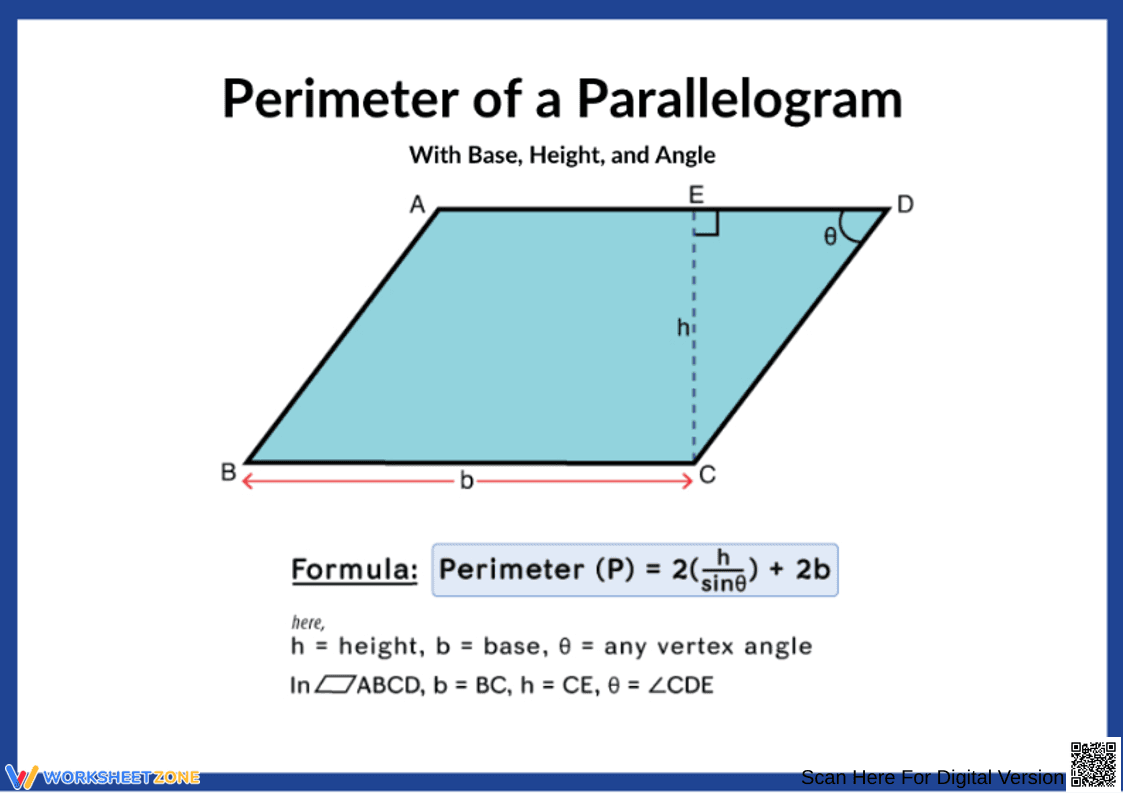
A geometry chart that explains how to calculate the perimeter of a parallelogram when the base, height, and an angle are given. It features a labeled diagram with the formula clearly shown.
Why Use It:
This chart provides a more advanced method for calculating perimeter when side lengths are not directly provided. It helps students connect trigonometry with geometry and problem-solving.
How to Use It:
• Use as a classroom reference or formula sheet
• Pair with practice worksheets for solving perimeter problems
• Help students prepare for exams requiring mixed methods in geometry
Grade Suitability:
Best suited for Grades 8–11.
• Grades 8–9: Introduces trigonometric applications in geometry
• Grades 10–11: Reinforces connections between trigonometry and geometry formulas
Target Users:
High school students, math teachers, and homeschool educators.
A geometry chart that explains how to calculate the perimeter of a parallelogram when the base, height, and an angle are given. It features a labeled diagram with the formula clearly shown.
Why Use It:
This chart provides a more advanced method for calculating perimeter when side lengths are not directly provided. It helps students connect trigonometry with geometry and problem-solving.
How to Use It:
• Use as a classroom reference or formula sheet
• Pair with practice worksheets for solving perimeter problems
• Help students prepare for exams requiring mixed methods in geometry
Grade Suitability:
Best suited for Grades 8–11.
• Grades 8–9: Introduces trigonometric applications in geometry
• Grades 10–11: Reinforces connections between trigonometry and geometry formulas
Target Users:
High school students, math teachers, and homeschool educators.


