


























Views
Downloads





Printable Area of Squares Worksheet | Grade 3 Math Ready
Paste this activity's link or code into your existing LMS (Google Classroom, Canvas, Teams, Schoology, Moodle, etc.).
Students can open and work on the activity right away, with no student login required.
You'll still be able to track student progress and results from your teacher account.
This comprehensive Grade 3 area worksheet provides students with focused practice on calculating the area of squares using the standard formula. By working through structured geometric problems and real-world word problems, learners develop a deep conceptual understanding of how side lengths relate to total surface area. Access this essential resource to support your geometry unit today.
At a Glance
- Grade: 3 · Subject: Math
- Standard:
CCSS.MATH.CONTENT.3.MD.C.7— Multiply side lengths to find areas of rectangles with whole-number side lengths- Skill Focus: Area of Squares and Side Length Extraction
- Format: 5 pages · 30 problems · Answer key included · PDF
- Best For: Independent practice and formative geometry assessment
- Time: 25–35 minutes
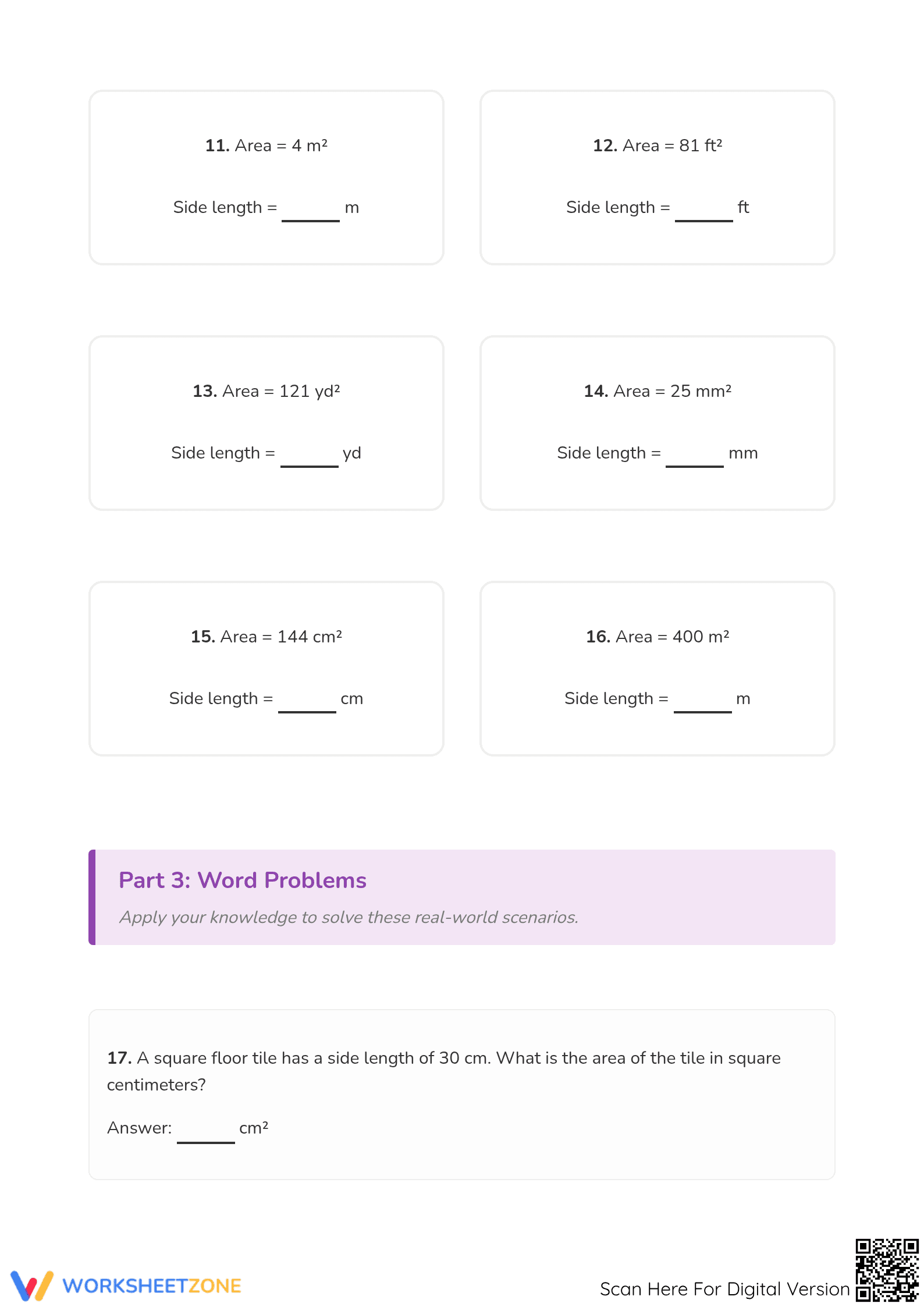
What's Inside: This 5-page PDF contains four distinct sections designed for mathematical progression. Part 1 focuses on basic area calculation with visual squares; Part 2 reverses the process, asking students to find the side length given a known area; Part 3 applies these skills to real-world word problems; and Part 4 challenges students with inequality comparisons. A full answer key is provided for immediate grading.
Skill Progression
- Guided Practice: 8 visual problems where students use the $A = s \times s$ formula with provided side lengths to calculate area across various units.
- Supported Practice: 8 algebraic problems requiring students to identify the square root (inverse operation) to determine side lengths from area values.
- Independent Practice: 14 higher-order problems including complex word problems and comparative analysis using greater than, less than, or equal symbols.
This structure follows the gradual-release model, moving from concrete visual computation to abstract problem-solving and logical comparison.
Standards Alignment: This worksheet is primarily aligned to `CCSS.MATH.CONTENT.3.MD.C.7`, which requires students to relate area to the operations of multiplication and addition. It specifically targets sub-standard 3.MD.C.7.A, finding the area of a rectangle with whole-number side lengths by tiling it and showing that the area is the same as would be found by multiplying the side lengths. Both standard codes can be copied directly into lesson plans, IEP goals, or district curriculum mapping tools.
How to Use It: Assign this worksheet during the independent practice phase of your geometry lesson or as a follow-up to direct instruction on area formulas. It serves as an excellent formative-assessment tool; observe Part 2 carefully to ensure students understand the relationship between squaring a number and its side length. Expected completion time is approximately 30 minutes depending on student familiarity with multiplication facts.
Who It's For: This resource is designed for Grade 3 students mastering multiplication and area concepts, though it provides excellent review for Grade 4 learners. It is particularly effective for students requiring structured repetition to solidify the area formula. Pair this with a physical tiling activity or an anchor chart displaying the square area formula for maximum instructional impact.
Standardized measurement proficiency requires a transition from counting unit squares to applying mathematical formulas as evidenced in the 30 tasks provided here. Aligned with CCSS.MATH.CONTENT.3.MD.C.7, this worksheet ensures students can calculate square area and determine side lengths from area totals. According to Fisher & Frey (2014), the use of scaffolded tasks that move from visual representations to word-based applications is critical for long-term retention of geometric concepts. This resource bridges that gap by providing 8 visual prompts followed by 22 abstract and applied problems. The inclusion of diverse measurement units (cm, in, ft, m, yd, mm) further prepares students for standardized testing environments. This standalone summary, grounded in research-backed pedagogy, confirms that the worksheet is a valid tool for developing elementary area mastery. Aligned standard codes and plain-English actions facilitate easy integration into modern digital gradebooks and lesson planning software.


