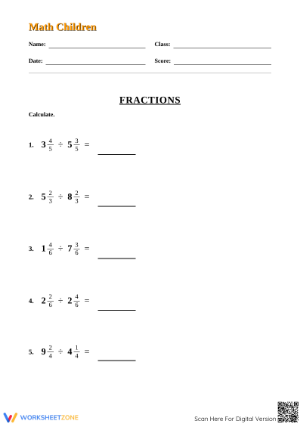
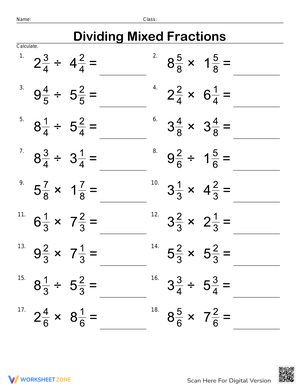
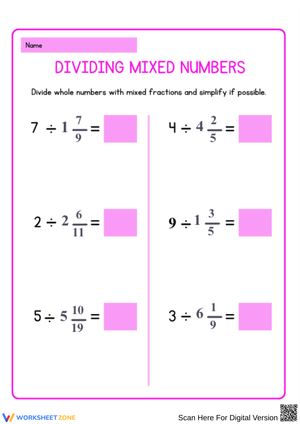
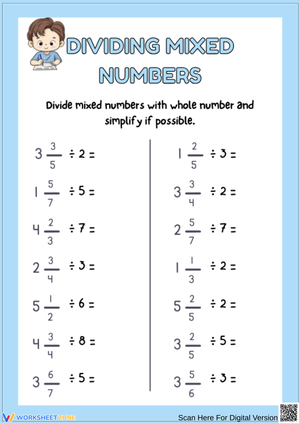
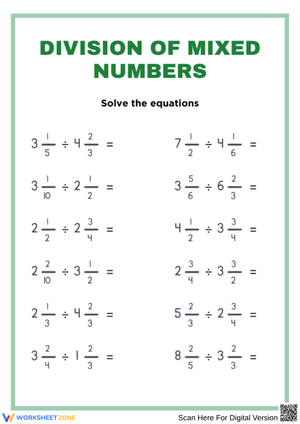
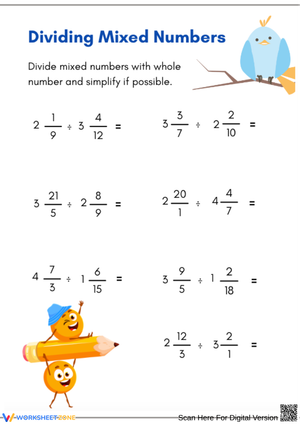
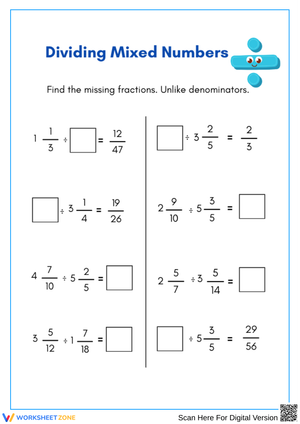
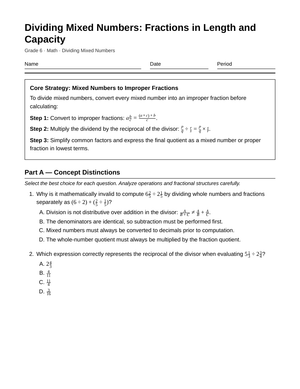
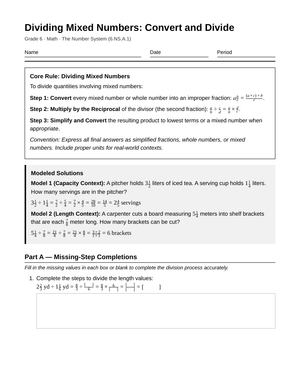
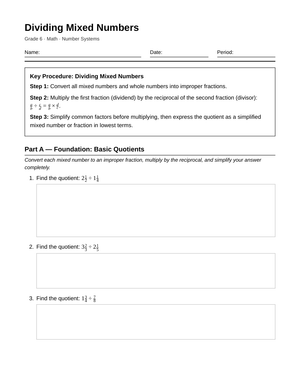
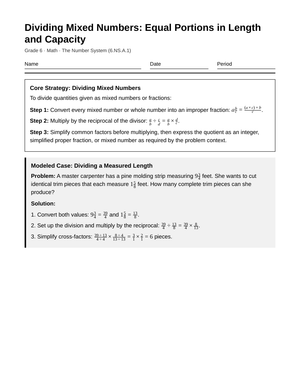
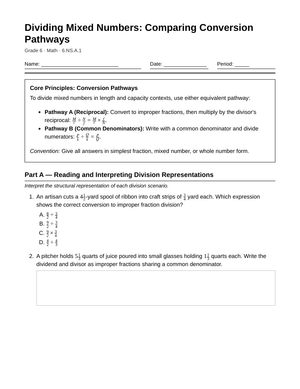
These divide mixed numbers worksheets give 6th-grade teachers a structured, ready-to-print set for one of the most procedurally demanding fraction skills in the middle school curriculum. Each page targets a specific stage of the algorithm so you can see exactly where a student's work falls apart — not just that their final answer is wrong.
The Multi-Step Skill These Worksheets Build
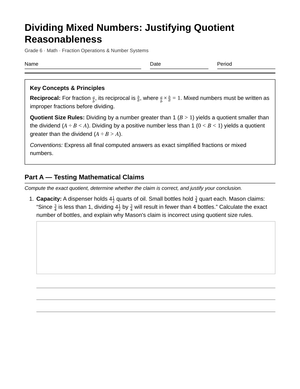
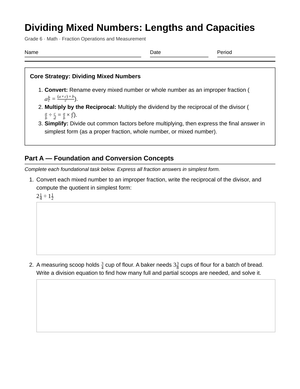
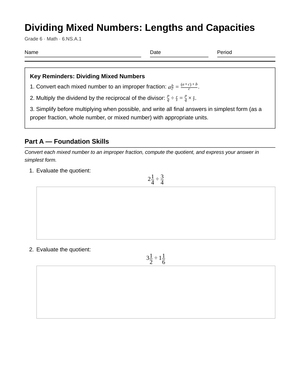
Dividing mixed numbers requires students to execute four distinct sub-skills in sequence: converting a mixed number to an improper fraction, keeping the dividend, replacing the division sign with multiplication, and flipping the divisor to its reciprocal. That's before they multiply and simplify. What makes this topic hard isn't any single step — students who can convert and students who can multiply fractions often still produce wrong answers because they've never practiced the full chain under mild time pressure. These worksheets treat the procedure as a multi-step skill that needs deliberate sequencing, not just a rule to memorize.
Problems span three structural types: mixed number ÷ mixed number, mixed number ÷ whole number, and whole number ÷ mixed number. That last type surfaces a specific gap — students who can handle 3½ ÷ 2¼ will still write the whole number 5 above the division bar as-is rather than expressing it as 5/1 before flipping. Including all three types on the same worksheet forces students to read each problem carefully before reaching for the algorithm.
Where Students Lose the Thread
Four error patterns show up consistently in student work on this topic, and they're worth knowing before you hand out the first page.
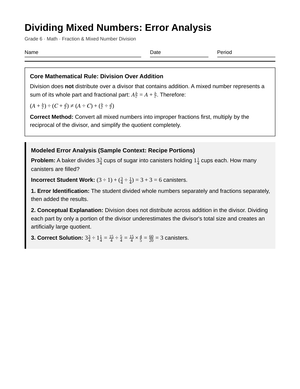
- The most common is flipping the wrong fraction. Students learn "flip the second one" but under mild cognitive load they flip the dividend instead of the divisor — so 2¾ ÷ 1½ becomes 4/11 × 3/2 instead of 11/4 × 2/3. The answer looks plausible enough that students don't catch it without checking.
- A second error is skipping the initial conversion: students split the whole number and the fraction, operate on them separately, and produce a result that's close but wrong.
- Third, many students leave answers as improper fractions, either because they forget the final conversion step or because they're unsure whether the answer should be a mixed number.
- Fourth, when a problem mixes a whole number with a fraction — say, 6 ÷ 1⅔ — students who haven't practiced writing whole numbers over 1 treat the 6 as if it were already a proper fraction and get 1/6 as their starting point instead.
Each of these errors is diagnosable from a student's written work if you require them to show the conversion, the reciprocal, and the multiplication as separate lines. Worksheets that give students a three-line work space for each problem make that analysis faster for you and make the procedure more visible to students who are still building automaticity.
How to Use These Worksheets Across the Week
The worksheets are designed to run as a progression, not as interchangeable practice pages. Day 1 focuses on conversion only — students rewrite mixed numbers as improper fractions and convert back, nothing else. Day 2 presents problems where conversion is already done and students practice only the keep-change-flip and multiplication steps. Day 3 combines both into the full algorithm. This sequence matters for diagnostic reasons: a student who gets problems wrong on the Day 3 worksheet but got them right on Day 2 has a conversion problem, not a multiplication problem. That distinction changes what you reteach.
For the Friday review block or as an exit check after direct instruction, a single 4-problem page takes about eight minutes and gives you enough data to sort students into two groups before the next lesson. Students who miss only the simplification step need different feedback than students who are still flipping the wrong fraction.
Standards Alignment
This skill sits at the center of CCSS 6.NS.A.1, which asks students to interpret and compute quotients of fractions and solve word problems involving division of fractions by fractions. The standard explicitly includes mixed numbers, and it appears in Grade 6 because students arrive with familiarity with fraction multiplication from 5th grade (5.NF.B.4) — dividing mixed numbers extends that understanding rather than introducing an entirely new concept. Teachers who frame it that way ("you already know how to multiply fractions; division is one extra move before you do that") find that students approach the algorithm with more confidence.
Frequently Asked Questions
Do students have to convert to improper fractions first, or can they divide whole-number and fraction parts separately?
They need to convert. Dividing the parts separately produces wrong answers because the whole-number part and the fraction part aren't independent — 3½ isn't "3 and ½" in any operationally separable sense when you're dividing. Every worksheet enforces the conversion as Step 1, which is also the best defense against that particular error pattern appearing later on assessments.
How do you handle the whole number ÷ mixed number problem type with students who haven't seen it yet?
One classroom move that works: before distributing the worksheet, write 8 ÷ 2½ on the board and ask students to tell you what they'd do first. Most will say "convert the mixed number" and ignore the 8. From there the discussion almost runs itself — someone will eventually ask "but what about the 8?" and you can introduce 8/1 as a natural answer to their own question rather than a rule you're imposing.
Can these be used for students who are a year behind in their fraction fluency?
The foundational tier works well as catch-up material for 7th graders who haven't consolidated this skill, and the Day 1 conversion-only worksheet serves as a standalone review of improper fraction work for any student who needs it before the division algorithm is introduced.













 Interactive Worksheet Maker
 Quiz Maker
 Word Search Maker
 Crossword Puzzle Maker
 Word Scramble Generator
 Sentence Scramble Generator
 Handwriting Worksheet Generator
 Name Tracing Generator
 Fill In The Blank Generator