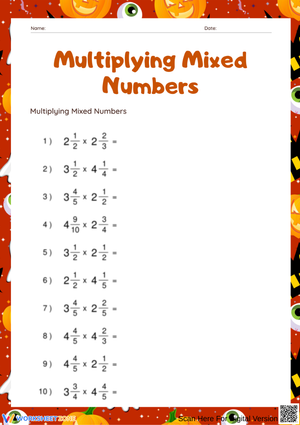
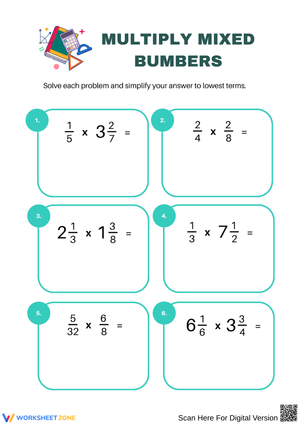
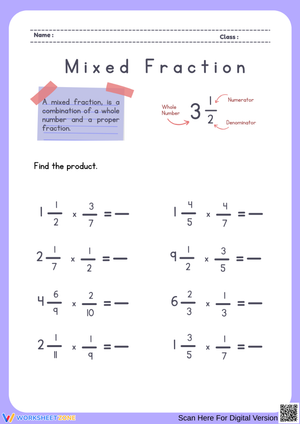
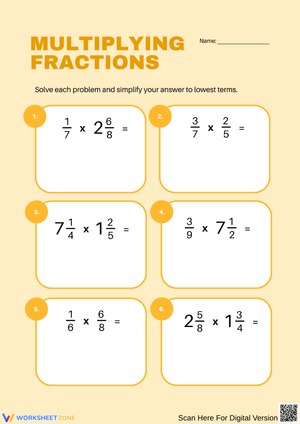
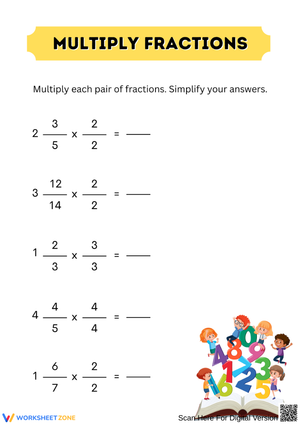
These multiplying mixed numbers worksheets give 5th and 6th grade teachers a tiered, print-ready set of practice pages that move students from the initial conversion step through full mixed-number multiplication and simplification. Three difficulty levels and a word problem strand mean the same unit generates practice for every readiness level in the room — without building separate lesson materials from scratch.
What the Skill Actually Demands
Multiplying mixed numbers requires students to hold a multi-step algorithm together while managing fraction arithmetic at each stage: convert both mixed numbers to improper fractions, multiply across numerators and denominators, then simplify and convert the result back. That's four distinct operations, each with its own failure point. What makes the skill hard isn't any single step — it's that errors in step one (the conversion) corrupt every step that follows, and students rarely catch the problem until the final answer looks wrong in ways they can't explain.
This skill lands in 5th grade because students have spent 3rd and 4th grade building fraction concepts: equivalence, comparison, and addition with like denominators. By grade 5, Common Core standard 5.NF.B.6 asks students to solve real-world problems involving multiplication of fractions and mixed numbers — making this one of the year's most demanding fraction standards and a direct conceptual predecessor to ratio and proportional reasoning in 6th grade.
What's Inside This Worksheet Collection
The worksheets are organized into three levels so you can match each page to where a student actually is, not where the calendar says they should be.
- Level 1 — Mixed number × proper fraction: Students convert one mixed number to an improper fraction and multiply by a simple proper fraction. Keeping one factor already in fraction form reduces working memory load and isolates the conversion step for deliberate practice.
- Level 2 — Mixed number × whole number: Students rewrite the whole number with a denominator of 1, then apply the same algorithm. This is a natural bridge — it's procedurally identical to Level 3 but feels more intuitive, which builds confidence before both factors require conversion.
- Level 3 — Mixed number × mixed number: Both factors require conversion. Problems at this level include simplification steps and, in several sheets, multi-step word problems set in contexts like recipe scaling and area measurement.
Each page carries a compact reference box at the top — Convert → Multiply → Simplify — so students can self-monitor mid-problem rather than raising a hand every time they lose their place. Fully worked answer keys accompany every sheet.
Standards Alignment
5.NF.B.6 is one of the major work standards in 5th grade under the Numbers and Operations — Fractions domain. It sits downstream of 5.NF.B.4 (multiplying a fraction by a whole number or a fraction) and feeds directly into 6th grade ratio and rate reasoning, where students regularly scale quantities that aren't whole numbers. A student who leaves 5th grade without reliable mixed-number multiplication fluency will run into that gap repeatedly in 6th grade ratio work — not as a fraction problem but as a division or scaling problem, which makes it harder to diagnose and address.
Where Students Struggle Most
The single most durable error in this skill is distributing the multiplication across the whole-number and fractional parts separately. A student solving 2½ × 3¼ computes (2 × 3) + (½ × ¼) and arrives at 6⅛ with complete confidence. The answer is wrong, but it's internally consistent with a faulty mental model — one where mixed numbers behave like expressions with two separate terms rather than single quantities. This error doesn't respond to reminders to "check your work" because the student believes the work is already correct. The only fix is returning to why conversion to an improper fraction is necessary in the first place.
Two other patterns appear consistently in student work: forgetting to convert the second mixed number (students treat the algorithm as convert-one, multiply, done) and leaving an improper fraction in the answer because the conversion back feels optional. That second one tends to cluster in students who are strong computationally but haven't internalized that a mixed number is the expected form of a final answer.
One classroom move that surfaces these errors quickly: after students finish a set of problems, have them estimate each product by rounding both factors to the nearest whole number before looking at their computed answers. A student who estimates 3 × 2 = 6 and then checks their written answer of 6⅛ on a 2½ × 3¼ problem will immediately recognize something is off. Pairing estimation with error-tracing turns a worksheet into a self-correction exercise and builds the habit of reasonableness-checking that the standard explicitly expects.
How These Pages Fit Into a Unit
During the first week of instruction, a single row of Level 1 problems works well as a Monday-through-Friday warm-up routine. Five minutes at the start of class, four or five problems, immediate self-check — that repetition builds conversion fluency faster than a longer session twice a week, and it costs almost no instructional time.
For small-group rotations, all three levels running simultaneously keeps the room productive. The student who isn't ready for two mixed-number factors works Level 1 problems independently; the student who has the algorithm down moves to Level 3 word problems. Answer keys make both groups self-sufficient, which frees the teacher to pull a targeted group rather than circulate and field procedural questions.
The word problem pages are strongest on Fridays, when there's natural room for slower, discussion-based work. A recipe-scaling problem — tripling 2¾ cups of flour, say — gives students a reason to care whether their answer is reasonable. It also surfaces the question of when you'd actually want to convert back to a mixed number versus leave a result as an improper fraction, which is a conversation worth having explicitly.
For exit tickets, two Level 3 problems at the end of a lesson give immediate formative data. The first problem shows whether a student can execute the algorithm; the second, slightly more complex one shows whether they can simplify correctly and recognize when a conversion back is needed. That's a clean picture of where to start the next day.
Frequently Asked Questions
Can I use these worksheets before I've finished teaching the full algorithm?
Yes — Level 1 is designed for exactly that moment. It isolates the conversion step and pairs it with simple proper fraction multiplication, so students can practice what they've learned without being blocked by steps they haven't seen yet. Introducing Level 2 once conversion feels automatic, and Level 3 after both conversion and multi-factor multiplication are secure, mirrors the gradual release structure most teachers already use.
My students know the steps but still make errors on almost every problem. What's happening?
Usually it's a conversion error that students don't recognize as an error. Ask a student to solve a problem while narrating each step aloud — "I'm multiplying the whole number by the denominator, then adding the numerator." Students who can recite the rule often slip when executing it, multiplying the whole number by the numerator instead of the denominator, or adding incorrectly. Hearing their own process makes the slip visible in a way that checking written work often doesn't.
Are these appropriate for 6th grade review?
Level 2 and Level 3 sheets work well for the first week of 6th grade as a fraction fluency review before ratio instruction begins. The worked answer keys make them practical for independent review without requiring a full re-teach of the unit.













 Interactive Worksheet Maker
 Quiz Maker
 Word Search Maker
 Crossword Puzzle Maker
 Word Scramble Generator
 Sentence Scramble Generator
 Handwriting Worksheet Generator
 Name Tracing Generator
 Fill In The Blank Generator