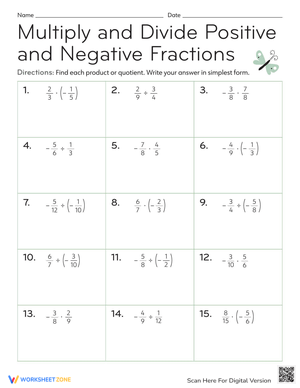
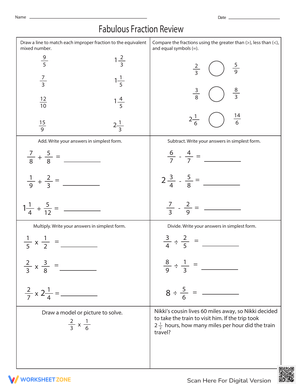
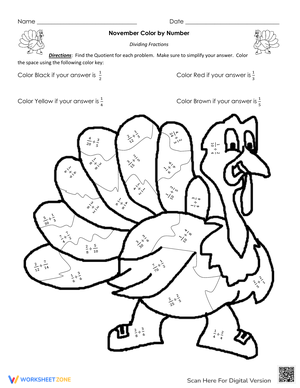
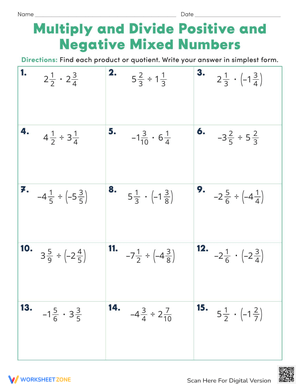
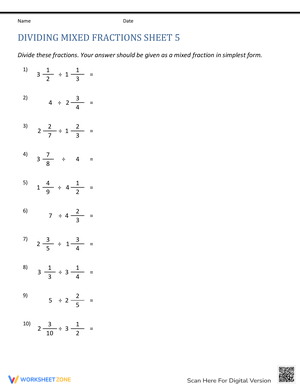
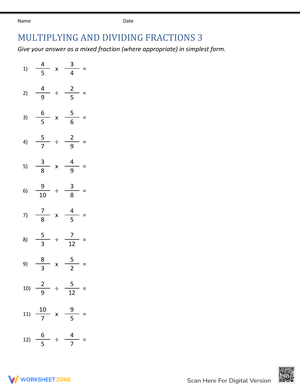
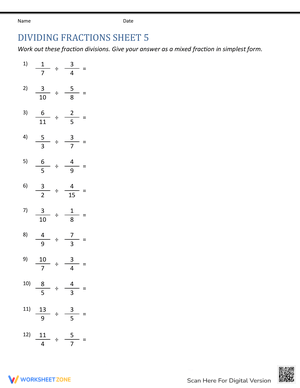
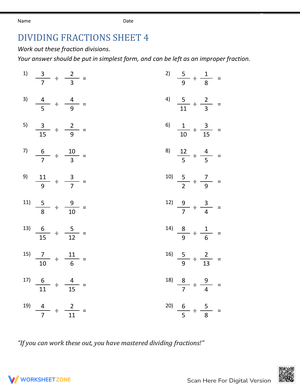
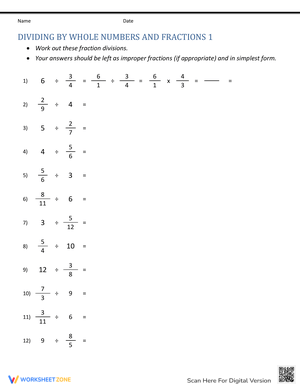
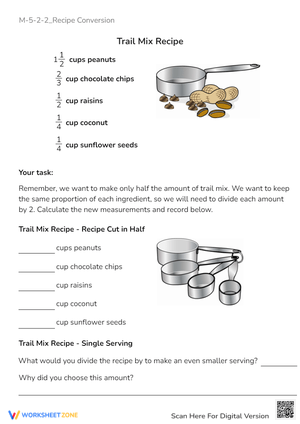
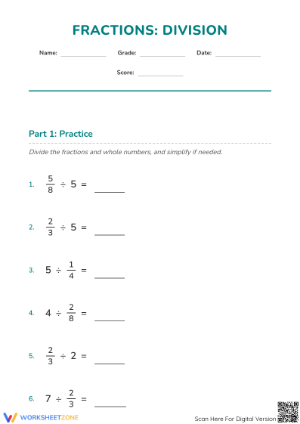
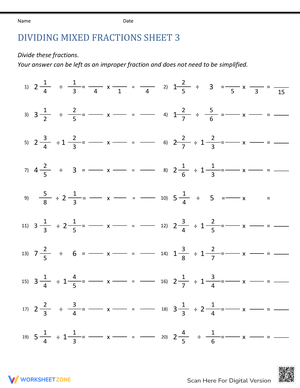
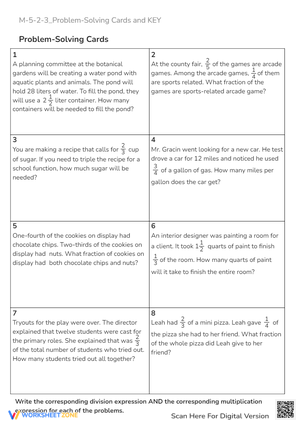
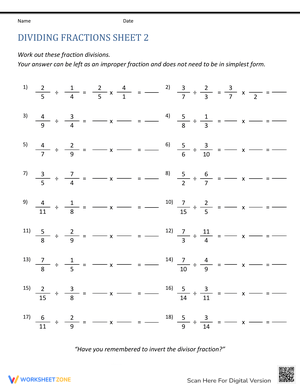
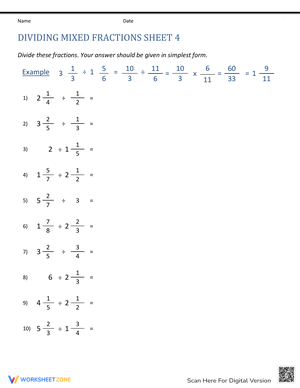
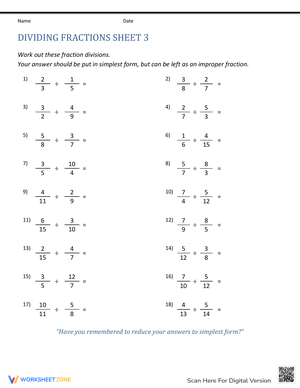
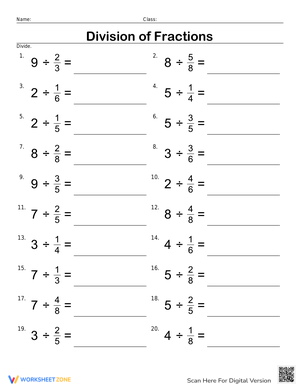
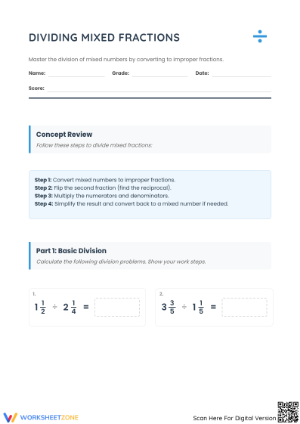
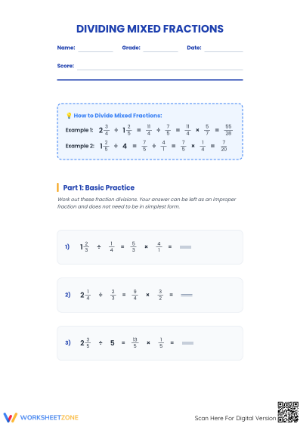
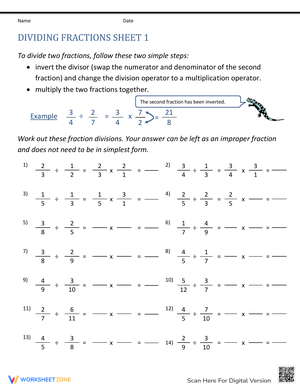
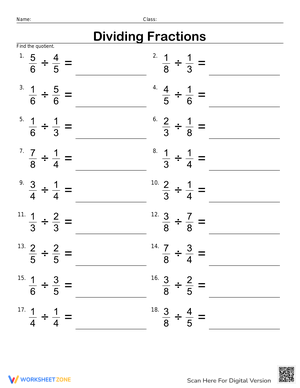
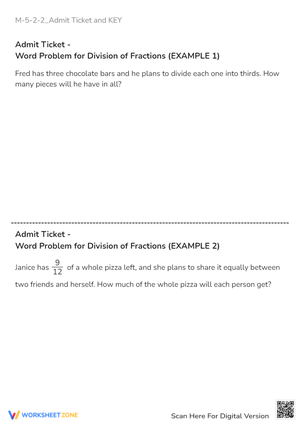
These dividing fractions worksheets move students through the full progression from unit fractions in grade 5 to mixed-number division and contextual word problems in grade 6 — giving teachers a single, organized set that covers multiple years of instruction without requiring separate searches for each problem type.
The Aligned Standards of This Dividing Fraction Worksheet Collection
Fraction division sits at a specific and demanding point in the upper-elementary math sequence. CCSS 5.NF.B.7 introduces the concept narrowly — a unit fraction divided by a whole number, or a whole number divided by a unit fraction — before CCSS 6.NS.A.1 broadens the expectation to any fraction divided by any fraction, including word problems. These two standards represent distinct instructional phases, and the worksheets are organized to match them. A fifth-grade teacher running a unit on fraction division and a sixth-grade teacher doing review before rational-number work are both served by the same set, just starting at different entry points.
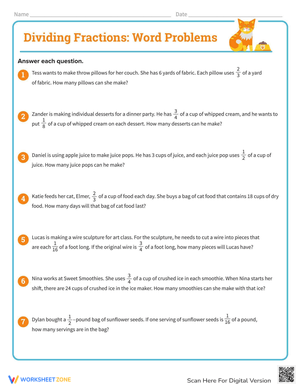
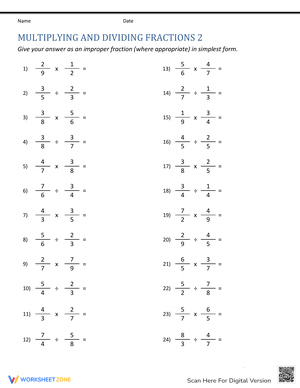
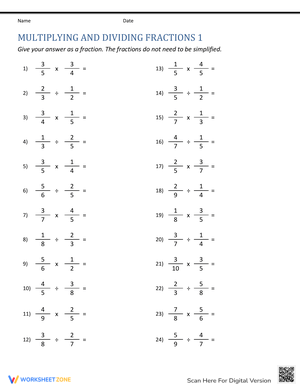
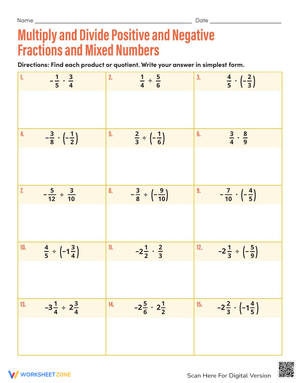
Within that arc, the problem types students encounter include unit fraction ÷ whole number, whole number ÷ unit fraction, proper fraction ÷ proper fraction, and mixed number ÷ fraction or mixed number. Word problems appear at the end of the set rather than as an afterthought — they draw on measurement and equal-sharing contexts, which is where CCSS 6.NS.A.1 spends most of its interpretive weight.
What Students Actually Work on Each Page
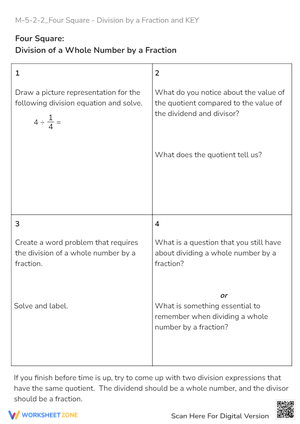
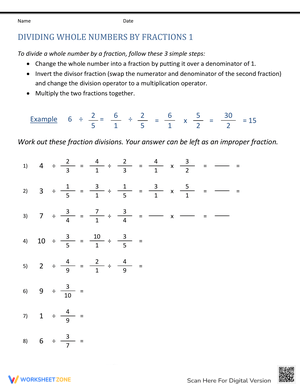
Students underline the dividend, identify whether conversion to an improper fraction is required, apply the Keep-Change-Flip algorithm, and write the answer in simplest form. On pages covering mixed numbers, there is a dedicated conversion column to the left of the main work area — a structural choice that reduces the most common procedural collapse, which is students attempting KCF before converting. Visual model pages ask students to mark a number line or shade a bar model before writing the equation, so the concrete step happens on paper rather than only in a teacher's demonstration.
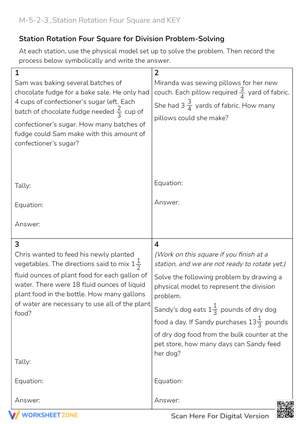
Word problem pages include an answer frame: a sentence with a blank that specifies the unit ("Each piece is ___ yards long"). This sounds minor, but it eliminates a persistent problem where students compute a correct quotient and then write a nonsensical interpretation because they never tracked what the numbers represented.
Where Students Commonly Make Mistakes
Three errors show up in student work across this topic with enough regularity that they are worth anticipating before you hand anything out.
The first is flipping the dividend instead of the divisor. A student who writes 3/4 ÷ 2/5 and then correctly identifies "flip the second fraction" will still sometimes flip the 3/4 — especially on early practice days when the rule is verbal but not yet automatic. Worksheets at the intermediate level label the two fractions "first" and "second" directly in the problem layout, which reduces this error without removing the cognitive work of applying KCF.
The second error appears exclusively with mixed numbers: students skip conversion and apply KCF to the whole number and the fraction part separately. The student who writes 2 1/3 ÷ 1/2 and treats it as "2 ÷ 1/2, then 1/3 ÷ 1/2" is not confused about KCF — they are confused about what a mixed number means as a single quantity. A ten-minute number sense discussion before the mixed-number worksheet often does more than additional procedure practice.
The third is simplification avoidance. Students who reach a correct but unreduced answer — say, 18/12 — often leave it, either because they do not recognize it needs simplifying or because they are not confident with GCF. Worksheets in this set include a simplify prompt in a separate column rather than assuming students will do it as part of the main computation step.
How Teachers Use These in the Classroom
The most effective entry point before independent worksheet time is a brief error-analysis opener. Put two or three already-worked problems on the board — one correct, two with specific mistakes — and have students work in pairs to identify and fix the errors. Five minutes of this before the worksheet reduces the number of repeated procedural errors considerably, because students arrive at independent practice actively monitoring rather than executing on autopilot.
During a unit, the three difficulty tiers support station rotation without requiring teachers to write three separate lesson plans. Level 1 pages (unit fractions) sit at one station, Level 2 (proper fractions) at another, and Level 3 (mixed numbers and word problems) at a third. Students either rotate by schedule or by readiness at teacher direction. The answer keys at each station allow self-checking, which keeps stations running without constant teacher presence.
Half-sheet exit tickets — four or five problems pulled from the same level a student worked that day — are included in the set. Sorting a class set of exit tickets into three piles (solid, shaky, not there yet) takes about four minutes and sets up the next day's grouping decisions without a full formal assessment.
Supporting Students Who Struggle with the Abstract Form
The jump from "dividing a whole number by a unit fraction on a number line" to "dividing a mixed number by a fraction on a blank page" is steeper than it looks in a curriculum scope-and-sequence. For students who stall when presented with a bare computation page, the visual model worksheets in this set extend further into the proper-fraction range than most free resources do — they are not only a grade-5 scaffold.
A student who can accurately mark how many 2/3-sized pieces fit into 4 wholes on a bar model is demonstrating the concept even if the algorithm is not yet automatic. That demonstration matters for formative purposes. Teachers working with students who have dyscalculia or significant fraction-number-sense gaps find these pages useful as an alternative evidence-of-understanding format rather than strictly a bridge to abstract computation.
Frequently Asked Questions
Should I require simplified answers from the start?
Not necessarily. On the first two or three days of fraction division instruction, requiring simplification adds a separate cognitive demand on top of a new algorithm — the result is often that students rush the simplification and make errors that obscure whether they actually understand KCF. A reasonable approach: accept unsimplified answers through Level 1, then introduce the simplify column at Level 2. By Level 3, require simplest form as a standard expectation.
My students know the Keep-Change-Flip steps but still get wrong answers — why?
Usually the problem is one of two things: they are flipping the first fraction instead of the second, or they are working with a mixed number without converting it first. Both errors are procedural but for different reasons. The first is a retrieval error (the rule is not yet automatic); the second is often a conceptual gap about what mixed numbers represent. Sorting a few student papers and looking at which error predominates tells you which one to address.
How do I use these with a class that is split across two grade levels in terms of readiness?
Assign the Level 1 pages to students who are still consolidating unit-fraction division from fifth grade, and run Level 2 or 3 pages with students who are solidly in the sixth-grade range. The word problems at Level 3 can also serve as enrichment for students who master the algorithm quickly — interpreting a quotient in context is a meaningfully different challenge than computing it.













 Interactive Worksheet Maker
 Quiz Maker
 Word Search Maker
 Crossword Puzzle Maker
 Word Scramble Generator
 Sentence Scramble Generator
 Handwriting Worksheet Generator
 Name Tracing Generator
 Fill In The Blank Generator