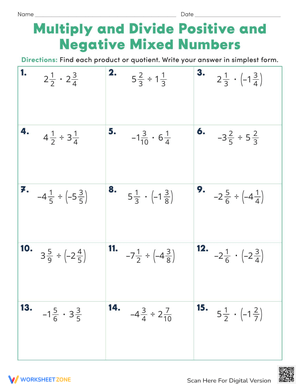
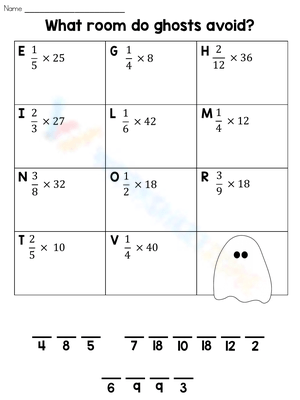
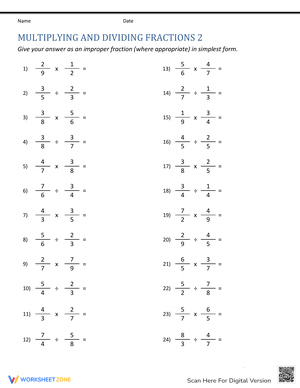
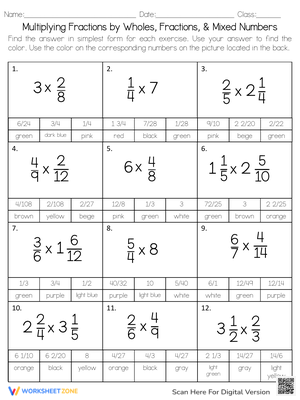
These multiplying fractions worksheets give students in grades 4 through 7 the structured repetition they need to move from "I think I remember the steps" to genuine fluency — covering fraction-by-fraction products, fraction-by-whole-number problems, mixed number conversion, and multi-step word problems across a progression of difficulty levels.
What's on Each Page
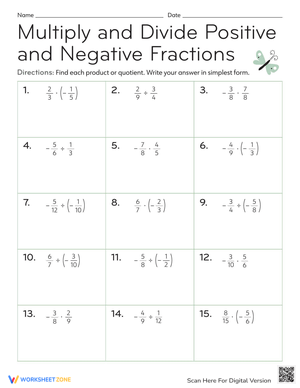
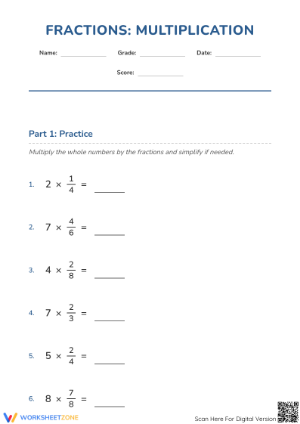
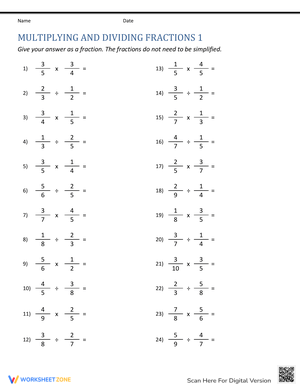
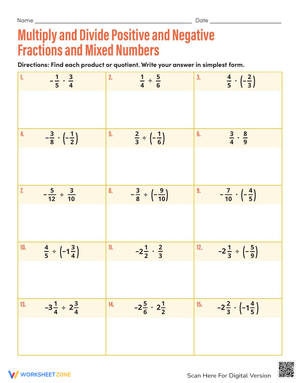
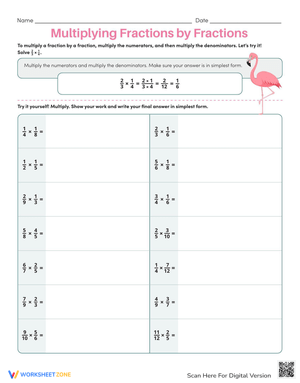
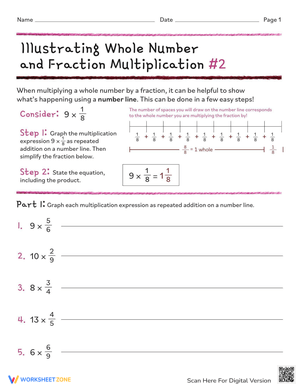
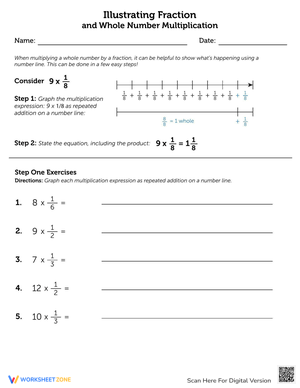
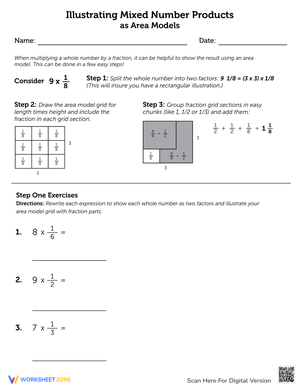
The set moves through four distinct problem types. Students start with fraction-times-whole-number problems, which connect multiplication to the repeated addition they already know — three times two-fifths reads naturally as three groups of two-fifths before the algorithm takes over. From there, pages target proper-fraction multiplication with denominators that simplify cleanly, then introduce cross-cancellation, and finally move into mixed numbers and context problems. Each level isolates a specific demand so students aren't simultaneously managing unfamiliar number types and a new procedure.
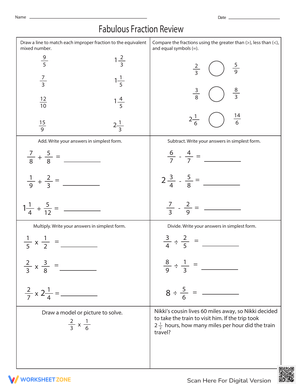
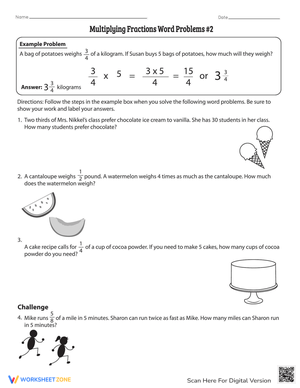
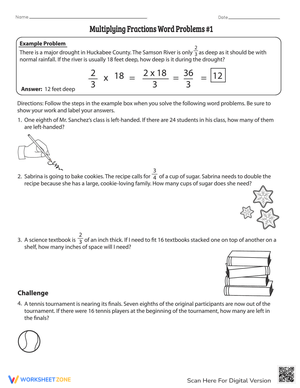
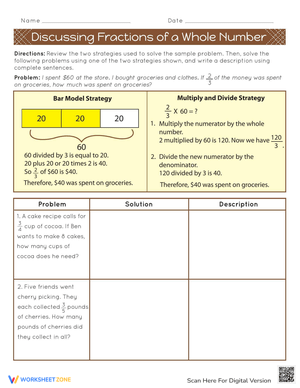
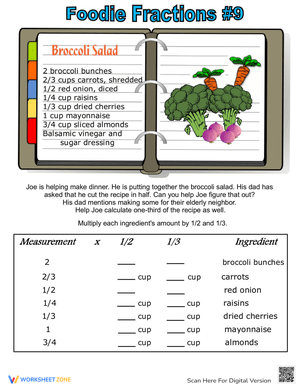
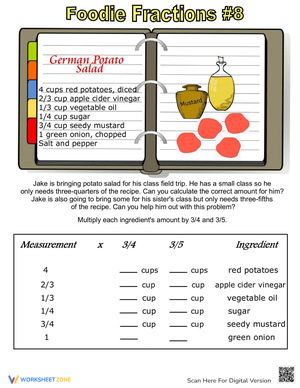
Word problems appear throughout rather than only at the end. A problem asking how much flour is needed for three-quarters of a recipe that calls for two-thirds of a cup keeps the operation grounded in meaning. Students who have only drilled bare equations often freeze the moment context is added — embedding word problems across the set prevents that gap from forming.
Standards Alignment
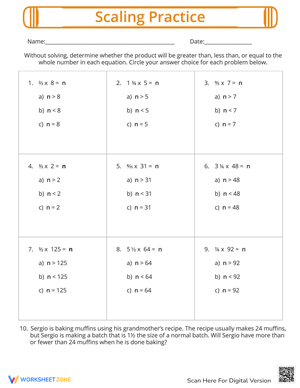
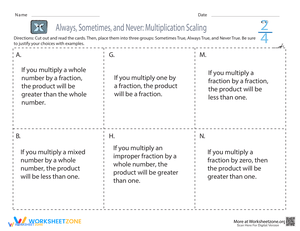
5.NF.B.4 is the anchor standard here — fifth graders are expected to multiply a fraction by a fraction, interpret multiplication as scaling, and solve real-world area problems involving fractional dimensions. What that standard demands in practice is more than a procedure: students need to explain why multiplying by a fraction less than one produces a product smaller than the original, which is why the conceptual pages matter as much as the computation pages.
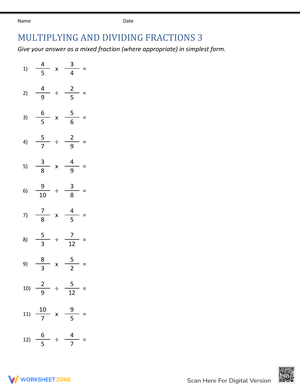
Students who move into sixth grade without this foundation hit 6.NS.A.1 — dividing fractions — almost immediately. Fraction division is built on fraction multiplication (dividing by a fraction means multiplying by its reciprocal), so gaps here compound fast. These worksheets serve both as the core 5.NF.B.4 resource and as the groundwork for rational number operations in sixth grade.
The Mistakes That Students Often Makes When Working On These Worksheets
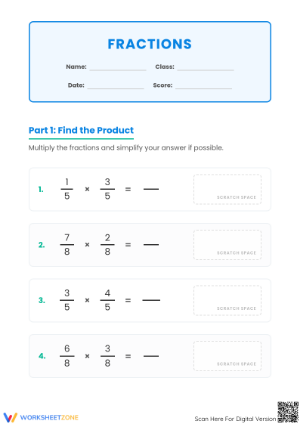
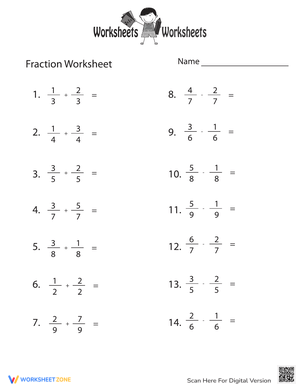
The most durable mistake is denominator addition. Students who spent months finding common denominators for fraction addition reach for that same habit and write one-half times two-thirds as two-sixths — arrived at by adding three and three rather than multiplying two and three. It looks like a simplification step, so it doesn't feel obviously wrong to the student producing it. Having students first estimate — "is the answer going to be bigger or smaller than one-half, and why?" — catches this before they commit the calculation to paper.
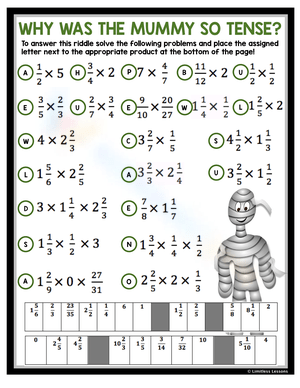
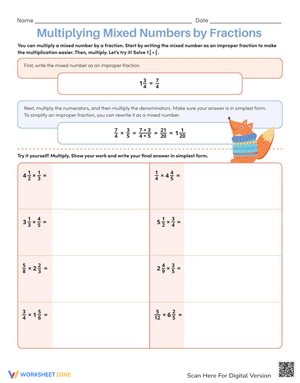
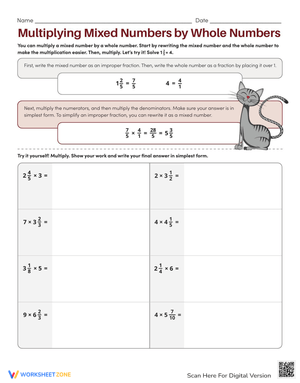
Mixed numbers bring a different problem. Students who know to convert two and three-fourths to eleven-fourths often carry the whole number along anyway: they write two times one-half as one, then tack on the three-fourths and call it one and three-fourths. The error is invisible to them because the answer looks like a reasonable mixed number. A page that sequences three mixed-number problems with increasing whole-number parts, followed by a self-check using estimation, surfaces this pattern quickly.
Cross-cancellation also produces a characteristic mistake. Students who learn it too early — before they're solid on the basic algorithm — sometimes cancel across the multiplication sign in a way that doesn't apply: they'll reduce the numerator of the first fraction against the denominator of the same fraction, which is simplification, not cross-cancellation. Holding off on those pages until students can reliably simplify after the fact is the right call.
How To Best Distribute These Worksheets Throughout The Week
The three-problem bell-ringer version works well in the ten minutes after morning meeting before the full math block begins. One problem with a visual model, one bare computation, one word problem — that combination takes most fifth graders about eight minutes and gives you an immediate read on where yesterday's instruction landed. Students who consistently get the word problem wrong while nailing the computation are telling you something specific about their conceptual understanding.
The longer computation pages belong in the independent practice portion of a lesson, not as homework on a night when students are first meeting the concept. Fraction multiplication is exactly the kind of skill where a student can practice incorrectly for twenty problems, deepen a bad habit, and arrive the next morning more confused than before. Send these home after you've confirmed in class that the procedure is solid.
Laminated pages at a math station work particularly well for cross-cancellation practice. Students work with dry-erase markers, erase, and try again — the low stakes encourage them to try a simplification step they're uncertain about rather than defaulting to the brute-force multiply-then-simplify approach.
How To Adapt These Worksheets For Students Across Levels
Students who are still shaky on multiplication facts hit a wall fast when the denominators get large. A page with problems like five-sixths times seven-eighths demands fluency with 6×8 and 5×7 before fraction logic even enters the picture. For these students, keeping denominators at 2, 3, 4, and 5 removes the arithmetic interference and lets them focus on the procedure itself. Once the steps are automatic with small numbers, larger denominators follow quickly.
On the other end, students who finish early and find the standard pages mechanical are ready for problems that embed fraction multiplication inside a larger context — area of a rectangle with fractional side lengths, or scaling a set of measurements up or down by a fractional factor. These don't require new instruction; they just require the student to identify that multiplication is the right operation before executing it.
Frequently Asked Questions
Do students need a common denominator when they multiply fractions?
No — and this confuses students who just finished a long unit on addition and subtraction. When multiplying, students multiply numerators straight across and denominators straight across. The common-denominator requirement belongs to addition and subtraction, where the parts need to be the same size before they can be combined. Multiplying fractions is conceptually different, and it helps to say that explicitly.
When should cross-cancellation be introduced?
After students are fully comfortable with the standard algorithm and can simplify a resulting fraction reliably. Cross-cancellation is a shortcut that keeps numbers manageable — it's not a separate concept. Introducing it too early, when students are still uncertain about the basic procedure, tends to create confusion about what's being canceled and why.
How do mixed numbers fit into the sequence?
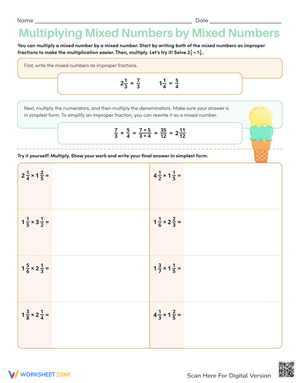
Mixed numbers belong after students are solid on proper-fraction multiplication. The key step — converting two and one-half to five-halves before multiplying — is a prerequisite, and students need to do it automatically rather than treating it as its own challenge. A short review of improper fraction conversion the day before introducing mixed-number multiplication saves a lot of confusion during the lesson itself.













 Interactive Worksheet Maker
 Quiz Maker
 Word Search Maker
 Crossword Puzzle Maker
 Word Scramble Generator
 Sentence Scramble Generator
 Handwriting Worksheet Generator
 Name Tracing Generator
 Fill In The Blank Generator