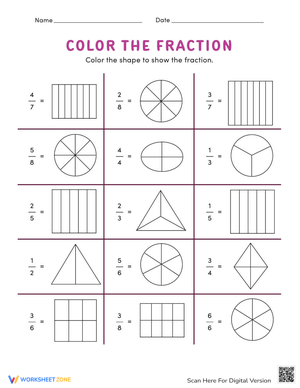
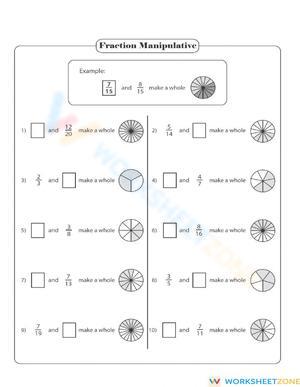
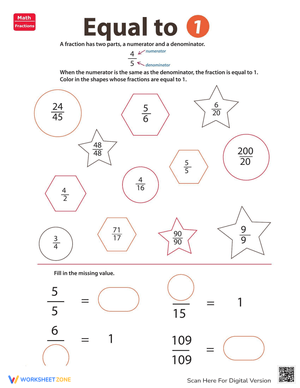
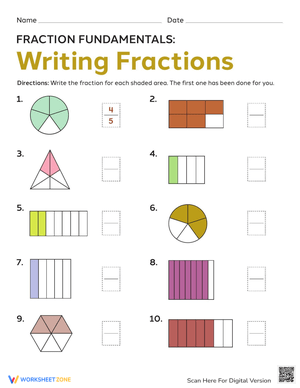
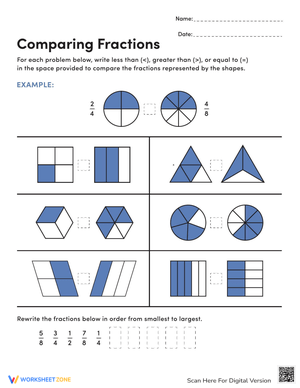
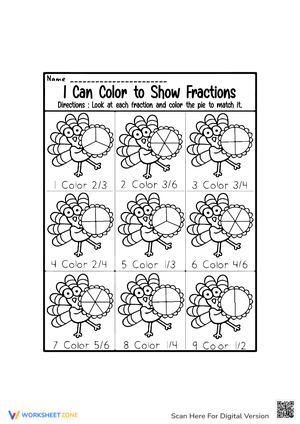
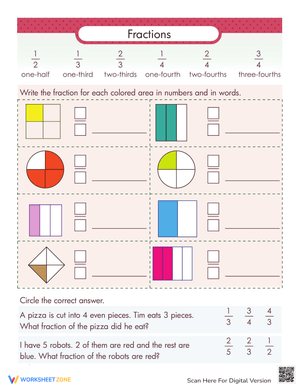
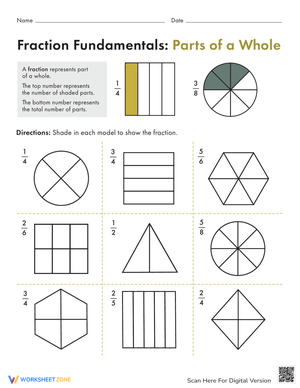
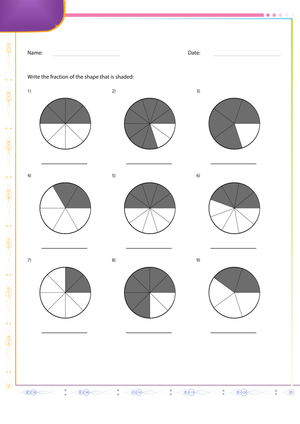
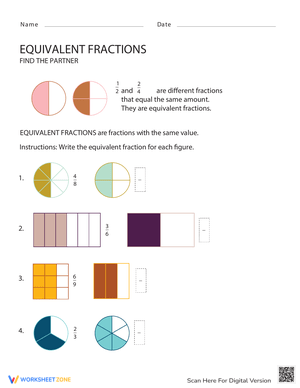
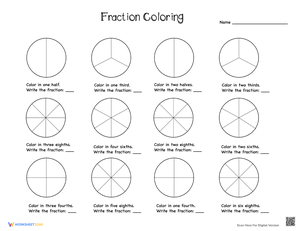
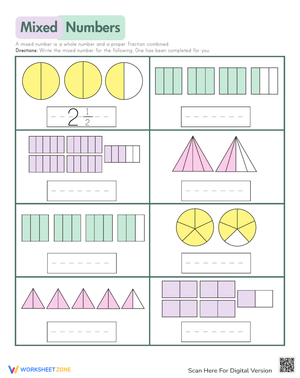
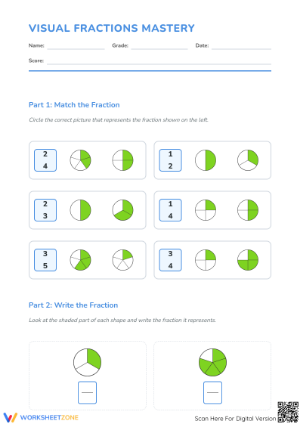
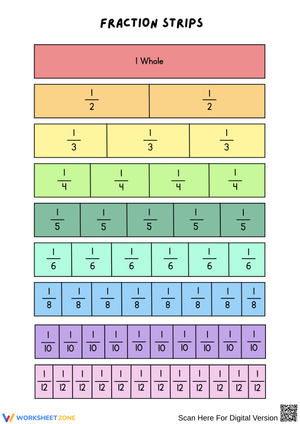
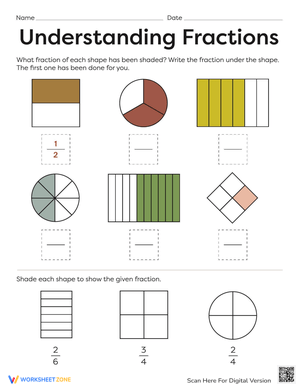
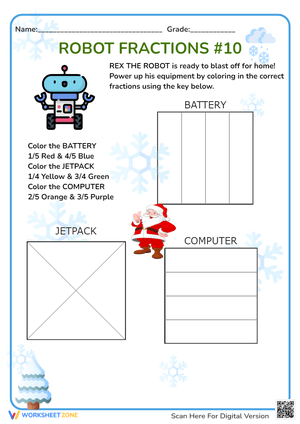
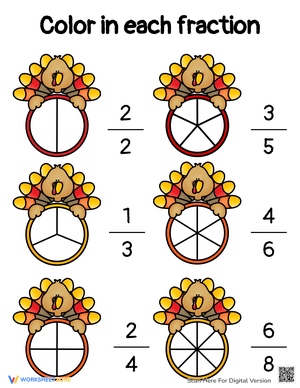
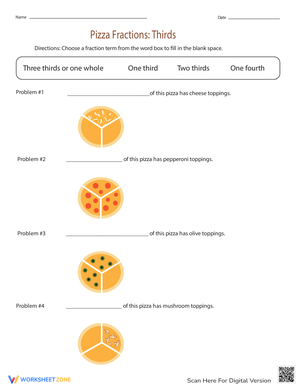
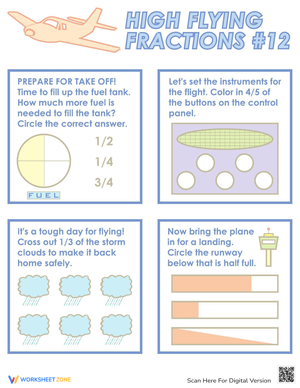
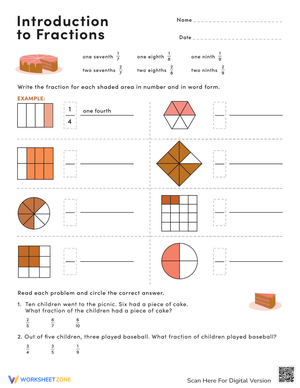
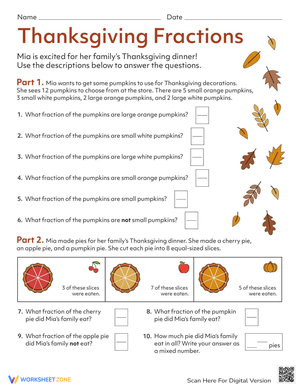
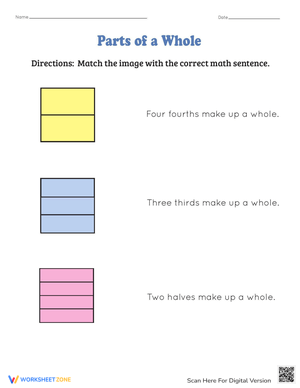
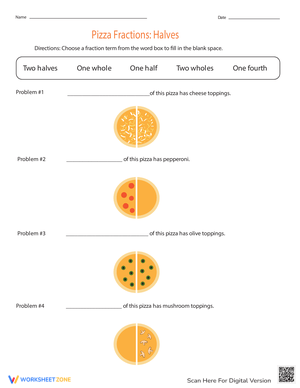
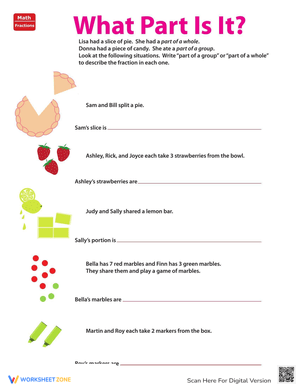
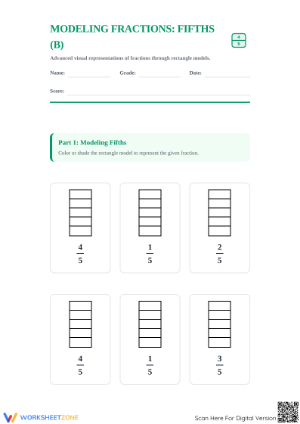
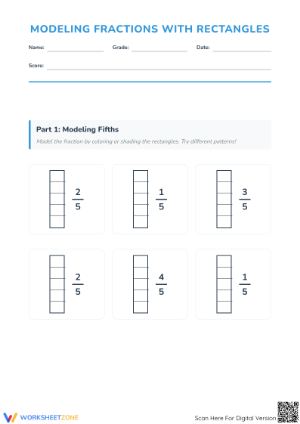
These fractions as parts of a whole worksheets give 2nd and 3rd grade teachers a focused set of visual practice pages for the moment students first encounter the idea that a single object can be split into equal portions — each with a name and a number. The pages move from identifying equal parts to shading a given fraction to writing the fraction that matches a pre-shaded model, covering the full arc of early conceptual work without drifting into operations.
Concepts on Each Page
The core skill is reading and writing fractions as a relationship between parts and whole, not as two separate numbers stacked on top of each other. That distinction matters more than it sounds — students who treat 3/4 as "a 3 and a 4" will misread visual models and later struggle with equivalence. Each worksheet targets one or two steps in the progression: recognizing equal partitions, counting total parts to identify the denominator, counting shaded parts to identify the numerator, and finally producing the fraction notation independently.
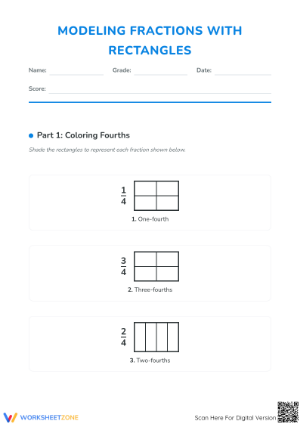
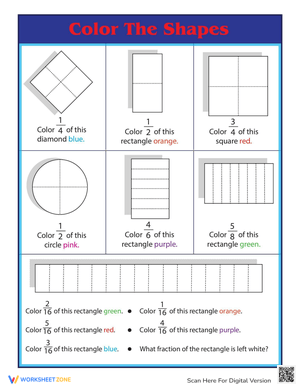
Shapes across the set include circles, rectangles, hexagons, and fraction strips. Using multiple shapes is deliberate — students who only practice with circles often fail to recognize that a rectangle divided into three equal columns also shows thirds. Unit fractions (1/2, 1/3, 1/4) appear first, with denominators up to eighths introduced after students can reliably write unit fractions from a visual. A handful of pages also ask students to circle or mark which shapes are not divided into equal parts, which builds the concept from the other direction.
Where Students Struggle Most
The most persistent error is writing shaded-to-unshaded instead of shaded-to-total. A student looking at a rectangle divided into four parts with one shaded writes 1/3 — because there is one shaded part and three unshaded parts, and both numbers are right there in front of them. This is not a careless mistake; it reflects a genuine confusion about what the denominator counts. It shows up most often in the first week and resurfaces whenever students switch to a less familiar shape.
A second pattern: students who correctly identify halves and fourths sometimes stall on thirds because dividing a shape into three equal parts is visually harder to verify. A circle cut into thirds looks slightly "off" to many 2nd graders who expect symmetry they can fold and match. Pages that include thirds benefit from a brief class discussion about why you cannot fold a circle into thirds the same way you fold it into halves — the partitions are equal in area even when they look less tidy.
The coloring routine that works well in practice: students use one color for the shaded parts and a different color to fill in the remaining parts. Tracing the outline of each section in those two colors forces students to count every region, which catches the shaded-to-unshaded error before they write anything down.
How To Take Full Advantages Of These Worksheets
The most natural entry point is the introduction lesson, where a single page with three or four fraction models gives the whole class a shared reference during guided instruction. Project it, work through the first problem aloud counting total parts before shaded parts, and then release students to finish the page independently. Collecting it at the end of that first lesson gives immediate formative data on who grasped the numerator-denominator distinction and who is still treating the fraction as two whole numbers.
These pages also fit cleanly into the ten minutes before a transition — the window after math workshop wraps up and before students shift to another subject. A single page with six problems is enough practice to consolidate a recent lesson without demanding the full cognitive load of a new task. Friday review blocks and Monday warm-ups after a weekend gap are two other reliable spots, particularly for unit fractions, where a brief retrieval exercise prevents backslide on vocabulary.
For small-group intervention, select pages that isolate the specific breakdown. If a group is confusing equal and unequal partitions, use the identification pages first. If they can identify fractions but not write them, use the notation pages with the visual already shaded. Keeping the manipulative — a set of fraction circles or folded paper strips — on the table alongside the worksheet lets students check their written answer against a physical model before committing.
How This Aligns to CCSS 2.G.A.3 and 3.NF.A.1
In the Common Core sequence, 2.G.A.3 asks students to partition circles and rectangles into equal shares and describe them using the words halves, thirds, and fourths — but not yet with fraction notation. The notation arrives in 3.NF.A.1, which defines a fraction 1/b as one part of a whole partitioned into b equal parts, and a/b as a copies of that unit fraction. These worksheets sit directly at that transition: the earlier pages match the 2nd grade standard, and the later pages with written notation and denominators through eighths address the 3rd grade standard explicitly. Teachers using these across both grades may want to separate the set into two groups rather than distributing all pages at once.
Frequently Asked Questions
1. At what point should I introduce parts of a set alongside parts of a whole?
Hold them apart until students write fractions from area models fluently — typically three to four weeks into instruction. Parts of a set, where students identify a fraction of a group of discrete objects, uses the same notation but a structurally different model. Introducing both at the same time increases the number of students who write the right numbers for the wrong reason and do not actually understand either concept. The CCSS sequence supports this order: area models appear in 2nd and 3rd grade; parts of a set work typically deepens in 3rd and 4th.
2. What do I do when a student can shade the correct fraction but cannot write it?
That gap usually means the vocabulary — numerator and denominator — has not fully attached to the counting action. Have the student say the fraction aloud while pointing: "Three parts are shaded. Four parts total. Three-fourths." Then write it together. The spoken fraction often bridges to the written form faster than additional written practice alone. If the gap persists after a few sessions, check whether the student understands that the denominator counts all parts, not just the unshaded ones — that is the conceptual piece that makes writing the notation meaningful.
3. Should beginners always start with circles?
Circles are intuitive for halves and fourths because students recognize them from real objects. But they are harder to partition accurately for thirds and sixths, and students can develop the misconception that fractions only apply to round objects. Rectangles are easier to draw and verify, and fraction strips show the linear side of the concept. Starting with both circles and rectangles from the beginning — rather than circles first — gives students a more transferable mental model.













 Interactive Worksheet Maker
 Quiz Maker
 Word Search Maker
 Crossword Puzzle Maker
 Word Scramble Generator
 Sentence Scramble Generator
 Handwriting Worksheet Generator
 Name Tracing Generator
 Fill In The Blank Generator