


























Views
Downloads

Grade 3 Fraction Circles — Printable No-Prep Worksheet
Paste this activity's link or code into your existing LMS (Google Classroom, Canvas, Teams, Schoology, Moodle, etc.).
Students can open and work on the activity right away, with no student login required.
You'll still be able to track student progress and results from your teacher account.
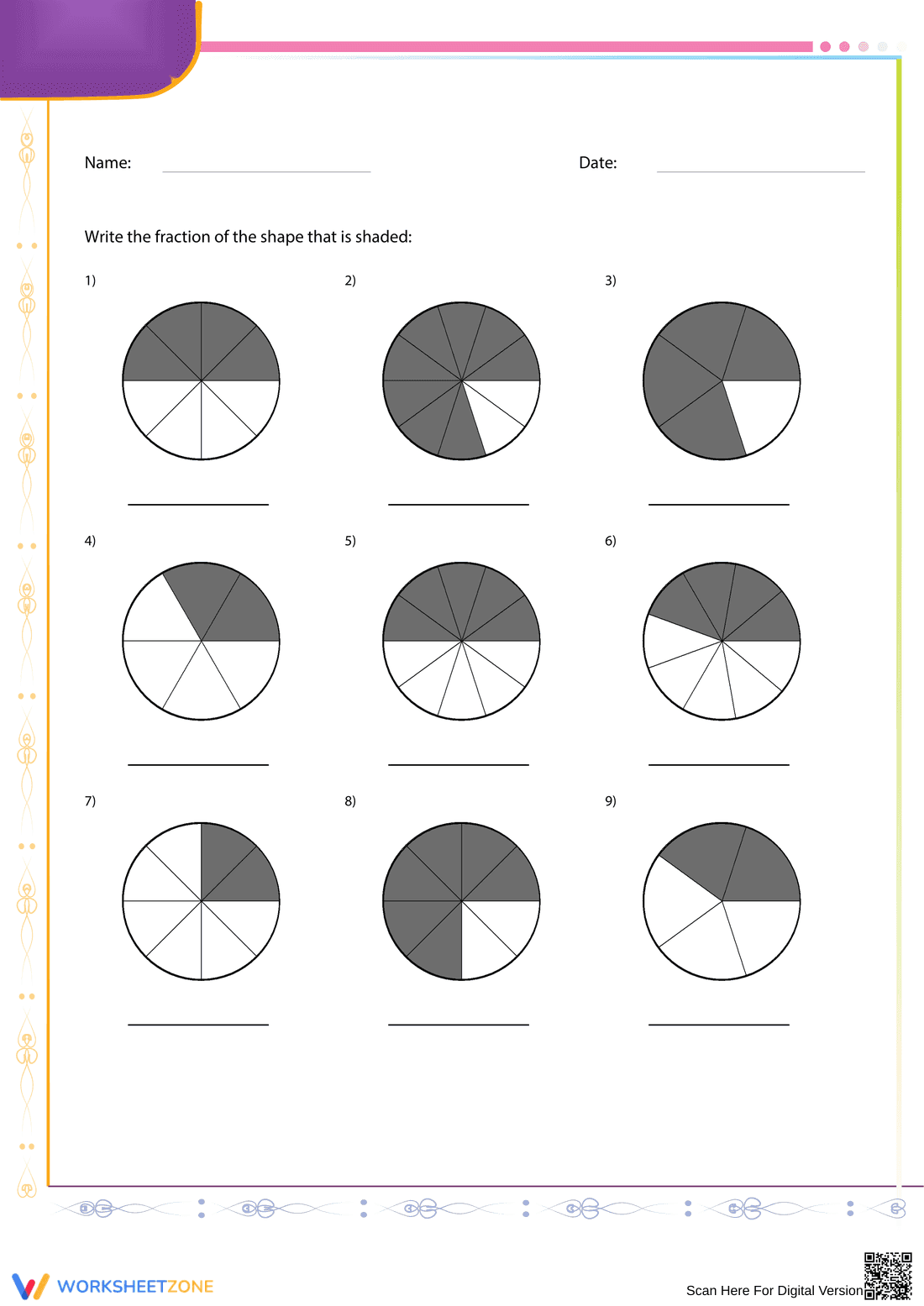
This worksheet provides focused practice for third-grade students on identifying and writing fractions based on visual models. Through a series of 9 clear problems using shaded circles, learners will strengthen their fundamental understanding of fractions as parts of a whole, building a crucial foundation for more complex number operations.
At a Glance
- Grade: 3 · Subject: Math
- Standard:
CCSS.MATH.CONTENT.3.NF.A.1— Understand a fraction as the quantity formed by parts of a whole.- Skill Focus: Identifying fractions from circular models
- Format: 2 pages · 9 problems · Answer key included · PDF
- Best For: Independent practice, homework, or skill reinforcement
- Time: 10–15 minutes
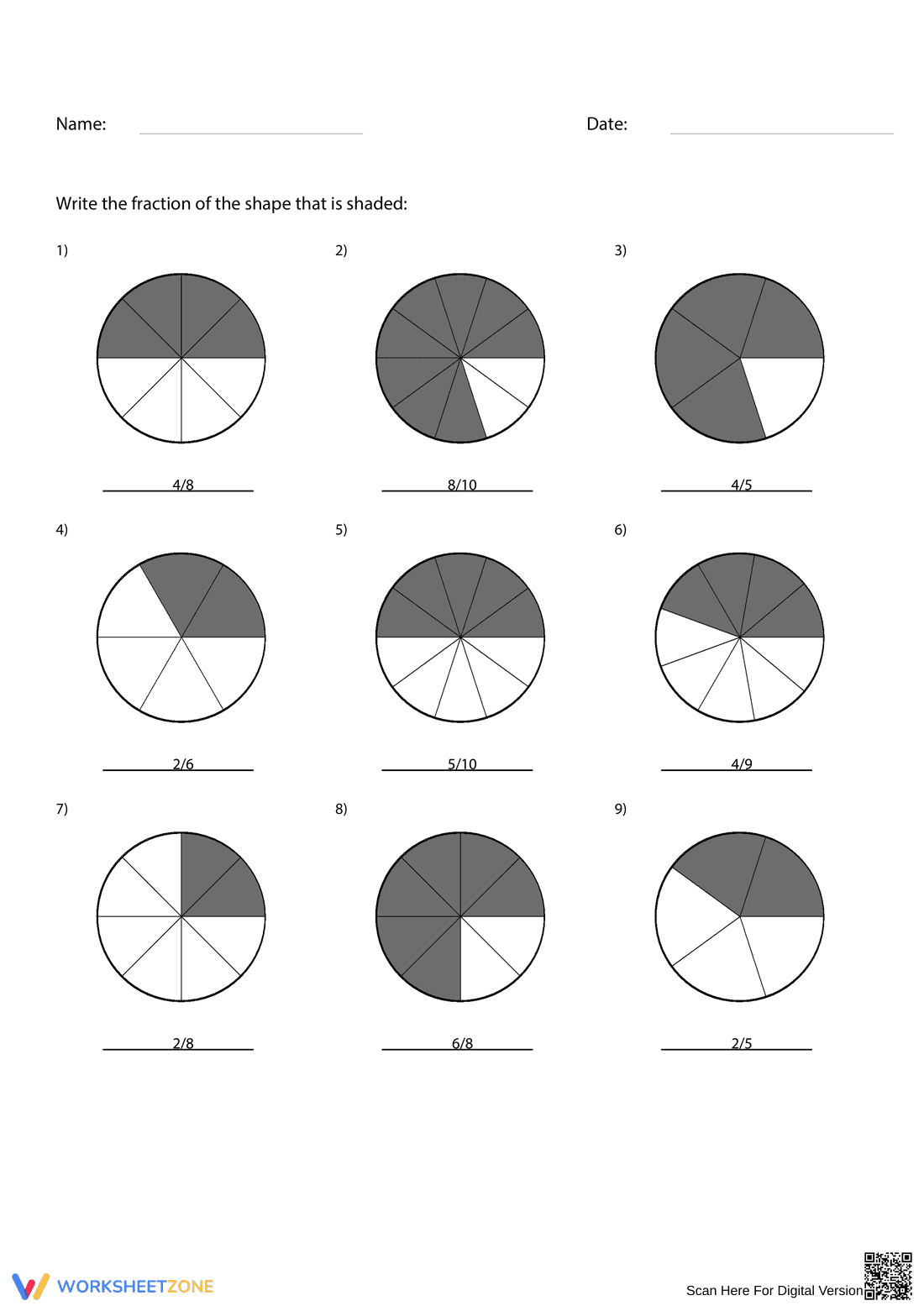
This resource includes a single-page worksheet with nine distinct problems. Each problem presents a circle divided into equal parts with a specific portion shaded. A corresponding answer key is provided on a separate page for quick and easy grading, making it a self-contained and efficient tool for any educator.
Zero-Prep, Maximum Impact
This worksheet is designed for maximum efficiency in the classroom, requiring less than two minutes of total teacher preparation time.
- Print (30 seconds): The PDF is formatted for immediate, high-quality printing on standard paper.
- Distribute (60 seconds): Hand out the single page to students for a focused work session.
- Review (5 minutes): Use the included answer key for fast, accurate self-assessment or peer grading.
Its straightforward design makes it an ideal resource for substitute plans or as an emergency lesson filler when you need a reliable, standards-aligned activity without any setup.
Standards Alignment
This worksheet directly supports the Common Core standard CCSS.MATH.CONTENT.3.NF.A.1, which requires students to "Understand a fraction 1/b as the quantity formed by 1 part when a whole is partitioned into b equal parts; understand a fraction a/b as the quantity formed by a parts of size 1/b." Both standard codes can be copied directly into lesson plans, IEP goals, or district curriculum mapping tools.
How to Use It
Use this worksheet as independent practice immediately following a direct instruction lesson on representing fractions. It serves as an excellent formative assessment tool; observe which students can correctly identify both the numerator and denominator to diagnose misunderstandings about the parts and the whole. It can also be assigned as homework to reinforce the concept learned in class. Most students will complete the nine problems in approximately 10-15 minutes.
Who It's For
This resource is designed primarily for third-grade students beginning their study of fractions. It's also perfectly suitable for fourth-grade students who may need a quick review of core concepts before moving on to more complex fraction operations. The clean, uncluttered layout benefits all learners, including those who require minimal visual distraction. Pair this worksheet with a hands-on activity using fraction circle manipulatives to connect the concrete to the abstract representation.
This drill worksheet provides essential practice for CCSS.MATH.CONTENT.3.NF.A.1, helping students connect visual representations to abstract fractional numbers. Mastery of this foundational skill is a key predictor of later mathematics achievement. Research confirms that repeated, targeted practice with core representations solidifies understanding and improves fluency. According to the RAND AIRS 2024 report on elementary math instruction, students who achieve automaticity with fraction models are better equipped to handle subsequent topics like equivalent fractions and operations with fractions. The nine problems in this resource offer a concise, effective tool for building that initial automaticity. Providing such clear and structured practice aligns with established best practices for developing deep, lasting mathematical competence in young learners.


