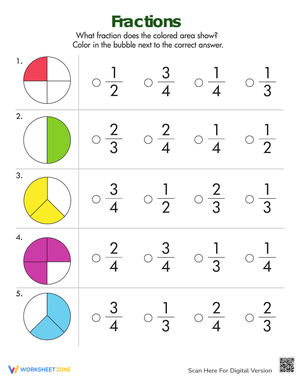
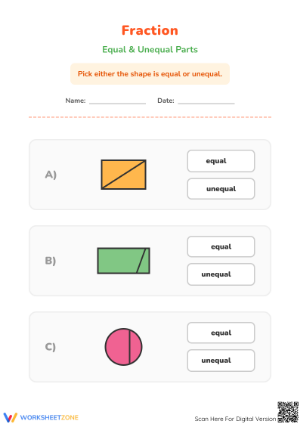
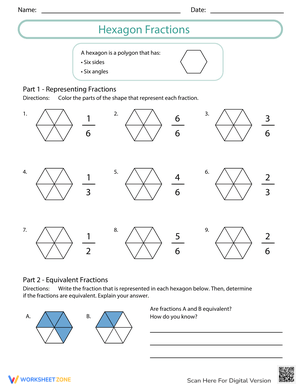
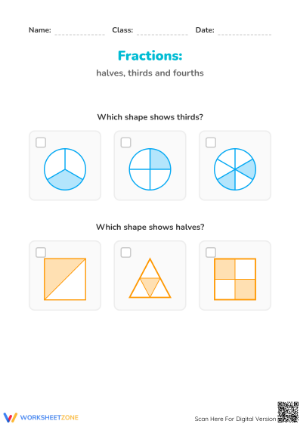
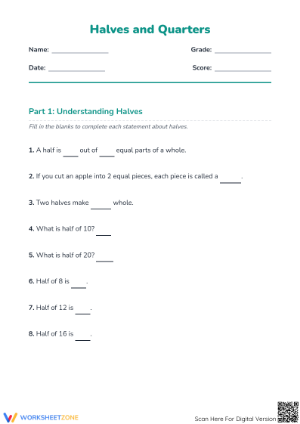
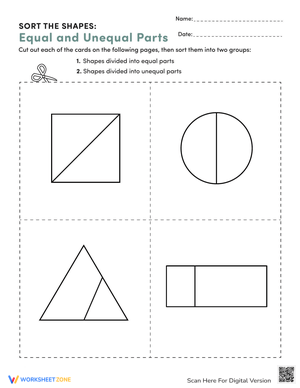
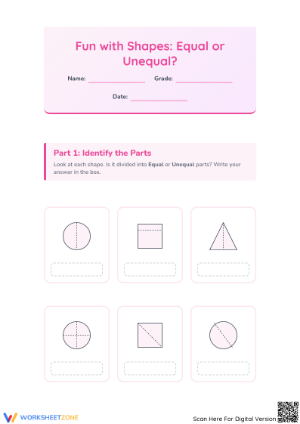
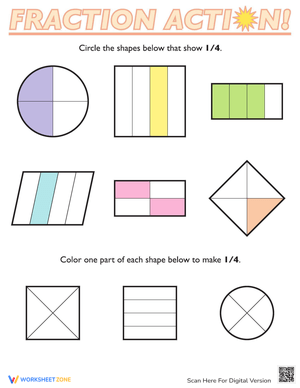
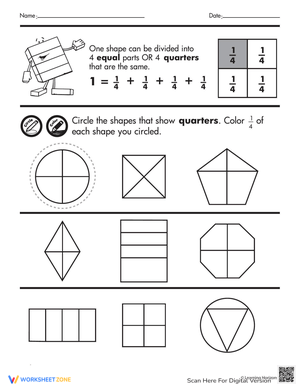
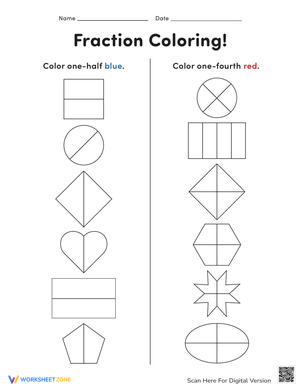
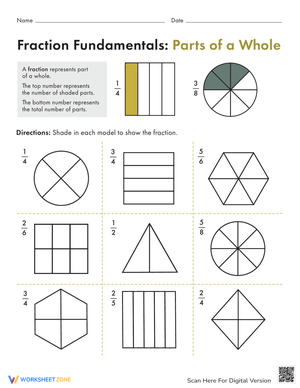
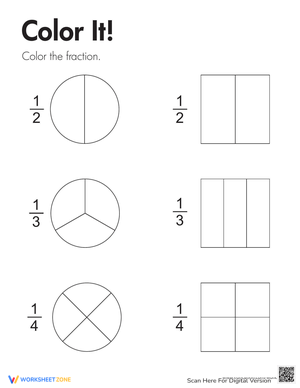
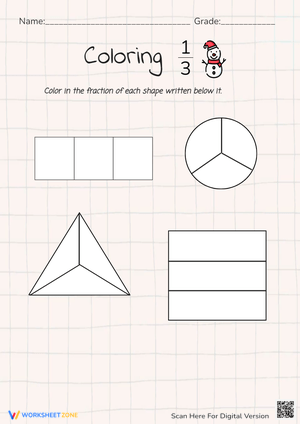
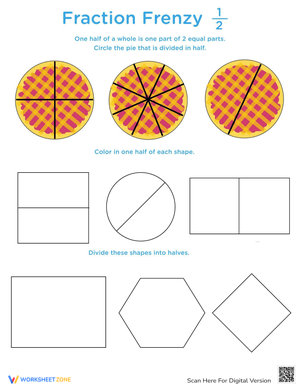
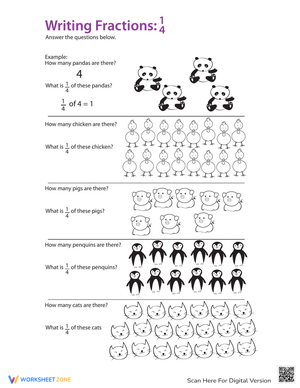
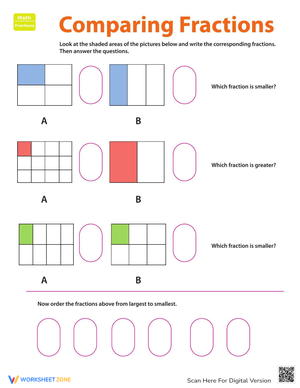
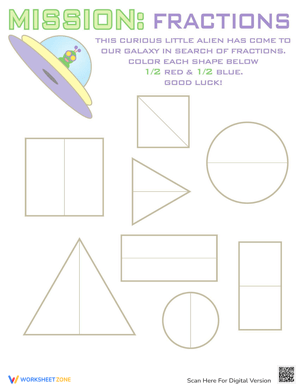
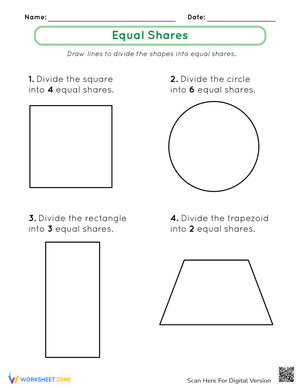
These equal shares worksheets give first and second graders repeated, structured practice with one of the most underestimated concepts in early math — that dividing something into more pieces doesn't make those pieces bigger, and that two pieces isn't the same as two equal pieces. Each page targets a specific skill: partitioning circles and rectangles, identifying correctly and incorrectly divided shapes, labeling parts as halves, thirds, or fourths, and matching real-world scenarios to the right fraction language.
Concepts on Each Page
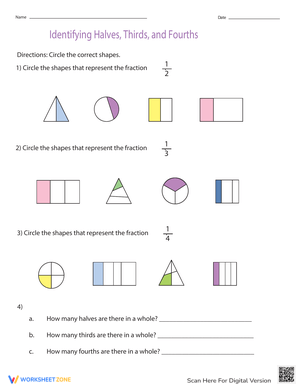
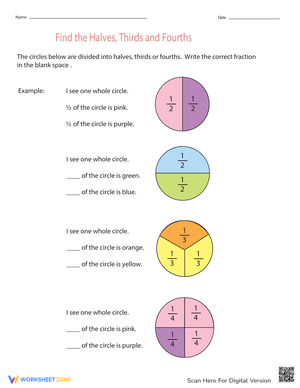
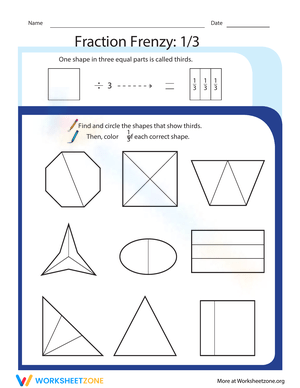
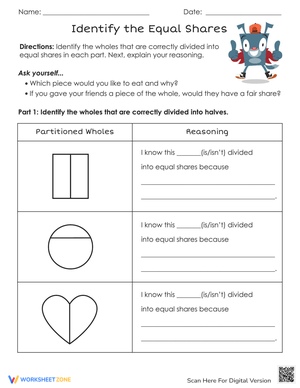
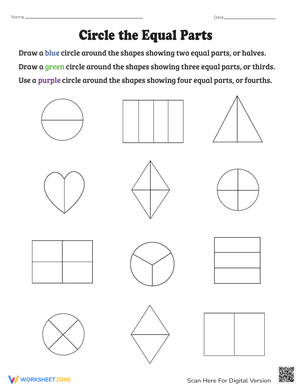
The set moves through equal shares systematically rather than cycling through the same task at different sizes. Early pages ask students to draw a single partition line and decide whether two resulting sections match. Mid-set pages introduce thirds — the trickiest of the three because students can't fold a rectangle cleanly in thirds the way they can in half, so the lines require genuine judgment rather than muscle memory. Later pages layer in comparison tasks: students mark which of three shapes shows fourths correctly, with one option partitioned into four unequal regions that still totals four pieces. That last type is the most diagnostically useful page in the set.
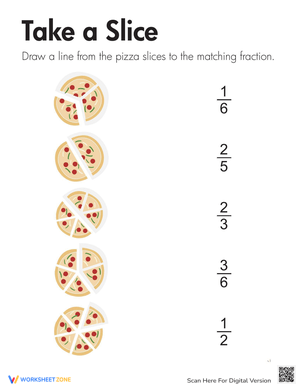
Students also work with the language of equal shares — not just the visual. They read short prompts ("Jana cuts a sandwich into 3 equal parts. Circle the shape that shows her sandwich.") and annotate shapes with the correct name for the shares shown. This pairing of visual and verbal keeps either skill from developing in isolation.
Standards Alignment
The core standard here is CCSS 1.G.A.3, which asks first graders to partition circles and rectangles into two and four equal shares and describe those shares using the words halves, fourths, and quarters. The standard includes one key idea that worksheets often omit: decomposing a shape into more equal shares creates smaller shares. That inverse relationship — four parts means each part is smaller than if you'd made two — is exactly the misconception that shows up in third grade when students insist that one-fourth must be larger than one-half because four is larger than two. These pages address it directly at the moment it first becomes teachable, not as a remediation after the fact.
Second grade extends this work through 2.G.A.3, adding thirds and the understanding that equal shares of the same whole don't have to look identical in shape. A square divided into four triangles and a square divided into four smaller squares both show fourths. Students who've only ever seen one representation of a fraction will stall on that concept.
Patterns You'll Recognize in Student Work
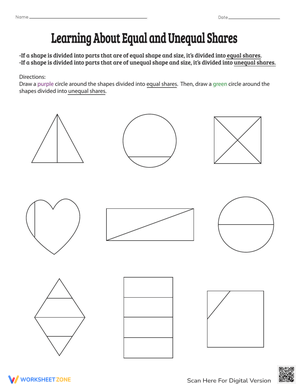
The most consistent error isn't drawing unequal parts — it's drawing unequal parts and then labeling them correctly anyway. A student will split a circle with a line that sits notably off-center, write "halves" underneath, and feel entirely confident. They've satisfied their own criterion, which is counting two sections. What they haven't done is check size. The equal-versus-unequal identification pages specifically target this: students sort a set of pre-partitioned shapes into two groups, which forces them to look at size rather than count.
Thirds produce a different problem. Most students draw a vertical line and then a second line that's too close to the first, creating one narrow strip and one wide section rather than three even columns. It helps to do the physical paper-folding task before the worksheet — fold a strip of paper into thirds, crease it, open it, and use the crease lines as a guide. The spatial memory from that folding transfers to the page in a way that verbal instruction alone doesn't produce.
A third pattern: students who understand halves and fourths sometimes treat thirds as a harder version of halves rather than a genuinely different partition. They'll draw a line, note it's not at the midpoint, and shift it slightly rather than reconceptualizing the shape as divided into three. Working through the concrete folding and then immediately going to a worksheet while the physical experience is fresh reduces how often this pattern appears.
How These Fit Into a Lesson Sequence
The pages work best as the independent practice phase after a concrete or pictorial introduction — not as the introduction itself. In a typical lesson, students might fold paper shapes, sort manipulative pieces, or use fraction tiles before the worksheet comes out. Once the concept is anchored, a single page gives you a clean formative read: who drew equal parts, who counted pieces without checking size, who used the correct vocabulary label. That's enough information to structure the next day's small group.
The sorting and identification pages work well in the 10 minutes before a math lesson ends — students complete them independently while you circulate, and you collect them as an exit check rather than a graded assignment. The partitioning pages (draw your own lines) take longer and are better suited to a math center where students have space to work carefully and, if needed, use a ruler.
For homework, the identification pages travel better than the partitioning pages. A student who needs to draw their own partition lines often benefits from having a teacher nearby when the work starts. A student identifying equal versus unequal shares from a printed set of shapes can complete that task independently and explain their reasoning to a parent, which reinforces the vocabulary in a natural way.
Adjusting for Different Learners
Students who struggle with fine motor control when drawing partition lines often have the conceptual understanding but lose it to frustration before the page is done. For those students, start with pages where the partition lines are already drawn and the task is identification only — mark equal or unequal, write the name of the shares. That removes the execution barrier and lets you assess whether the concept is actually there. Once you've confirmed the understanding, reintroduce drawing tasks with a ruler and a partner to check.
For students who move through the grade-level pages quickly, the most useful extension isn't adding fractions — it's asking them to create their own examples. Hand them a blank rectangle and ask them to show fourths three different ways. Students who genuinely understand equal shares can do this; students who've memorized a single correct partition cannot. That distinction tells you something important before the unit ends.
Frequently Asked Questions
1. Do these worksheets address the idea that the same whole divided into more pieces produces smaller pieces?
Yes, and it's handled in the comparison tasks rather than as a standalone explanation. Students look at a circle divided into halves and the same-sized circle divided into fourths and answer questions about which shares are larger. The visual contrast does most of the work. If you want to reinforce the principle verbally, the accompanying prompts use language like "Jordan wants the biggest piece. Should the pie be cut into 2 equal shares or 4 equal shares?" — which puts the inverse relationship in a context students can reason through before they're asked to state it abstractly.
2. At what point should I move students from equal shares into formal fraction notation?
The signal isn't a date on the calendar — it's whether students can reliably identify equal versus unequal partitions, use the vocabulary (halves, thirds, fourths, quarters) accurately, and understand that more pieces means smaller pieces. When a student can do all three, fraction notation becomes a label for something they already understand rather than a new concept requiring its own conceptual foundation. Rushing notation before those pieces are in place is exactly what produces the "four is bigger than two so one-fourth must be bigger than one-half" error in third grade.
3. Can these pages be used with kindergartners?
The halves pages work for kindergartners who are ready — partitioning a circle or rectangle into two equal shares appears in some kindergarten standards and is developmentally accessible for many students by late in the year. The thirds and fourths pages are better held for first grade, when students have had more experience with spatial reasoning and can manage the finer judgments those partitions require.













 Interactive Worksheet Maker
 Quiz Maker
 Word Search Maker
 Crossword Puzzle Maker
 Word Scramble Generator
 Sentence Scramble Generator
 Handwriting Worksheet Generator
 Name Tracing Generator
 Fill In The Blank Generator