


























Views
Downloads

Visual Fractions Printable Worksheet | Grade 3 Math
Paste this activity's link or code into your existing LMS (Google Classroom, Canvas, Teams, Schoology, Moodle, etc.).
Students can open and work on the activity right away, with no student login required.
You'll still be able to track student progress and results from your teacher account.
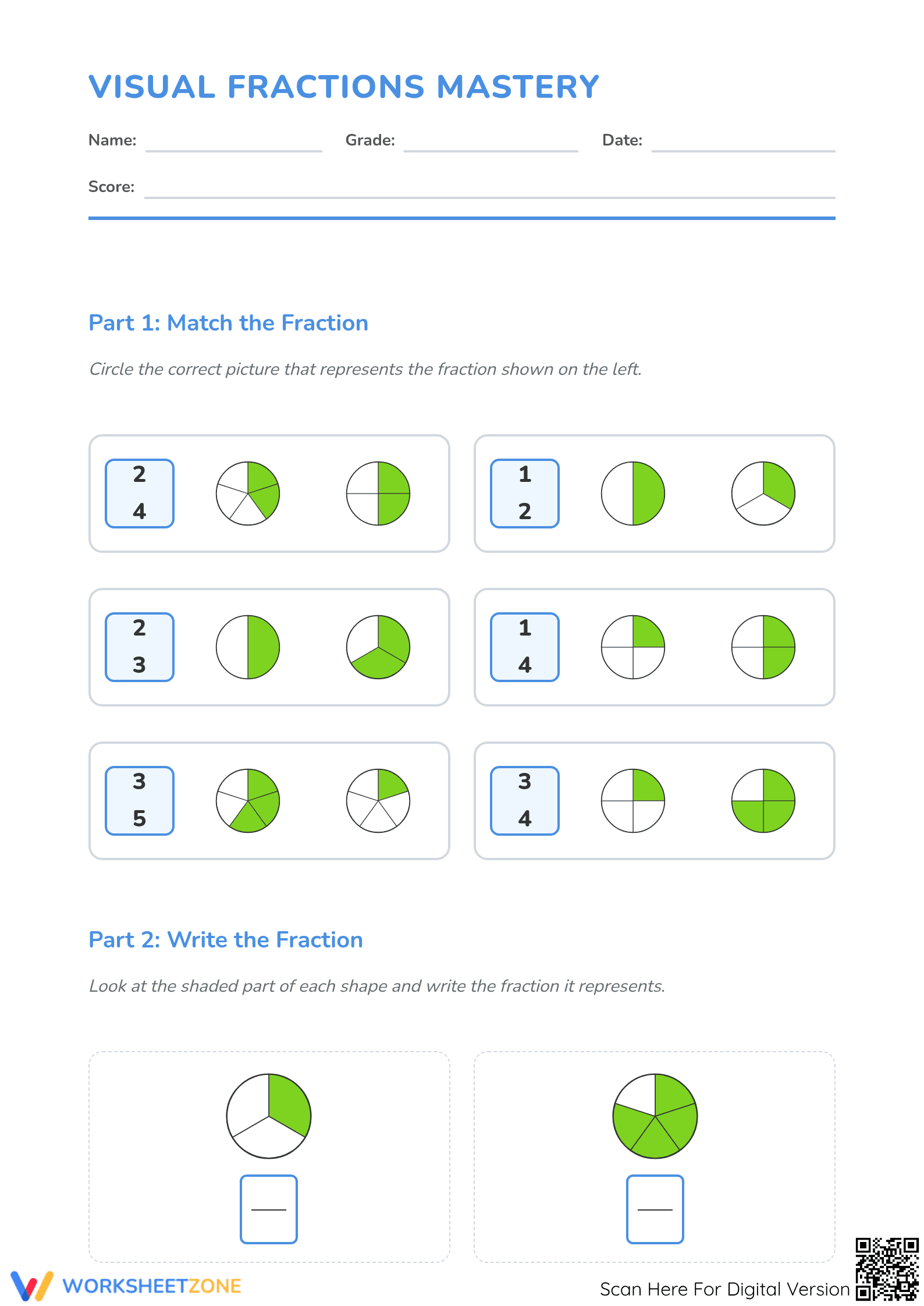
This visual fractions worksheet helps third-grade students connect numerical fractions to their corresponding visual models. By matching, writing, and shading fractional parts, learners develop a strong foundational understanding of numerators and denominators. This resource provides clear, structured practice to build confidence in early fraction concepts.
At a Glance
- Grade: 3 · Subject: Math
- Standard:
CCSS.MATH.CONTENT.3.NF.A.1— Understand fractions as parts of a whole using visual models.- Skill Focus: Visual Fractions
- Format: 2 pages · 12 problems · Answer key included · PDF
- Best For: Independent practice and review
- Time: 15–20 minutes
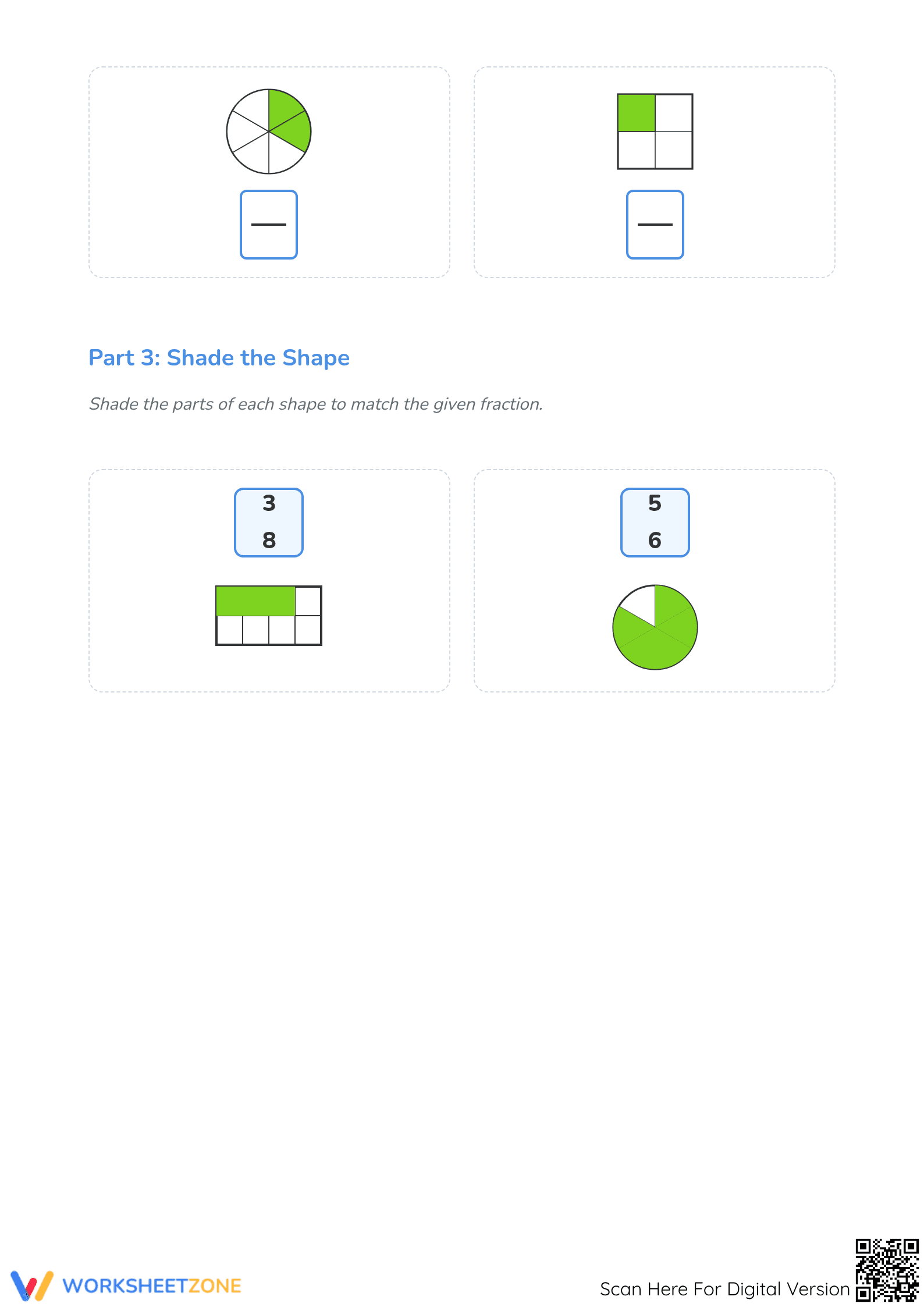
This two-page resource features 12 multi-part problems divided into three distinct sections. Students begin by circling the correct visual representation for a given fraction, move on to writing the numerical fraction for a shaded shape, and conclude by shading blank shapes to match specific fractions. A complete answer key is included to support quick grading and immediate student feedback.
- Guided practice: Part 1 offers 6 multiple-choice style problems where students simply identify and match the correct visual model to a provided fraction.
- Supported practice: Part 2 includes 4 problems requiring students to analyze a pre-shaded shape and write the corresponding numerator and denominator.
- Independent practice: Part 3 challenges students with 2 problems where they must independently partition and shade a blank shape to represent a specific fraction.
This gradual-release approach ensures students build confidence before tackling more complex, generative tasks.
Aligned to primary standard CCSS.MATH.CONTENT.3.NF.A.1, this worksheet ensures students understand a fraction 1/b as the quantity formed by 1 part when a whole is partitioned into b equal parts, and a/b as the quantity formed by a parts of size 1/b. Both standard codes can be copied directly into lesson plans, IEP goals, or district curriculum mapping tools.
Deploy this worksheet during the independent practice phase of a math block, immediately following direct instruction on visual fraction models. It also serves as an excellent morning work assignment or homework task. As a formative assessment tip, observe how students tackle Part 3; if they struggle to shade the correct number of pieces, they may need additional hands-on practice with fraction manipulatives. Most students will complete the activities within 15 to 20 minutes.
This resource is designed for third-grade general education students, but it is also highly effective for second graders needing enrichment or fourth graders requiring foundational review. The clear, uncluttered layout minimizes visual distractions, making it accessible for students with learning accommodations. Pair this worksheet with physical fraction tiles or a classroom anchor chart displaying common fraction models for maximum impact.
Developing a robust understanding of fractions through visual representations is a critical milestone in elementary mathematics. According to EdReports 2024, instructional materials that emphasize visual models before transitioning to abstract numerical symbols significantly improve long-term retention of rational number concepts. This worksheet directly supports that pedagogical sequence by requiring students to interact with visual fractions in multiple modalities—identifying, translating, and generating models. By aligning with CCSS.MATH.CONTENT.3.NF.A.1 to understand fractions as parts of a whole using visual models, educators can ensure their instruction meets rigorous academic expectations. Providing students with targeted, multi-step practice helps solidify the relationship between numerators and denominators, reducing common misconceptions as they progress to more advanced operations. Incorporating this evidence-based approach into daily math routines fosters deeper conceptual mastery and builds essential mathematical fluency.


