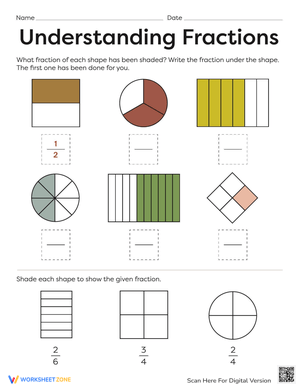
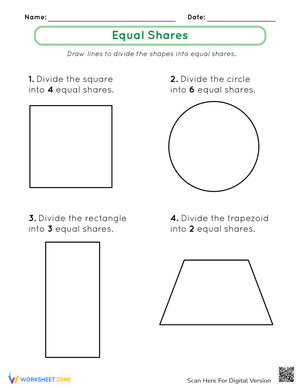
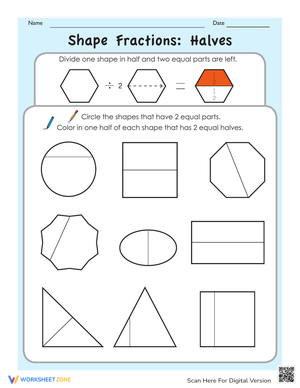
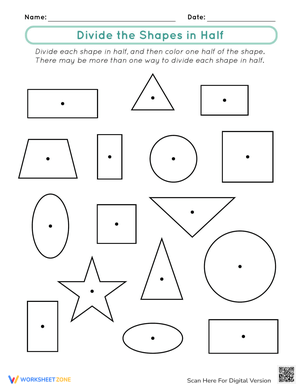
These fractions and fair shares worksheets give first and second graders structured, visual practice with one of the most conceptually loaded transitions in early elementary math: the move from counting whole things to reasoning about equal parts of a whole. Each page builds that understanding through partitioning tasks, shading exercises, and fairness comparisons before a single numerator or denominator ever appears.
Concepts Covered Across the Set
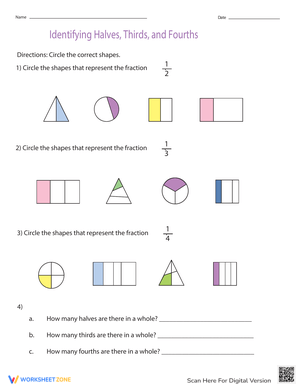
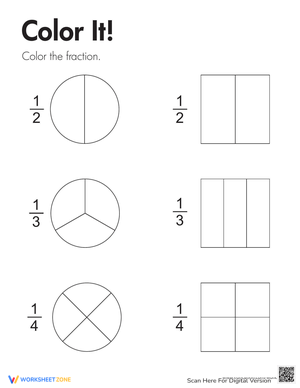
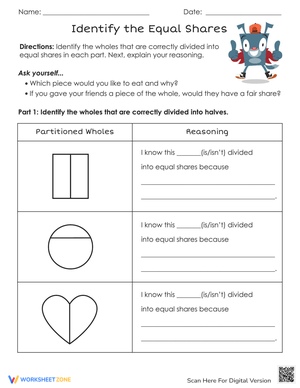
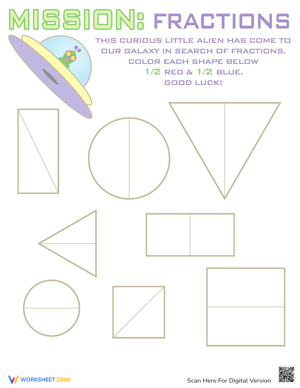
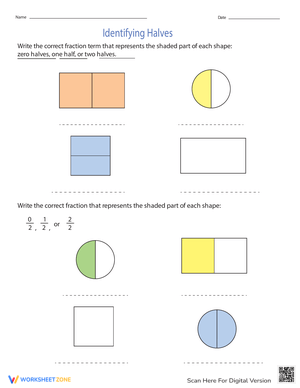
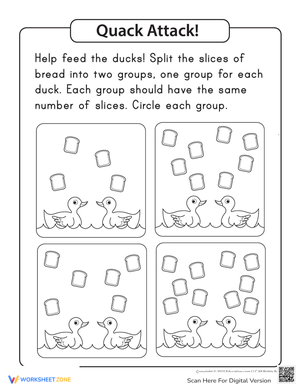
The worksheets focus on three interconnected skills. Students partition shapes — primarily rectangles and circles — into equal shares by drawing lines, then shade a specified number of parts. They also examine pre-divided shapes and determine whether the parts are equal or unequal, which demands more visual discrimination than partitioning from scratch. A third strand involves sets of objects: distributing a group of items equally among two, three, or four recipients, which lays groundwork for division while reinforcing what "fair" means across a different kind of model.
Vocabulary is embedded throughout. Students label shares as halves, thirds, and fourths, and write or circle phrases like "one of two equal parts." The language work is deliberate — children who can only draw a half but cannot say "half" or recognize it written are not yet ready for fractional notation.
Standards Alignment
The partitioning work ties directly to 1.G.A.3, which asks first graders to partition circles and rectangles into two and four equal shares and to describe those shares using words like halves and fourths. The standard also expects students to understand that dividing a whole into more parts produces smaller shares — a counterintuitive idea that confuses many six-year-olds and deserves its own focused practice.
Second grade's 2.G.A.3 extends this by introducing thirds and making the important conceptual move that equal shares of the same whole don't have to look identical — a horizontal cut and a vertical cut both produce halves of the same rectangle. Several pages address that idea explicitly by showing two differently-divided shapes and asking whether both show equal parts.
Why This Sequence Works for This Age
Fractions land in the geometry standards at grades 1 and 2 — not the number standards — for a reason. Before students can treat one-half as a number on a number line, they need spatial experience dividing regions and sets into equal groups. Skipping that concrete stage and moving straight to symbolic notation (½, ¼) creates a fragile understanding that breaks down when students encounter equivalent fractions in third grade.
The worksheet format supports gradual release effectively here. A teacher models a partitioning task at the board, students try one together with a partner, and then they work independently on the remaining items — with the page in front of them holding the structure steady so cognitive load stays on the concept, not on remembering directions. Spaced repetition across multiple short sessions with these pages produces more durable learning than one extended fraction unit.
Error Patterns Worth Watching
The most persistent mistake is students drawing lines that divide a shape without checking whether the resulting parts are equal. A child will draw a diagonal across a rectangle, end up with two triangles of unequal size, and still call it "halves" — because there are two pieces. The worksheets address this directly with unequal-partition examples that students must mark as "not fair shares," but during independent work you will still see students who partition incorrectly and then confidently shade one part as a fraction. Asking them to fold the paper to check whether the parts match catches this before the misconception sets.
Circles present a different challenge. Students who neatly bisect a rectangle with a vertical line will still draw an off-center chord across a circle, producing two unequal regions they insist are halves. This is a fine-motor and spatial reasoning issue as much as a conceptual one — the rectangle pages are worth completing successfully before the circle pages for students who show this pattern.
With set models, a recurring slip is students distributing objects one-by-one until they run out, then counting unequally-sized groups and calling the distribution fair because "everyone got some." The worksheets that ask students to circle equal groups make the size comparison visible and concrete.
Fitting These Into the Week
These pages work well as Monday warm-ups during a fractions unit — five minutes of independent work while attendance and morning meeting wrap up, followed by a brief whole-class discussion of one item. They also serve as same-day practice after a hands-on lesson with physical materials: fold the paper strips, cut the playdough, then reinforce through the worksheet. For small-group pullout, the pages that mix fair and unfair shares are particularly useful because they generate conversation — students who disagree about whether a partition is equal will argue their case and talk through the geometry in ways that whole-class instruction rarely surfaces.
As a formative tool, the partitioning pages reveal a lot quickly. A student who consistently produces unequal shares when drawing lines — even after several lessons — may need more time with folded paper before pencil-and-paper tasks, while a student who partitions accurately but mislabels the shares is showing a vocabulary gap, not a conceptual one. Those two students need different follow-up.
Frequently Asked Questions
1. My students understand halves but fall apart with thirds — is that typical?
Yes, and it's developmental. Halves have a natural anchor: fold the paper and match the edges. Thirds require students to estimate a one-in-three split with no fold that confirms accuracy, which demands stronger spatial reasoning. Giving students a rectangle and asking them to fold it into thirds before they draw on the worksheet reduces the abstraction enough for most students to access the concept. Circles are harder still — thirds on a circle are best handled later in the sequence after students are solid on thirds in rectangles.
2. Should I use these before or after hands-on fraction work?
After — or alongside. The worksheets reinforce and assess understanding that concrete materials build first. Students who have folded, cut, and physically shared objects bring a mental image to the page that makes the tasks meaningful. Using the worksheets cold, without any prior manipulation, tends to push students toward copying visual patterns rather than reasoning about equality.
3. How do I use these with students who finish early?
The most productive extension is asking early finishers to create their own "unfair share" example — draw a shape divided unequally and write a sentence explaining why it isn't a fair share. This requires them to articulate the definition of equality rather than just apply it, which is a harder cognitive move and a good signal of genuine understanding.













 Interactive Worksheet Maker
 Quiz Maker
 Word Search Maker
 Crossword Puzzle Maker
 Word Scramble Generator
 Sentence Scramble Generator
 Handwriting Worksheet Generator
 Name Tracing Generator
 Fill In The Blank Generator